Log in



Kansas’ embattled Republican Sen. Roger Marshall is embracing the support of anti-abortion activists in his closing reelection pitch to voters — including the leader of an organization that has promoted violence against abortion providers and conservative pastors who have compared abortion to human sacrifice.
Marshall has spent little time talking about abortion in his reelection bid. But at a Sunday faith-based public gathering in Wichita, Marshall — an OB-GYN who has made his background caring for women central to his political identity — spoke alongside Troy Newman, the head of the anti-abortion group Operation Rescue, and local evangelical pastors Kyle Lammott and Con Howerton. Lammott called on attendees to pray for “wives who are submissive” and said Kansas’ abortion protections have left the state “soaked with the blood of the innocent.” Howerton decried the “babies, millions of them being sent to Molech” — a Biblical reference to child sacrifice — and criticized the state’s laws for turning it into “a destination state for abortion.” Another speaker compared aborted fetuses to people killed at Auschwitz, the Nazi concentration camp where over 1 million Jews and others were murdered during World War II.
Marshall did not use such extreme language, but was referenced as a champion for the anti-abortion movement by other speakers at the event, who also repeatedly criticized his opponent, Democrat Adam Hamilton. Marshall has not distanced himself from their remarks.
“I don’t know what I would put ahead of the sanctity of life,” Marshall, who opposes abortion, said in his remarks. “The people of Kansas have told me that the most important thing for them is to protect our traditional Kansas values,” he added.
Newman moved Operation Rescue to Wichita in 2002 to focus on protesting outside the clinic of Dr. George Tiller, a then-prominent abortion provider who was murdered in 2009. (Operation Rescue at the time denounced Scott Roeder, the man who shot Tiller; Roeder said he had met with Newman and owned an autographed copy of his book.)
Polls suggest that Marshall could lose his seat to Hamilton, a moderate megachurch pastor who has focused his campaign on issues such as diesel prices and agricultural policy. Recently, Hamilton’s campaign has emphasized Marshall’s history of suing former patients over medical debt, including some who were jailed. But Marshall, who has been endorsed by the anti-abortion group Kansas for Life, has spent little time highlighting abortion policy in his reelection bid, instead arguing that his opponent is too liberal for a conservative state like Kansas.
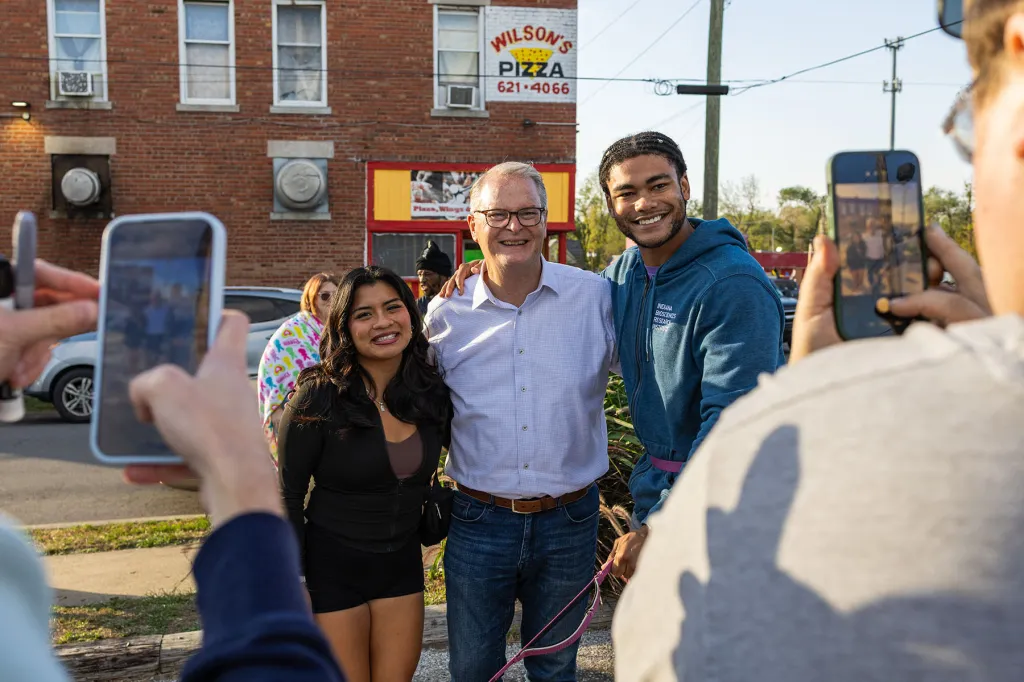
Marshall’s presence at the event, which also featured remarks from Ty Masterson, the state’s Republican candidate for governor and a longtime abortion opponent, has not been widely reported. Marshall’s campaign did not respond to a request for comment.
Voters in Kansas have repeatedly backed abortion rights. In August, Kansans shot down a ballot measure that would have changed the selection process for the state’s Supreme Court, a move largely seen as a first step toward undercutting the state’s constitutional abortion protection. Since the fall of Roe v. Wade in 2022, Kansas has seen a massive influx in out-of-state abortion patients, largely from Texas and Oklahoma, which both have strict bans.
Most Kansans feel the state has already handled the issue of abortion and that politicians should “stay out of it and stay out of their decisions,” said Ashley All, a Kansas-based political strategist who worked to defeat a 2022 anti-abortion ballot measure in the state and was previously communications director for Democratic Gov. Laura Kelly.
“This is the most extreme segment of the Republican electorate they are trying to reach with this, which is interesting in and of itself,” All said.
An October poll from The New York Times and Siena University found that only 3 percent of likely Kansas voters say abortion is their top issue. Those voters are more likely to identify as Republicans and to say they previously voted for President Donald Trump in 2024.
But “when abortion is not high on a list of voters’ priorities, the wrong interpretation is that this issue doesn’t matter to voters,” said Molly Murphy, president of the Democratic polling firm Impact Research, who has extensively researched how voters feel about abortion. “That is a wrong interpretation. We know abortion matters. We know voters can have multiple priorities.”
Marshall’s appearance at this event, she added, could alienate most voters, who largely don’t want to ban abortion.
“I don’t think anybody on their side would say that type of statement or aligning yourself with that type of rhetoric is a good strategy.”
Marshall’s appearance alongside ultraconservative religious figures underscores a challenge for the GOP as Democrats pursue inroads in traditionally red states such as Kansas and Texas: How to define faith and religion — which for decades have been associated with conservatism — when running against challengers who promote more liberal readings of Christianity.
“Democrats have historically been more reluctant to use faith and Christianity and quote the Bible,” said Melissa Deckman, a professor who studies religion and politics. “But because Christian nationalism has become so powerful in the Republican Party, they feel compelled to offer a competing religious narrative — and they’re doing it very effectively.”
In Kansas, Republicans including Trump and Vice President JD Vance have thrown their support behind Marshall and specifically criticized how Hamilton, whose congregation is part of the United Methodist Church, presents religion.
Hamilton, for his part, has said although he personally struggles with abortion, saying there is a “moral tension” with the issue, he believes it should be legal. That framing, All said, is consistent with how many Kansas voters handle the issue.
“There’s a small percentage of Kansans who are pretty evangelical, but there’s a lot of people here who are much more in the mainline faith — Methodists included — and it seems like an odd choice to be telling folks that their faith is wrong,” she added.
In a recent local news interview, Hamilton also cited his Christian faith to criticize political attacks on transgender people, saying, “I look at people, and I understand one thing really clearly when it comes to transgender, and that is Jesus told me I was to love my neighbors.”
A similar dynamic has unfolded in Texas, where the state’s Republican attorney general, Ken Paxton, has struggled in a U.S. Senate race against Democrat James Talarico, a state representative and Presbyterian seminarian who has cited his faith in arguing against abortion restrictions.
“We’re both Christians, and the Bible is silent on the issue of abortion. It means you and I both have to look at different scriptures to try to come to a conclusion,” Talarico said at a recent CNN event in response to a question from a woman who said she opposed abortion for Biblical reasons. “But what I think we can do is actually come together on reducing the number of unplanned pregnancies and the number of abortions. Because if we treat this issue as a public health problem and not a culture war problem, then we can actually make progress together.”
To check your voter registration status or to get more information about how to vote and what’s on your ballot, visit vote.org.