 Log in

Sprout is planning to sell replacement motherboards for certain iPods. “Sprout only replaces the motherboard and uses your iPod’s original parts. No soldering required, and fully reversible.” Bluetooth, WiFi, 500K songs, USB-C, even streaming.

|
I am the Queen of Awesome. My words do not represent my employer, but I bet you already knew that.
|

Overland Park, KS

They Stopped 57 Shootings. Everyone Was Just Fired. “A program called Peace Orlando hired neighborhood residents closest to the violence…who could see a shooting coming and talk people down.” It worked…and then the program was shut down.
Overland Park, KS

 Perimenopause is destabilizing, and even debilitating for many women with ADHD. In an ADDitude survey of nearly 5,000 women, 63% of respondents aged 45 and older said ADHD had the greatest impact on their lives during the menopausal transition.
Fluctuating estrogen levels affect attention, memory, executive function, and emotional regulation. Meanwhile, hot flashes, poor sleep, anxiety, and brain fog place added stress on an already strained nervous system.
Emerging research suggests that women with ADHD may experience perimenopause and its symptoms earlier than their neurotypical peers. In a study published in European Psychiatry, women with ADHD reported their most severe perimenopausal symptoms from ages 35 to 39 — almost a decade younger than women without ADHD. Their symptoms were also relatively more severe, which may help explain the uptick in ADHD diagnoses at this time.1
We cannot yet definitively say that hormonal changes begin earlier in women with ADHD. However, research suggests that significant symptoms of perimenopause may emerge earlier than clinicians expect.
Perimenopause Is Under-Recognized
If your periods, sleep, mood, or ADHD symptoms have changed, do not dismiss them because a doctor says you’re “too young” for menopause. These changes deserve thoughtful medical evaluation.
[Free Webinar Replay: Perimenopause in Women with ADHD]
In a large study published in the journal Menopause, one in three women aged 35 and older said they were unsure whether they were in perimenopause. Many did not know whether their symptoms reflected hormonal changes, especially if their periods remained regular and/or they had other health conditions. About 16% attributed their uncertainty to barriers such as dismissive healthcare encounters, including being told they were “too young.” 2
Uncertainty was highest among women with the most severe symptoms. Put another way, the women who might benefit most from intervention were the least likely to know they were in perimenopause.
Adding to the problem, some women experience perimenopause symptoms while their menstrual cycles remain regular. They may not develop obvious menstrual changes until later in the transition or until they’ve entered menopause.
“It is a universal transition with ambiguity and often lack of validation,” the study’s authors wrote. Better symptom recognition and communication are critical first steps toward improving care.
[Free Self-Test: Is It Perimenopause?]
Keep a Perimenopause Log
Use the Perimenopause Log below to identify patterns and track physical symptoms and symptoms related to mood, menstrual cycle, ADHD, cognition, and ADHD medication efficacy. Keep a journal to record more specific experiences, such as missing an appointment, losing words during a conversation, or forgetting to complete tasks that once seemed manageable.
| Perimenopause Log | ||||
| Symptoms | 0 = none | 1 = minimal | 2 = moderate | 3 = high |
| Hot flashes | ||||
| Constipation | ||||
| Fatigue | ||||
| Breast Tenderness | ||||
| Vaginal Dryness | ||||
| Pain During Sex | ||||
| Urinary urgency, frequency, or discomfort | ||||
| Anxiety | ||||
| Sadness or low mood | ||||
| Irritability | ||||
| Anger or rage | ||||
| Overwhelm | ||||
| Less interest in sex | ||||
| Brain Fog | ||||
| Cramps | ||||
| Mucus secretions | ||||
| Increased/Decreased flow or bleeding | ||||
| Difficulty focusing | ||||
| Difficulty planning or organizing | ||||
| Forgetfulness | ||||
| Impulsivity | ||||
| Degraded efficacy | ||||
| Shorter duration of coverage | ||||
| Elevated side effects | ||||
Hormone Testing for Perimenopause
Hormone tests are typically used when symptoms begin earlier than expected, the diagnosis is unclear, or another condition is suspected. If testing is warranted, your doctor should look at follicle-stimulating hormone (FSH) and estrogen levels. FSH signals the ovaries to develop eggs and produce estradiol. As ovarian function becomes less predictable during perimenopause, FSH generally rises to compensate while estradiol fluctuates. Multiple tests may be needed to establish a clear picture.
If you are younger than 40 and have irregular periods along with perimenopause symptoms, ask whether you should be evaluated for primary ovarian insufficiency (POI), a condition that requires careful treatment.
Finding Stability in Perimenopause
I use the term “hormone stabilization therapy,” or HST, to describe hormonal treatment during perimenopause, when the goal is to smooth disruptive hormonal swings rather than replace hormones after menstruation has ended.
Certainty that you are in perimenopause is not required before discussing relief. Treatment should focus on the symptoms causing the greatest problems even while your doctor continues to evaluate their source.
Medication Considerations in Perimenopause
Estrogen therapy relieves symptoms of perimenopause and may improve the effectiveness of ADHD stimulant medication. Prior use of estrogen therapy may render it less effective. If you have a uterus and use systemic estrogen, you will need a progestogen to protect the uterine lining. The type and schedule should be individualized. Vaginal estrogen may be an option for urinary or vaginal symptoms, including for some women who cannot use systemic treatment.
ADHD medication may need to change — whether it’s the dose, timing, or type of medication — during this stage for continued symptom control.
Birth control is often recommended for its role in smoothing hormonal fluctuations. In my clinical experience, progestin-only birth control may worsen mood and symptoms of ADHD in some women Talk to your provider about your symptoms and whether other birth control options may be right for you.
Antidepressants and other non-hormonal medications can help manage hot flashes, mood swings, anxiety, and depression.
Keep track of your results. When possible, make one planned change at a time so it will be easier to understand what has helped.
Women with ADHD need support during perimenopause. Take your needs seriously and seek counseling, ADHD coaching, or peer-support groups to help you find new ways to cope.
Perimenopausal Symptoms: Next Steps
- Download: Free Menstrual Cycle Workbook for Women with ADHD
- Read: The Menstrual Cycle Impacts ADHD Symptoms in Disparate Ways
- Read: Let’s Talk About Perimenopause and ADHD
Patricia O. Quinn, M.D., is a developmental pediatrician and international authority on ADHD.
ADDITUDE IS HUMAN
Artificial intelligence does not create or edit any written content published by ADDitude. Our editorial team is 100% human, and our mission is simple: listen to and serve our readers with hand-crafted, expert-informed resources. To support ADDitude, please consider subscribing. Your readership and support help make our commitment possible. Thank you.
Sources
1Jakobsdóttir Smári, U., Valdimarsdottir, U.A., Wynchank, D., de Jong, M., Aspelund, T., Hauksdottir, A., Thordardottir, E.B., Tomasson, G., Jakobsdottir, J., Lu, D., Nevriana, A., Larsson, H., Kooij, S., Zoega, H. (2025). Perimenopausal symptoms in women with and without ADHD: A population-based cohort study. Eur Psychiatry. https://doi.org/10.1192/j.eurpsy.2025.10101
2 Xu, Y., Fergus, D., Hewings-Martin, Y., Hedges, M., Prentice, C., Cunningham, A., Zhaunova, L., Shufelt, C., & Faubion, S. (2026). Exploring prevalence and drivers of perimenopause uncertainty among US Women: a mixed-methods study. Menopause. https://doi.org/10.1097/GME.0000000000002837
Overland Park, KS
PRRI’s 2026 American Values Survey reveals some, uh, interesting views on whether Americans think empathy is a good thing or not. Those respondents unaffiliated with a religion were much more inclined to think that empathy is “a foundational moral value that helps build a healthy society”.
With the exception of white evangelical Protestants (42%), around two-thirds or more of all major religious groups believe that empathy is a foundational moral value for a healthy society, including about eight in ten religiously unaffiliated Americans (83%), members of other non-Christian religions (80%), and Jewish Americans (77%). By contrast, a majority of white evangelical Protestants (54%) believe empathy can become dangerous when it leads people away from building a society guided by God’s truth.
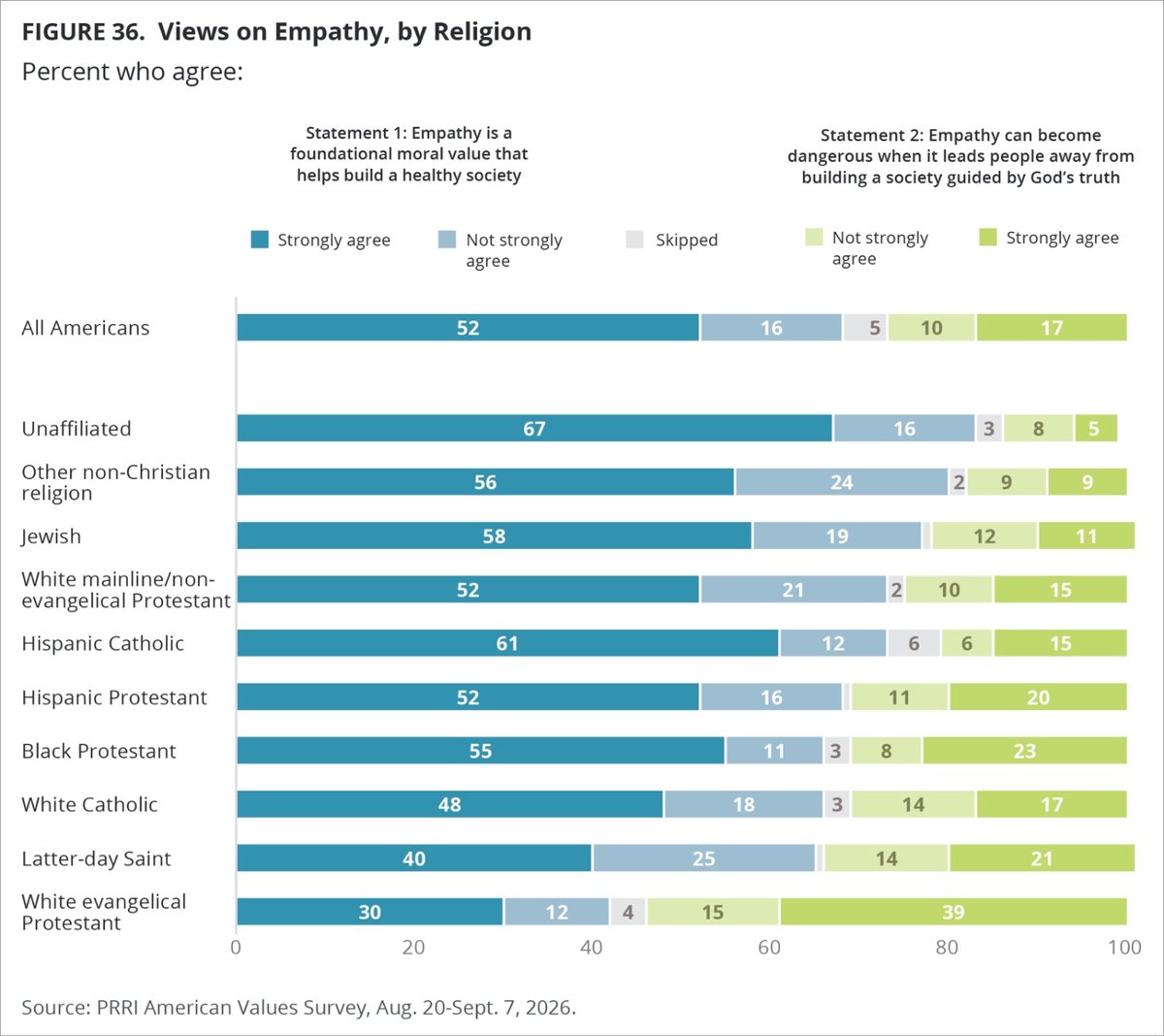
Here’s the breakdown by party:
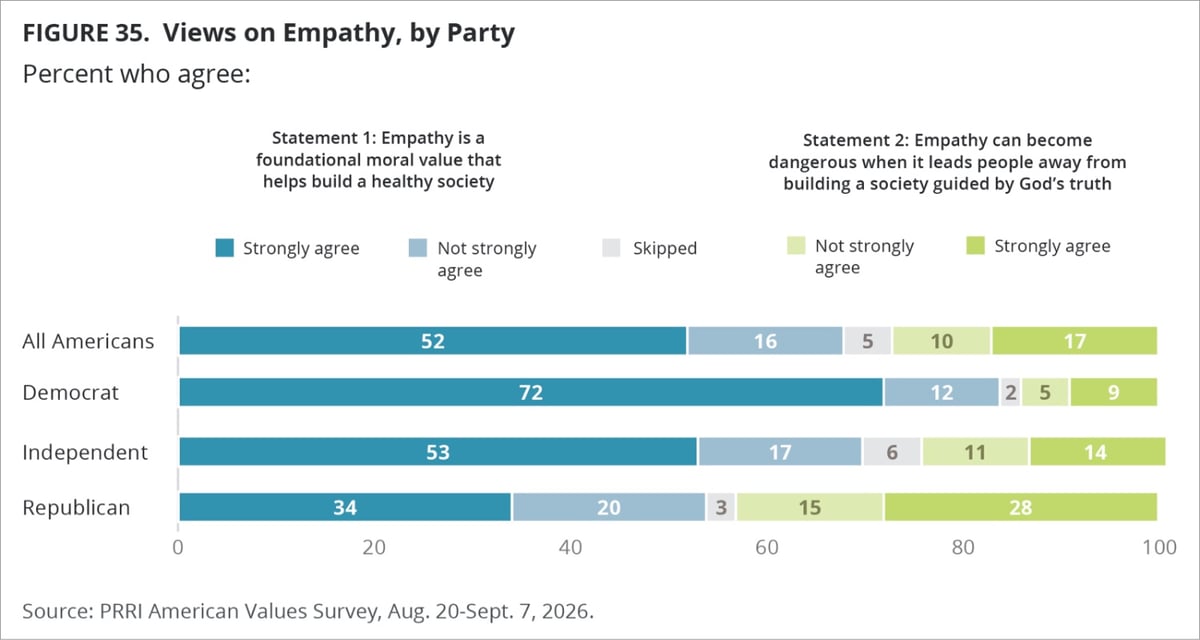
(Btw, “not strongly agree” seems to mean “agree, but not strongly” and not “disagree”. Grammatically correct but a little confusing if you don’t read it carefully…)
See also How empathy came to be seen as a weakness in conservative circles.
Overland Park, KS

“They just want to be taller because they hate being / looked down upon.” — Matthew Siegel
Overland Park, KS

Greeting cards made by Hammerpress on display at its workshop and retail storefront in Kansas City’s West Bottoms.

Overland Park, KS
Next Page of Stories