I am the Queen of Awesome. My words do not represent my employer, but I bet you already knew that.
18922 stories
·
35 followers

It’s Official: Flock Is For Stalking

1 Share

Flock Safety is happy it’s the go-to choice for tons of law enforcement agencies. While it does suffer some occasional bleeding, its supercharged automatic license plate readers (ALPRs) — ones that not only capture plates, but pictures of drivers/passengers and full vehicle images to capture any other distinctive features — are so widely deployed they’re now capturing 20 billion images per month across the nation.

Not bad for a company that started out pitching its spy wares to HOAs and gated communities. Most cops in America now have access to Flock’s databases, either directly or by asking those with access to run searches for them. Just ask federal law enforcement officers, who have asked for help so often its gotten them (and their enablers) in legal trouble.

Whether the cameras are being used to solve crimes, pull over innocent drivers, or help vengeful boyfriends attempt to thwart out-of-state abortions, Flock is there to… um… help?

The problem with 20 billion plates a month is this: cops have access to these records. It’s not that Flock has somehow made cops worse. They’ve been abusing access to databases like these for years to stalk exes, pursue sexual conquests, and harass protesters and critics.

So, this isn’t a Flock problem, per se. It’s definitely a cop problem, though. Millions of employed people have access to sensitive or proprietary information. Very few of them misuse their access. But there’s something about law enforcement that draws in people willing to abuse access for extremely personal reasons.

Some of that is the lack of accountability that plagues US law enforcement as a whole. Some of that is due to a dearth of guardrails or rigorous oversight. But I would argue the largest contributor to the ongoing, serial abuse of Flock’s databases by officers is the culture of law enforcement itself. There’s little in the job that would attract the best people needed to fill these positions. Instead, the promise of power and nearly nonexistent accountability attracts abusers, bullies, thugs, and random people who think the world owes them an elevated place in society.

In other words, if cops were really honest about why they became cops, it would go something like this:

It’s been a steady stream of THIS for a few months now. In May, the Institute of Justice released a report detailing abusive access to Flock databases by cops, dating back to 2021. Dozens of criminal cases against cops were detailed, but nearly every one of them had this in common: officers were using Flock ALPRs to track ex-wives, ex-girlfriends, ex-fiancees — in other words, women — along with their new partners, friends, and acquaintances.

A few weeks later, even more details in ongoing cases were revealed via public records and court proceedings obtained by 404 Media.

This is what stalking looks like when cops have access to Flock ALPR records:

For months during the summer of 2024, Jarmarus Brown, an Orange City, Florida police officer, ran his ex-girlfriend’s license plate through the Flock automated license plate reader (ALPR) system lookup database at least 69 times. He searched for the license plate belonging to her mom at least 24 times, and searched for the license plate belonging to her dad at least 15 times. Brown’s searches were happening so often, and were so commonplace, that even one of his colleagues noticed Brown researching his ex-girlfriend’s whereabouts while the law enforcement officers sat in their police cruisers

Pretty fucked up. What’s even more fucked up is the end result of Brown’s prosecution, which is only going to encourage more cops to abuse their access to ALPR databases:

Brown was arrested last year and pleaded no contest to a charge of unauthorized use of computers. He was sentenced this month to five years of probation and a $618 fine.

This story isn’t going away. A new report from the Washington Post shows Flock has a cop problem, mainly because cop shops have a cop problem. Cops cannot be trusted to not use millions of easily available records to stalk their ex-wives, girlfriends, etc.

Braselton, Georgia (a suburb of Atlanta) was once home to Police Chief Michael Steffman. Steffman apparently couldn’t handle not knowing what his ex-girlfriend, Marci Bakely, was up to. Here’s how it started:

Flock had sold its system as a police officer’s dream crime-fighting tool. But the tool had also given the chief, Michael Steffman, the power to silently monitor Bakely’s life. By the time she understood what was happening, Steffman had looked up the tags for her and her teenage daughter roughly 600 times, according to Have I Been Flocked, a website that aggregates police search logs made available through public records.

This wasn’t spread out over the course of several years. (And not that a longer spread would make it any more acceptable.) These 600 searches occurred over the span of eight months. Roughly twice a day, the police chief was running searches targeting his ex-girlfriend and her daughter. Even the police chief gets days off, so the searches were definitely happening more than twice per (work) day.

Steffman was arrested last November and charged with stalking, harassment, and misuse of the Flock database. Steffman chose to escape justice.

In April, before a trial could take place, he was found dead in his home from what officials said was a suicide.

Steffman is not an outlier. He’s just another symptom of a law enforcement-specific disease:

In Wisconsin, a police officer allegedly used Flock to check whether his ex-girlfriend had gone to an abortion clinic, according to a police affidavit for a case set for trial this month.

In Kansas, a police chief who tracked his ex through Flock sneaked up on her while she was intimate with another man, a state police certification body alleged, leading to his firing.

In Florida, a deputy speeding to stop a young actress he’d added to a watch list for a license-plate tool called Guardian nearly caused a head-on crash, according to a police report and video from his dashboard camera. The deputy was arrested in March, and his attorney declined to comment.

And in California, prosecutors said a former deputy, Alexander Vanny, used Flock as part of a months-long campaign of “stalking” and “humiliating” his former fiancée that also involved following her around town and installing a hidden camera in her roommate’s bathroom, according to a sentencing brief.

This data just keeps coming in. Public records are being compiled at scale to allow people (you know, non-cops) to see how often their plate records have been accessed by law enforcement officers. There’s no PR win on the horizon for Flock, which has been largely (and belatedly) reactive to exposures of abuse by officers and further abuse by agencies who use other agencies to run searches they can’t legally perform themselves.

The comment offered in response to the Post’s reporting is par for the course:

After The Post relayed its findings to Flock, the company said in a statement it “will soon be announcing better filters and tools to stop abuse before it happens.”

Oh. OK. Since records of this abuse date back at least a half-decade, you would think Flock would already be on top of this. Instead, it appears to be tossing out a bit more lip service because this story just isn’t going away.

What has been implemented by Flock to date has almost exclusively been tools and guardrails law enforcement agencies can opt in to. None of this is on by default. Training guides and search logs are useless if law enforcement officers and officials aren’t going to read either of them. Voluntary “audit assistance” algorithms that scan for possibly suspicious searches by officers are similarly useless, since they’re entirely optional. If these were applied by default and statements/actions from police oversight groups was needed to remove them, they might actually have an effect. And I find it hard to believe any Flock sales rep is highlighting this optional feature when trying to talk cops into signing a contract.

Everything seen here is just going to keep getting worse. Flock offloads all professional responsibility to its end users. Its end users are rarely interested in accountability, much less proactive measures that might deter police misconduct. The company keeps adding cameras daily, which just gives abusers drawn to the opportunities for abuse that the law enforcement profession provides even more to work with. The victims aren’t the people buying or using these cameras, so they don’t matter and whatever happens to them will just be waved away with bland statements about “bad apples” and Flock spokespeople who abbreviate “we take these concerns seriously” as IDGAF.

Read the whole story
angelchrys
1 hour ago
reply
Overland Park, KS
Share this story
Delete

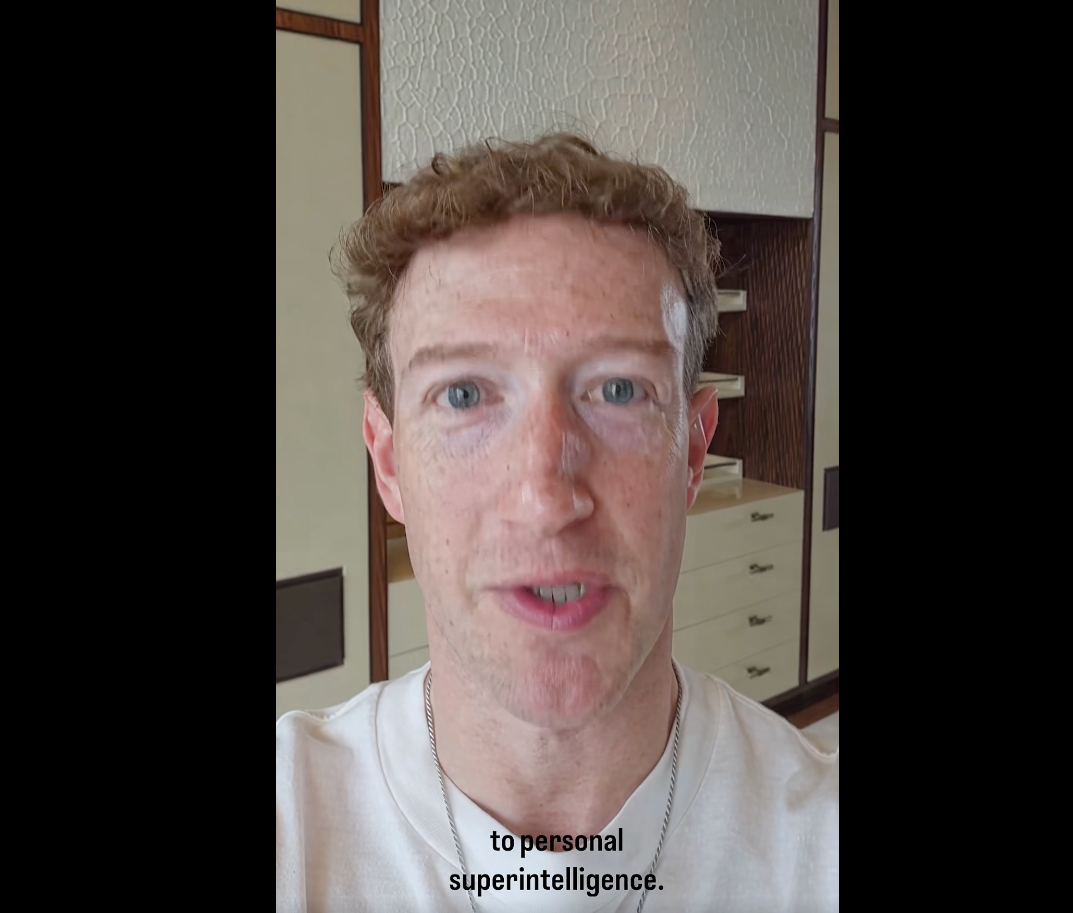
Mark Zuckerberg Posts Deranged 6,500-Word Essay About Giving Everyone AI Superintelligence

2 Shares
Mark Zuckerberg Posts Deranged 6,500-Word Essay About Giving Everyone AI Superintelligence

Mark Zuckerberg, whose superyacht apparently spent the weekend ignoring or missing the distress signal from a boat that ran out of fuel near Alaska, has posted a deranged, 6,500 word essay detailing his vision for AI superintelligence, a future that is “for everyone” but which sounds less social than ever.

Zuckerberg posts these types of essays every so often for purposes that serve his own company, and this one, called “The Future Is For Everyone,” is designed to defend against general backlash to AI but also to Meta’s own practices. Zuckerberg lays out the potential use case for Meta glasses (whose huge marketing campaign cannot get people to stop calling them “pervert glasses”), AI agents, open weights AI development, and why data centers are not bad for communities, actually. Like most Silicon Valley “utopian” essays, to believe that any of this is going to go how Zuckerberg suggests it will requires one to have been recently concussed or to willfully ignore how this technology is being used today and believe that thousands of years of human nature will suddenly shift. 

For example, Zuckerberg writes “Everyone will have an exceptionally capable personal agent that understands you, your goals, and everything you care about. Your agent will work 24/7 on your behalf to improve your relationships, health, career, finances, home management, hobbies, and more. It will free up time for the things you enjoy, and help you accomplish more than you could otherwise. It will have strong privacy and security options so you can trust it to handle all of your personal content knowing that no one else can access your information, similar to how encryption works on WhatsApp. You’ll be able to interact with your agent through any device, including your glasses to keep you present in the moment with the people you care about.” 

Zuckerberg does not grapple with, or even gesture at, the idea that some people may not want to have an AI agent working on their “hobbies.” He does not consider that, even if everyone were to have an AI agent, perhaps not everyone would use these AI agents for good. In the few months that AI agents have become popular among the early adopter set, we have seen “benevolent” AI agents endlessly spam humans and the internet with drivel. And those are just the kind-of-annoying ones. We have seen AI agents hack companies, and over the weekend an Australian man went viral because his AI agent that he asked to sign him up for gym classes did so by hacking the gym’s reservation system and canceling other people’s reservations. 

Read the whole story
angelchrys
1 hour ago
reply
Overland Park, KS
Share this story
Delete

Don't Call It A Substack.

2 Shares
Back in 2024, Anil Dash published Don't Call it a Substack - an informative post about Substack's problematic history and foundations. This sums it up nicely:
Substack is, just as a reminder, a political project made by extremists with a goal of normalizing a radical, hateful agenda by co-opting well-intentioned creators' work in service of cross-promoting attacks on the vulnerable.
That may sound like an extreme review but the receipts are in the post. It's well noted on Wikipedia too, Substack allows Nazi content "because attempting to censor them would make the problem worse." Great, right? /s

Dash's post points to some alternatives but I will provide you with an updated list for 2026 - Finding a budget-conscious Substack alternative. Not only are these in the list budget-conscious, they aren't looking the other way when it comes to Nazi's (that I know of). TLDR: look at Buttondown and Email Octopus.

I am sure there is a bit of fatigue when it comes to thinking about what is a "Good" platform. Meta is a nightmare company but I still use Instagram. I left Spotify because of unfair artist treatment but I use YouTube Music instead... is Google really a "good" company? I left Twitter when Elon took over and, well, I do feel good about that one. Substack feels like a benign example when compared to the worst offenders but I bring this up just so you are aware. It's worth considering going elsewhere.
Read the whole story
angelchrys
5 days ago
reply
Overland Park, KS
rocketo
5 days ago
reply
seattle, wa
Share this story
Delete

Kansas voters reject another attempt to reshape the state’s abortion landscape

1 Share

Kansas voters rejected a ballot measure that would have made members of the state’s Supreme Court electable by popular vote — a seemingly technical issue that had become a proxy battle for the future of abortion rights in the state, Decision Desk HQ projects.

Conservatives in the state’s Republican-led legislature put forth the proposal in an effort to remake Kansas’ high court, which in 2019 issued a pivotal decision holding that the state constitution guaranteed the right to an abortion. Three years later, in 2022, Kansas voters rejected a measure that would have undone the court’s decision — securing the Sunflower State’s status as a destination for people seeking abortion from neighboring states such as Texas and Oklahoma, which have both banned the procedure.

State Attorney General Kris Kobach — then a candidate for the position — suggested in 2022 that abortion opponents should pivot to change the makeup of the state Supreme Court. A move to elect justices, he said, could enable lawmakers to “slowly and quietly” develop an anti-abortion judiciary that might ultimately overturn Kansas’ abortion rights protections.

The measure’s failure means that members of the Kansas court will continue to be appointed through a process in which the governor selects people from a list curated by a nine-member commission. The commission includes lawyers across the state who are elected by other Kansas attorneys, as well as non-lawyers selected by the governor.

Kansas Republicans argued the measure would impose needed transparency and accountability into the selection of court members. The measure’s opponents also argued that changing the court’s selection mechanism would empower billionaire donors to select justices, a point hammered in a TV ad  from a progressive coalition called Kansas United for Impartial Groups. 

Other states have indicated the potency of abortion in state court elections, and the massive levels of spending that can be funnelled in when voters directly elect members of their high courts.

In Wisconsin, where Supreme Court members are elected by popular vote, judicial elections in 2023 and 2025 — both races where liberal candidates emphasized their support of reproductive rights — shattered spending records, indicating “an era of rapidly intensifying state judicial politics,” wrote Douglas Keith, a deputy director at the Brennan Center for Justice, a nonpartisan civil rights group.

Opponents of the measure —  including the state’s chapter of the ACLU and Planned Parenthood Great Plains Votes, the healthcare provider’s advocacy arm — also framed the race as a contest about reproductive rights and an effort to relitigate the 2022 election. 

“Kansas is surrounded by states with abortion bans. We continue to see people coming from out of state for care here,” said Emily Wales, who heads Planned Parenthood Great Plains. “Abortion rights are clearly the focus of the legislature.”

In 2024, the most recent year for which state data is available, about three-quarters of all abortions in Kansas — around 15,000 out of just over 20,000 — were for people from other states, namely Texas, Oklahoma and Missouri. Since then, Missouri has passed ballot measures restoring state abortion rights. In Texas and Oklahoma, abortion remains almost entirely outlawed.

Read the whole story
angelchrys
5 days ago
reply
Overland Park, KS
Share this story
Delete

‘DO NOT MENTION ALPR USAGE’: How Cops Are Trying to Hide Their Use of Flock

4 Shares
‘DO NOT MENTION ALPR USAGE’: How Cops Are Trying to Hide Their Use of Flock

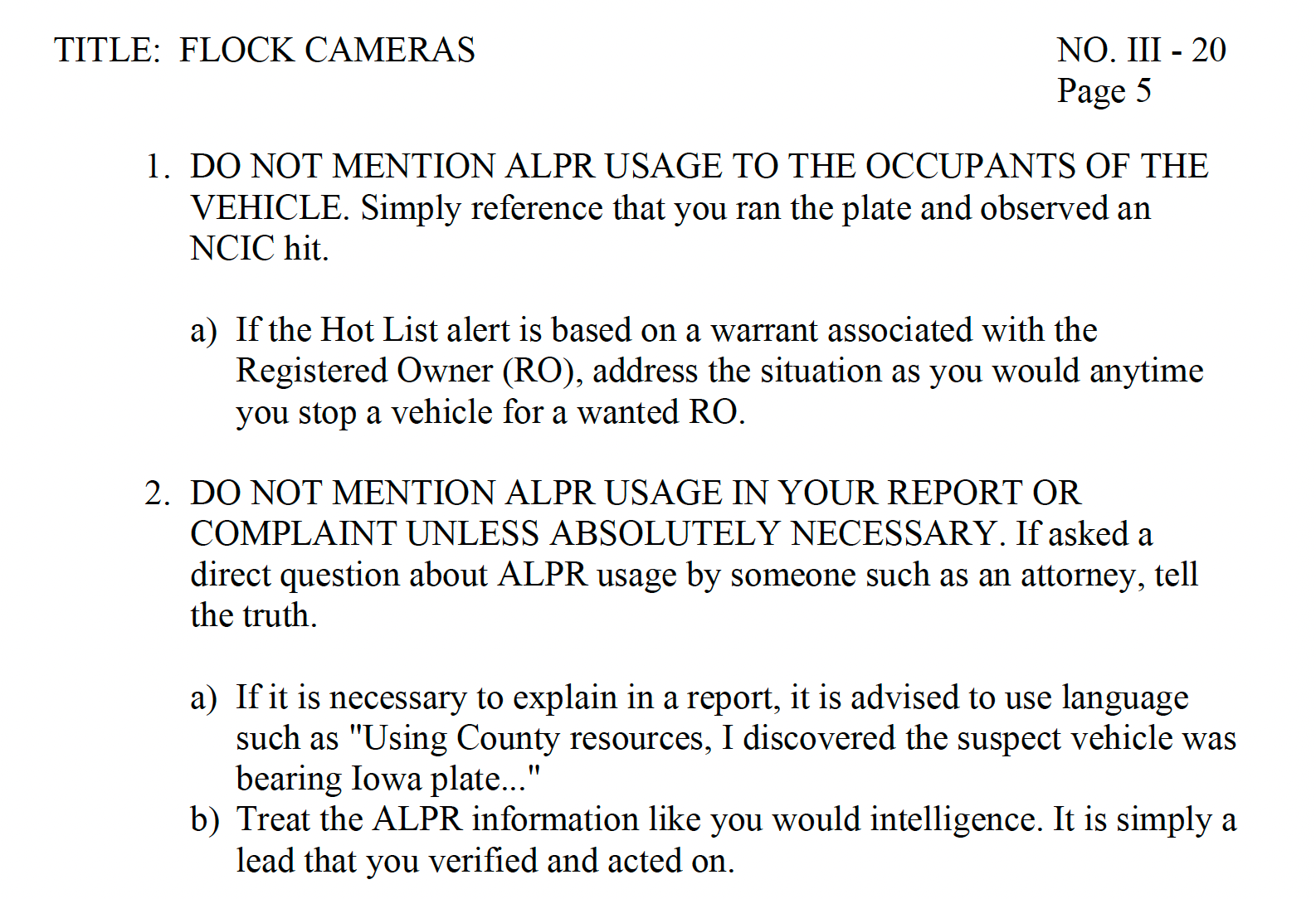
When cops use Flock to arrest someone in Wapello County, Iowa, they don’t want them to know. A usage policy for the automated license plate reader cameras in the county tells police, in no uncertain terms, to keep them a secret: “DO NOT MENTION ALPR USAGE TO THE OCCUPANTS OF THE VEHICLE,” the policy document reads. “DO NOT MENTION ALPR USAGE IN YOUR REPORT OR COMPLAINT UNLESS ABSOLUTELY NECESSARY.” 

The police guidance document is unusual in how clearly it tells police not to mention their Flock use, but it also highlights several important things in the Flock debate. While Flock likes to say that it is a transparent surveillance company and that it cares about “accountability” and “governance,” some of its customers believe its use should be kept secret. Flock is now operating in thousands of cities and towns, and when, how, and why police use the system is wildly inconsistent. Even though Flock does have various auditing and transparency tools, police have their own opinions about what Flock can and should be used for and what the policies for it should be. 

‘DO NOT MENTION ALPR USAGE’: How Cops Are Trying to Hide Their Use of Flock

It is not just local police in small communities who are creating policies designed to obfuscate Flock usage. Earlier this year, we reported that police in multiple states were being told to be “as vague as permissible” about why they were using Flock because their searches could be obtained using public records requests, and that warning was being shared by the FBI and Department of Justice. Residents of many towns using Flock also say that their cities entered into contracts with Flock with little public oversight, essentially quietly opting them into a nationwide surveillance network without robust public debate. 

Wapello County’s “standard operating procedures” document for Flock cameras was created in November of 2025 and was obtained by a 404 Media reader using a public records request and was shared with us. Coincidentally, Wapello County’s largest city is Ottumwa, Iowa, where 404 Media ran a Super Bowl commercial earlier this year. The county has four Flock cameras via a contract it signed with the company in late 2024. The policy further instructs police to be vague in any arrest report, suggesting that they simply call the Flock system “county resources.” 

“DO NOT MENTION ALPR USAGE IN YOUR REPORT OR COMPLAINT UNLESS ABSOLUTELY NECESSARY. If asked a direct question about ALPR usage by someone such as an attorney, tell the truth,” it says. “If it is necessary to explain in a report, it is advised to use language such as ‘Using county resources, I discovered the suspect vehicle was bearing an Iowa plate.’ Treat the ALPR information like you would intelligence. It is simply a lead that you verified and acted on.”

The guidance to keep Flock use secret is reminiscent—but less extreme—than guidance on some other secretive police technologies. For years, police tried to hide the existence of cell site simulators (popularly known as Stingrays), going as far as to drop criminal cases where it was likely that a judge would expose information about them. Stingrays are essentially fake cell phone towers that can be used to identify the phones of people in a specific area.

In the public records request, Sheriff Don Phillips said “there is no need” to tell people about the use of Flock.

“Our policy requires deputies to check the license plate to make sure the correct plate is accurate and the information as to an arrest warrant, stolen vehicle, stolen plate or missing person is correct,” he said. “There is no need to tell them about our investigative methods or sources, such as the camera system, because the information is verified by the deputy running the license plate. It is common practice for law enforcement to refrain from disclosing investigative methods and sources to prevent criminals from learning how to circumvent them.”

Phillips did not respond to a request for comment.

Read the whole story
angelchrys
6 days ago
reply
Overland Park, KS
Share this story
Delete

Dark money, misleading claims flood Kansas ahead of judicial selection referendum

1 Share
Hands holding a collection of political ad mailers

Donors have flooded organizations with millions of dollars ahead of the Aug. 4 vote on a ballot question that could change the way Kansas Supreme Court justices are selected. (Photo by Anna Kaminski/Kansas Reflector)

TOPEKA — Partisan donors have spent at least $12.8 million in Kansas on dozens of television ads and stacks of mailers, advocating for or against a ballot referendum that could determine the political temperature of the state Supreme Court for generations.

From county political parties to dark money mega-donors, Kansas’ “vote yes” and “vote no” campaigns are benefiting from millions in outside spending from high-profile financiers, seeking to influence Tuesday’s vote on a proposed constitutional amendment that asks Kansans if they want state Supreme Court justices to be selected by popular vote.

“Vote yes” ads have warned of “leftist elites” maintaining an unfair status quo on the bench. “Vote no” ads warn of “corrupt billionaires” seeking to control the court’s interests. Out-of-state backers have funded campaigns on both sides, according to state campaign finance records, up to July 20, the last campaign finance reporting date until October.

In Tuesday’s primary election, voters will choose whether to oppose or support a constitutional amendment that would, if passed, eradicate the current system of selecting Kansas Supreme Court justices and allow sitting justices and candidates for the open seats on the court to make political contributions and take part in political campaigns.

A “no” vote would maintain the current merit-based system. A nominating commission, which is made of up five lawyers who are put on the commission by other lawyers and four non-attorneys selected by the governor, chooses candidates to interview from a pool of prospective justices. The commission nominates three candidates, and the governor picks a justice from the three. Sitting justices undergo recurring retention votes in the next general election, and every six years after that.

Kansas has used the current system since voters established it in 1958. Thirteen states elect their Supreme Court justices in nonpartisan elections, and eight use partisan elections. Fourteen states, including Kansas, use merit selection, 10 use gubernatorial appointments, two use legislative appointments and four use a hybrid of elective and appointive methods, according to the Brennan Center for Justice, a law policy organization at New York University Law.


Ad claims

In a “vote yes” video ad paid for by Kansans for Democracy, a voiceover claims the nominating commission operates “behind closed doors, trading favors, rewarding friends.”

“The public can’t see it or control it,” the voice says.

In fact, the commission’s candidate interviews are public and broadcast on YouTube.

Anamarie Rebori Simmons, the communications director for Kansas United for Impartial Courts, which opposes the amendment, said Kansas’ merit-based system is “battle-tested,” and “constitutional experts from across the state select qualified, impartial justices.”

“Billionaire political donors are resorting to lies to try to trick Kansas voters in their desperate attempt to turn our qualified Supreme Court justices into politicians for sale. If this amendment passes, those same donors will be able to spend tens of millions of dollars on ads like this one to influence our courts,” she said.

Kansans for Democracy was the largest financial supporter of the proposed amendment. It is an organization funded with $1.7 million in donations from First Principles Action, a Nashville-based PAC founded in 2024 by the former executive director of the Republican Attorneys General Association. Both have ties to legal activist Leonard Leo, whose network of dark money nonprofits has filtered into state races.

Kansas United for Impartial Courts, which is affiliated with the American Civil Liverties Union and Appleseed, is the single largest spender in advocating for or against the ballot question. It has used rhetoric attempting to appeal to voters who want an unbiased court, and it has relied upon testimony in its ads from former Kansas Supreme Court Justices Carol Beier and Lawton Nuss, who have said a court established by partisan popular vote would be untrustworthy.

Elizabeth Patton, regional director for the Koch-founded conservative advocacy organization Americans for Prosperity, criticized the justices’ involvement. She said Kansas United for Impartial Courts has based its campaign in “deceiving voters that the current selection process is both impartial and non-political.”

“Former Justice Lawton Nuss was admonished for having meetings with lawmakers in active litigation, and former Justice Carol Beier had campaign fundraisers at her house. Members of the selection committee have said on the record that they make political calculations, not merit-based decisions in their nominations. The ‘vote no’ campaign is a campaign to continue this corruption,” Patton said.

Former Kansas Supreme Court Chief Justice Lawton Nuss takes part in a June 16, 2026, panel discussion about the proposed constitutional amendment at Washburn University in Topeka
Former Kansas Supreme Court Chief Justice Lawton Nuss takes part in a June 16, 2026, panel discussion about the proposed constitutional amendment at Washburn University in Topeka. Natalie Haag, former chief counsel to Gov. Bill Graves and member of the Supreme Court nominating commission, joined him on the panel. (Photo by Jessica Tufts for Kansas Reflector)

Nuss was admonished by a disciplinary board in 2006 for violating the judicial code of conduct after he discussed a school finance case over lunch with two Republican state senators.

“This is all a matter of public record from 20 years ago,” Nuss told Kansas Reflector. “Kansans were aware of this information — and my dedicated judicial service — when they voted to keep me as chief justice of their Supreme Court in 2010 and again in 2016. Our constitutional process worked. But now billionaire political donors are trying to change that process for their own gain.”

A state ethics panel dismissed a complaint against Beier in 2016 after it found her husband hosted an event while she wasn’t home for 2014 Democratic gubernatorial candidate Paul Davis.

“This claim is false,” she told Kansas Reflector. “The judicial conduct commission examined and dismissed it many years ago. This is just another last-minute smear — trying to give billionaires power over our high court.”

Kansas United for Impartial Courts has dwarfed groups’ trackable spending on both sides of the referendum. The organization has funneled more than $8.5 million into advertising and advocacy against the proposed amendment, encompassing the vast majority of the “vote no” campaign’s roughly $8.7 million in spending. Ads have included sentiments for keeping the court “fair and impartial” and leaving money out of politics.

Various arms of the American Civil Liberties Union gave the organization around $4 million and Planned Parenthood Action Fund donated $1 million. Oklahoma philanthropist and Kansas City native Lynn Schusterman gave $1 million. Liberal activist George Soros’ Open Society Policy Center gave the organization $400,000.

Americans for Prosperity spent almost $1 million, and Your Right to Vote Association received $700,000 from the nondescript, Virginia-based Impact Mission Fund and $10,000 from Justin Hill, president of The Lawrence Paper Co.

From small donations — such as $306 from the Franklin County Central Republican Committee — to big spenders including Schusterman, the money spent on referendum campaigns in the past year is significantly less than what states that elect judges experience when partisan groups want to move the ideological bent of the courts.

More than $51 million was spent in 2023 in Wisconsin to flip the court’s majority for the first time in 15 years, according to the Brennan Center’s Douglas Keith. In 2025, billionaire Elon Musk waded into the state’s judicial election, and more than $100 million was spent that year, Keith wrote.


‘Squishy’ writing

Democratic Gov. Laura Kelly said after casting her ballot on July 27 that the amendment’s language and advertising about it have been confusing “on purpose.” 

She said the constitutional amendment primarily is tied to two issues: Access to abortion and school finance, which the Legislature has unsuccessfully tried to challenge through the courts.

“The Legislature has never accepted the first ruling on either one of those, and so this is their way to change that and to give themselves the authority to decide these things,” Kelly said. “I just hope that people recognize that, and even through all the confusion that they know to vote no.”

The money that might enter Kansas judicial races concerns Barb DeSanto, who worries the biggest pocketbooks will change the courts. It can be difficult to identify the individuals who donate to organizations, adding to the challenge of understanding how voting is influenced. 

DeSanto, who taught public relations and journalism for 35 years and retired recently from Kansas State University, reeled off a list of questions about the dollars that might come into the state. 

She wants to know how donations will be accounted for, whether judges will have to disclose the donations as conflicts of interest if they’re hearing a case and how judges will get time away from the bench to raise funds. 

As someone who taught public relations, DeSanto also watched advertising about the amendment with interest. The messaging has sharpened throughout the campaign, especially those ads that challenge people to vote no, she said. 

The language in the amendment is confusing and some of the advertisements have been as well, DeSanto said. For instance, some ads say Kansans deserve the right to vote on judges, without explaining that Kansans do vote on whether to retain judges, which gives them input, she said. 

The potential for millions of dollars to be spent by organizations outside the state to elect judges with certain partisan political leanings upsets DeSanto, who said she thinks the Citizens United court decision was one of the worst things to happen to the country. That 2010 decision allowed unlimited spending by nonprofits, labor unions and businesses to voice opinions about federal political candidates.  

But ultimately, DeSanto said she’s worried people are voting on something that’s “not even real yet.” She criticized “squishy” writing in the amendment that leaves the process for electing judges unknown.

“This is a proposed amendment so you’re voting on something that hasn’t been written yet, and that’s misleading in itself,” DeSanto said. “Vote for this, and we’ll write the law. No, I’d rather you write the law first, and then I can read it and vote on it.”

Read the whole story
angelchrys
6 days ago
reply
Overland Park, KS
Share this story
Delete
Next Page of Stories