 Log in

Haven’t watched this 90-minute video yet, but I’ve seen so many recommendations for it that I’m posting it as a to-do list item for myself: You are being misled about renewable energy technology.

|
I am the Queen of Awesome. My words do not represent my employer, but I bet you already knew that.
|

Have seen it and the video is great and you should definitely stick around after the fake ending
Overland Park, KS


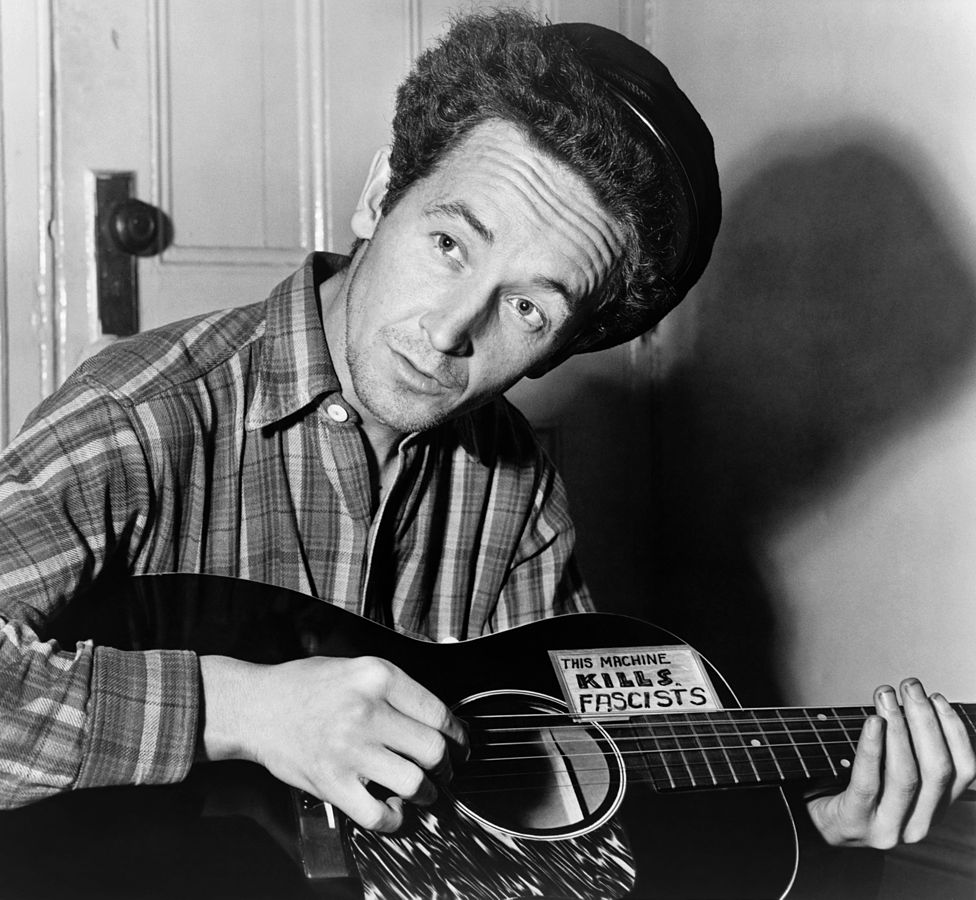
Photo by Al Aumuller, via Wikimedia Commons
Like another famous Okie from Muskogee, Woody Guthrie came from a part of Oklahoma that the U.S. government sold during the 1889 land rush away from the Quapaw and Osage nations, as well as the Muscogee, a people who had been forcibly relocated from the Southeast under Andrew Jackson’s Indian Removal Act. By the time of Guthrie’s birth in 1912 in Okfuskee County, next to Muskogee, the region was in the hands of conservative Democrats like Guthrie’s father Charles, a landowner and member of the revived KKK who participated in a brutal lynching the year before Guthrie was born.
Guthrie was named after president Woodrow Wilson, who was highly sympathetic to Jim Crow (but perhaps not, as has been alleged, an admirer of the Klan). While he inherited many of his father’s attitudes, he reconsidered them to such a degree later in life that he wrote a song denouncing the notoriously racist New York landlord Fred Trump, father of the current president. “By the time he moved into his new apartment” in Brooklyn in 1950, writes Will Kaufman at The Guardian, Guthrie “had traveled a long road from the casual racism of his Oklahoma youth.”
Guthrie was deeply embedded in the formative racial politics of the country. While some people may convince themselves that a time in the U.S. past was “great”—unmarred by class conflict and racist violence and exploitation, secure in the hands of a benevolent white majority—Guthrie’s life tells a much more complex story. Many Indigenous people feel with good reason that Guthrie’s most famous song, “The Land is Your Land,” has contributed to nationalist mythology. Others have viewed the song as a Marxist anthem. Like much else about Guthrie, and the country, it’s complicated.

Considered by many, Stephen Petrus writes, “to be the alternative national anthem,” the song “to many people… represents America’s best progressive and democratic traditions.” Guthrie turned the song into a hymn for the struggle against fascism and for the nascent Civil Rights movement. Written in New York in 1940 and first recorded for Moe Asch’s Folkways Records in 1944, “This Land is Your Land” evolved over time, dropping verses protesting private property and poverty after the war in favor of a far more patriotic tone. It was a long evolution from embittered parody of “God Bless America” to “This land was made for you and me.”

But whether socialist or populist in nature, Guthrie’s patriotism was always subversive. “By 1940,” writes John Pietaro, he had “joined forces with Pete Seeger in the Almanac Singers,” who “as a group, joined the Communist Party. Woody’s guitar had, by then, been adorned with the hand-painted epitaph, THIS MACHINE KILLS FASCISTS.” (Guthrie had at least two guitars with the slogan scrawled on them, one on a sticker and one with ragged hand-lettering.) The phrase, claims music critic Jonny Whiteside, was originally “a morale-boosting WWII government slogan printed on stickers that were handed out to defense plant workers.” Guthrie reclaimed the propaganda for folk music’s role in the culture. As Pietaro tells it:
In this time he also founded an inter-racial quartet with Leadbelly, Sonny Terry and Cisco Houston, a veritable super-group he named the Headline Singers. This group, sadly, never recorded. The material must have stood as the height of protest song—he’d named it in opposition to a producer who advised Woody to “stop trying to sing the headlines.” Woody told us that all you can write is what you see.
You can hear The Headline Singers above, minus Lead Belly and featuring Pete Seeger, in the early 1940’s radio broadcast of “All You Fascists Bound to Lose.” “I’m gonna tell you fascists,” sings Woody, “you may be surprised, people in this world are getting organized.” Upon joining the Merchant Marines, Guthrie fought against segregation in the military. After the war, he “stood shoulder to shoulder with Paul Robeson, Howard Fast, and Pete Seeger” against violent racist mobs in Peekskill, New York. Both of Guthrie’s anti-fascist guitars have seemingly disappeared. As Robert Santelli writes, “Guthrie didn’t care for his instruments with much love.” But during the decade of the 1940’s he was never seen without the slogan on his primary instrument.
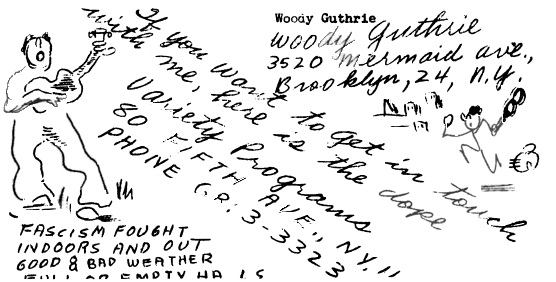
“This Machine Kills Fascists” has since, writes Motherboard, become Guthrie’s “trademark slogan… still referenced in pop culture and beyond” and providing an important point of reference for the anti-fascist punk movement. You can see another of Guthrie’s anti-fascist slogans above, which he scrawled on a collection of his sheet music: “Fascism fought indoors and out, good & bad weather.” Guthrie’s long-lived brother-in-arms Pete Seeger, carried on in the tradition of anti-fascism and anti-racism after Woody succumbed in the last two decades of his life to Huntington’s disease. Like Guthrie, Seeger painted a slogan around the rim of his instrument of choice, the banjo, a message both playful and militant: “This machine surrounds hate and forces it to surrender.”
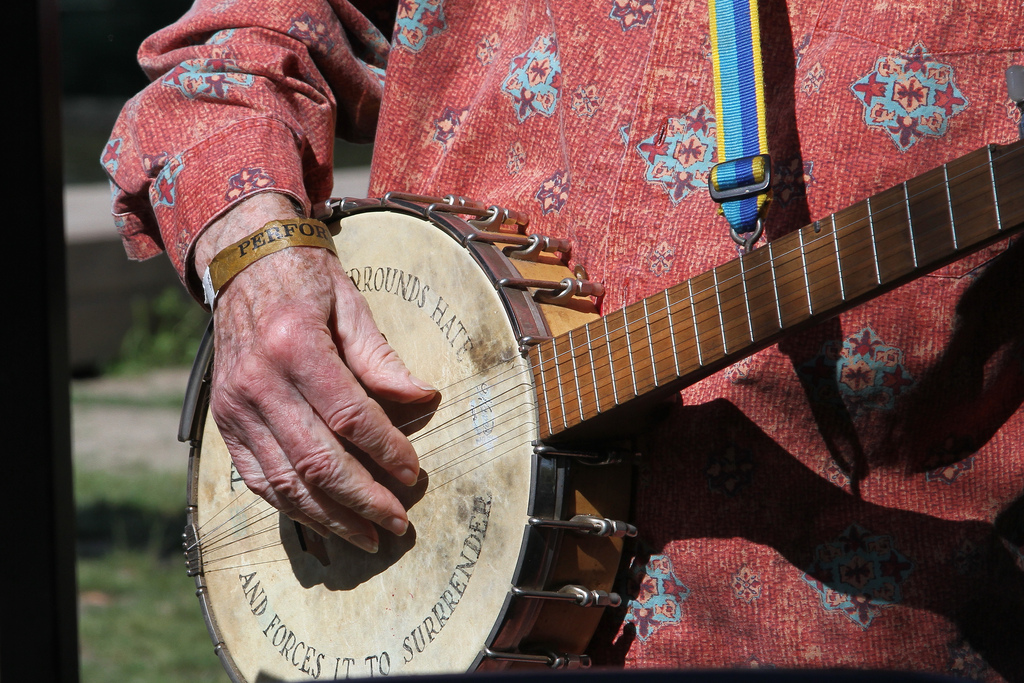
Photo by “Jim, the Photographer”
Seeger carried the message from his days playing and singing with Guthrie, to his Civil Rights and anti-war organizing and protest in the 50s and 60s, and all the way into the 21st century at Occupy Wall Street in Manhattan in 2011. At the 2009 inauguration of Barack Obama, Seeger sang “This Land is Your Land” onstage with Bruce Springsteen and his son, Tao-Rodriquez Singer. In rehearsals, he insisted on singing the two verses Guthrie had omitted from the song after the war. “So it was,” writes John Nichols at The Nation, “that the newly elected president of the United States began his inaugural celebration by singing and clapping along with an old lefty who remembered the Depression-era references of a song that took a class-conscious swipe at those whose ‘Private Property’ signs turned away union organizers, hobos and banjo pickers.”
Both Guthrie and Seeger drew direct connections between the fascism and racism they fought and capitalism’s outsized, destructive obsession with land and money. They felt so strongly about the battle that they wore their messages figuratively on their sleeves and literally on their instruments. Pete Seeger’s famous banjo has outlived its owner, and the colorful legend around it has been mass-produced by Deering Banjos. Where Guthrie’s anti-fascist guitars went off to is anyone’s guess, but if one of them were ever discovered, Robert Santelli writes, “it surely would become one of America’s most valued folk instruments.” Or one of its most valued instruments in general.

Photo by “Jim, the Photographer”
Note: An earlier version of this post appeared on our site in 2017.
Related Content:
Bruce Springsteen Won’t Back Down: Performs “Streets of Minneapolis” Live in Minneapolis
Hear Two Legends, Lead Belly & Woody Guthrie, Performing on the Same Radio Show (1940)
The Nazis’ 10 Control-Freak Rules for Jazz Performers: A Strange List from World War II
Josh Jones is a writer and musician based in Durham, NC.
Overland Park, KS
Many who are resisting authoritarianism are over-relying on the Democratic Party and Democratic elected leaders to save us. This is a very big mistake. The story of how the Franklin Delano Roosevelt administration, often lauded for its role in rescuing in the U.S. economy, fighting a war against fascism in Europe, and building a long-term base for Democratic politics, behaved in the face of authoritarian threats exposes how even “good guys” fighting “real fascism” can become complicit in authoritarianism when they prioritize coalition maintenance and Party survival over universal rights, and therefore treat governance in the face of authoritarian threats as normal politics.
Democratic Party leadership, even those fighting authoritarianism, should be assumed to be vulnerable to sacrificing marginalized communities when it serves their coalition-building strategy. In order to build a coalition for “democratic” politics, the Franklin Delano Roosevelt administration built robust democratic infrastructure (unions, social security, public works) for white workers while:
Abandoning anti-lynching legislation to keep Southern Democrats in the fold
Excluding domestic and agricultural workers (majority Black) from New Deal protections, again, to keep white Democrats in the coalition
Destroying Native communities through dams and displacement
Incarcerating 120,000 Japanese Americans while fighting fascism
Restricting immigration of Jewish refugees until genocide was a fait accompli, and, even then, never actually welcoming Jewish refugees even after the war
The pattern: Progressive governance for some, authoritarian violence for others, all justified as political necessity. And, what these failures did keep the avenues open for a post-WWII rise of authoritarianism in the U.S.
Democrats right now are likely to:
1. Choose “winnable” fights over existential ones
Negotiate infrastructure bills while authoritarian consolidation accelerates
Focus on 2026 messaging rather than immediate disruption in order to prevent consolidation
Treat this as a bad political cycle, not as anti-democratic regime change
2. Horse-trading vulnerable communities by “accepting” the following:
“We can’t protect trans kids AND win moderates”
We must abandon undocumented immigrants to look “tough on border security”
Sacrifice voting rights to preserve the filibuster
Soft-pedal on civil resistance because it polls badly
3. Mistaking partisan politics for anti-authoritarian resistance
Believing institutional norms and electoral strategy will save us when the historical evidence proves this completely wrong
Asking people to “vote harder” when the game has fundamentally changed
Treating mass civil disobedience as a radical position rather than as a necessary survival strategy
4. Measuring success by what Democrats gain rather than what authoritarianism loses
Celebrating legislative wins while ignoring pillars of authoritarian support going unchallenged
Focusing on 2028 candidate positioning while regulatory capture proceeds
Building party infrastructure instead of mass noncooperation capacity
The key difference you’re naming: Authoritarianism requires mass, sustained, disruptive, and sometimes illegal action - tactics that partisan actors structurally cannot lead.
Democrats will always be constrained by:
Electoral viability calculations
Donor relationships
Institutional position (can’t call for breaking laws they’re sworn to uphold)
Media narratives about “responsible” opposition
Coalition management that sacrifices some for others
But defeating authoritarianism requires:
Sustained noncooperation that disrupts economic/social functioning
Mass civil disobedience that accepts legal consequences
Offensive disruption of authoritarian consolidation, not defensive protest
Unity across ideological lines that transcends party loyalty
Willingness to sacrifice “normalcy” and comfort for sustained resistance
Nonpartisanship, which is often viewed as against Party interests
This history argues that anti-authoritarian resistance must be led by civil society, not party infrastructure, because:
Only civil society can mobilize disruptive action at scale - parties need to maintain legitimacy; movements can risk it
Only nonpartisan coalitions can achieve the mass required - achieving critical mass requires reaching beyond partisan bases
Only those outside institutional power can name the game has changed - Democrats will keep playing by rules that no longer exist
Only movements can refuse the horse-trading - parties will always sacrifice some communities; movements must hold the line for everyone
Only civil resistance can disrupt fast enough - legislative strategy operates on electoral timelines; authoritarianism consolidates daily
The warning translates to specific choices ahead:
When Democrats propose “bipartisan election reform” that abandons key protections - will movements accept it or escalate disruption?
When party leadership says mass walkouts will “hurt our chances in 2026” - will organizers defer or act anyway?
When protecting one marginalized community requires “compromise” on another - will civil society hold firm for universal protection?
When sustained noncooperation threatens economic stability - will resistance accept that cost or return to normal?
FDR built a powerful state apparatus and democratic infrastructure for white America while enabling authoritarianism against everyone else. The “good” politics and the authoritarian politics weren’t in tension - they were the same political project, with different populations experiencing different faces of state power.
Today’s Democrats could build climate infrastructure while abandoning immigrants, protect abortion while sacrificing trans people, strengthen unions while enabling police militarization - all while genuinely believing they’re fighting authoritarianism. But all of these moves destroy a fundamental pillar of democracy - pluralism. For those of us who want to live in a free country, pluralism matters greatly - it is the operative theory behind the famous quote by Dr. King, that “injustice anywhere is a threat to justice everywhere.
The only check on this kind of backsliding is a movement that refuses those trades, operates outside partisan constraints, and recognizes that mass civil resistance isn’t one tactic among many - it’s the difference between resisting authoritarianism and managing your position under it.

"The pattern: Progressive governance for some, authoritarian violence for others, all justified as political necessity. And, what these failures did keep the avenues open for a post-WWII rise of authoritarianism in the U.S."
seattle, wa

Nature, Published online: 22 January 2026; doi:10.1038/d41586-026-00222-7
A molecule produced by cancer cells can shield the brain from Alzheimer’s disease in mice. reply
reply


U.S. Rep. Sharice Davids, D-Kansas, discusses implications of President Donald Trump's imposition of new tariffs on imports with Brett Goodwin, center, and Alan Tipton, owners of The Learning Tree toy store in Prairie Village. (Tim Carpenter/Kansas Reflector)
She’s not saying it, not yet, but U.S. Rep. Sharice Davids sure looks like someone exploring a campaign for Senate.
Wednesday brought the announcement that the Democratic politician would visit four cities outside her 3rd District. Davids told Kansas Reflector that “right now, my focus really is on doing the best job I can by showing up, listening and delivering real results.” She said the tour “isn’t about some kind of announcement for something different.”
On the other hand, she’s still heading out into deepest Kansas. If folks throughout the state say how much they love her, why wouldn’t Davids explore the possibilities?
Davids was set on this path by redistricting chatter last year. Kansas Statehouse Republicans couldn’t muster the votes to kick Davids out of her blue-tinted stronghold, but she began considering next steps anyway. One intriguing possibility was challenging Republican U.S. Sen. Roger Marshall in his reelection bid this year.
“All I can say is that every option is on the table, including a statewide run,” Davids said in October when a special session about redistricting still looked like a real possibility.
Republicans’ map-drawing gambit fell apart shortly thereafter, when House members rebelled at the prospect. Journalists stuck around for a few days, examining the wreckage of House Speaker Dan Hawkins’ hubris, but ultimately moved onto other stories. The Legislature gaveled in this month, and leaders have avoided revisiting the issue thus far.
You might expect Davids to have gone back to work, or at least her House reelection campaign. Facts on the ground nationally have changed, however. And they’ve changed in a big way.
President Donald Trump’s administration has gone haywire, bullying Greenland and inflicting tariffs, killing protesters and deporting mothers, kicking people off Medicaid and shutting off food aid, all the while staggering around like an unwanted relative at Christmastime.
Congressional Republicans are retiring in droves. Meanwhile, the GOP holds only a five-seat majority in the U.S. House.
So let’s sit down and think for a spell, as I’m sure Davids and her advisers have done. Democrats need to flip relatively few seats to take control of the House. If they have to fight for every single one of those gains, representatives like Davids would need to stay put at all costs. As a Democrat holding a red state seat, she’s a precious commodity.
But what if party polling shows something else? What if political scientists have begun to suggest that a wave might happen after all? All of a sudden, Davids’ options look wider. And national Democrats may just need her to run for Senate.
Here’s why. Assume that Democrats rack up record numbers in November. Assume the party clinches more than the 14 House seats that Politico classified as “easier opportunities for Dems.” Assume Democrats flip 24 or even 30 House seats.
Now the Republican-led Senate looks like a mighty tempting target. Democrats face an uphill path to take over the chamber, needing to defeat Republicans in Alaska, Maine, North Carolina and Ohio to eke out a majority. Adding Kansas to that list of targets (along with longer-shot possibilities in Iowa and Texas) would give leaders a bigger playing field.
Meanwhile, Marshall has hitched his political identity so closely to Trump that you couldn’t stick a credit card between the two men.
He has accused Kansans disturbed by Trump’s would-be authoritarianism of being paid protesters. He’s shown shocking ignorance of how insurance works (remember, the former obstetrician brands himself as “Doc”). Even after U.S. Immigration and Customs Enforcement agents gunned down Alex Pretti in Minneapolis, Marshall couldn’t bring himself to issue the mildest tut-tut.
A smart Democratic candidate could make acres of hay from this man’s missteps. Several candidates have already jumped into the Democratic primary, with more likely to join them in coming months.
But Davids would be the most formidable candidate by far. She has established a durable base of political support in northeast Kansas and serves on the House Agriculture Committee besides. As a Native American and member of the LGBTQ+ community, she has consistently broken barriers. Like her fellow Kansas Democrat Laura Kelly, Davids can be underestimated. She’s not flashy. She’s not given to grand oratorical pronouncements.
What she is, and what she’s always been, is solid.
She would still face an uphill path. Kansans haven’t sent a Democrat to the U.S. Senate since George McGill in 1930. Marshall’s loyalty to Trump surely counts for something among the MAGA faithful and in the halls of power of Washington, D.C. Several well-qualified Kansans have fallen trying for a Senate seat in the past couple of decades: Barbara Bollier. Greg Orman. Jill Docking.
Yet I think Davids will make the attempt. Democratic leaders want to expand that Senate map. Marshall has humiliated himself repeatedly. Democrats nationwide will be expected to over-perform in November.
If Davids wants that Senate seat, and what ambitious politician wouldn’t, now’s the time to grab for the big brass ring.
Clay Wirestone is Kansas Reflector opinion editor. Through its opinion section, Kansas Reflector works to amplify the voices of people who are affected by public policies or excluded from public debate. Find information, including how to submit your own commentary, here.
She's pretty great, I'd love to see her replace Marshall.
Overland Park, KS
ICE/DHS has killed nine people in 2026 (that we know of): Keith Porter, Parady La, Heber Sanchaz Domínguez, Victor Manuel Diaz, Luis Beltran Yanez-Cruz, Luis Gustavo Nunez Caceres, and Geraldo Lunas Campos, Alex Pretti, and Renee Good.
Overland Park, KS
Next Page of Stories