I am the Queen of Awesome. My words do not represent my employer, but I bet you already knew that.
18869 stories
·
35 followers

As Pride Month dawns, Kansas governor helps celebrate rainbow flag creator Gilbert Baker

1 Share
Kansas residents and activists gathered with Gov. Laura Kelly last week for her signing of a proclamation honoring rainbow flag creator Gilbert Baker.

Kansas residents and activists gathered with Gov. Laura Kelly last week for her signing of a proclamation honoring rainbow flag creator Gilbert Baker. (Photo from Kansas governor's office)

Happy Gilbert Baker Day!

Thanks to a proclamation from Kansas Gov. Laura Kelly signed Friday, we can celebrate the life and work of Parsons native Baker this June 2. He created a piece of American iconography that has spread across the globe and into the hearts of those who care for their gay neighbors: the rainbow pride flag.

Kelly Wall, a board member of PFLAG Lawrence, requested the day after reading about Baker in an authoritative piece by founding Kansas Reflector opinion editor C.J. Janovy. (You can also read Janovy’s work in the new anthology “Kansas Matters: Twenty-First-Century Writers on the Sunflower State.”)

Lauren Shepard of Parsons was on hand at the Statehouse to watch Kelly sign. She had just graduated from Pittsburg State University with a master’s degree. According to her, efforts to honor Baker locally ran into static.

“Ultimately, the town, the city commission ended up tabling the idea, so we pivoted and got together and started a Gilbert Baker Memorial Scholarship through the Parsons High School, where he graduated,” she told me. “So now every year we select a student that’s active in their OAQ, which is like a gay-straight alliance, it’s a student organization there at the high school.”

Wall was out of the state Friday, but a group assembled by her showed up to honor Baker. It included Shepard, several Lawrence activists and state Sen. Marci Francisco. I tagged along and noted that multiple groups had gathered on the second floor of the Statehouse for their own proclamation time with Kelly. One was promoting an “Asteroid Day.”

Inside the governor’s ceremonial office, group members realized that no one had actually brought a rainbow flag — the symbol for Pride Month and LGBTQ+ rights more generally.

No worries, Kelly told them.

She retreated into her actual office and returned bearing a rainbow flag coaster and a copy of Janovy’s book, “No Place Like Home: Lessons in Activism from LGBT Kansas,” which features rainbow stripes on the cover.

Crisis averted, the group took pictures with Kelly, the proclamation and the props. That was that.

Janis Guyot, the president of PFLAG Lawrence, holds a proclamation designating June 2 as "Gilbert Baker Day" in Kansas.
Janis Guyot, the president of PFLAG Lawrence, holds a proclamation designating June 2 as Gilbert Baker Day in Kansas. (Photo by Clay Wirestone/Kansas Reflector)

No one on hand missed the broader implications. Baker had turned his back on his Kansas background, living in San Francisco and New York City. He had finally agreed to return to Parsons, Janovy writes, for a key to the city and film festival in 2017. A month before the events, Baker died at the too-young age of 65.

“It allows us to recognize one of our own who created an emblem that allows us to recognize all of LGBTQ across the country and across the world,” said Rachel Reed of Lawrence. “And it’s very, very important.”

Janis Guyot serves as president of Lawrence PFLAG and stood in for Wall at the signing. Afterward, she held the proclamation certificate as others in the group swirled around to take a look.

“I’m really happy that there’s something to celebrate for the LGBTQ world right now,” Guyot told me. “It’s tough time for all of them.”

Since Baker’s untimely death, we’ve seen a public push and pull over gay rights. Transgender folks — members of the movement from the beginning, whether they were identified as such or not — have been systematically excluded and discriminated against. The Kansas Legislature has repeatedly passed hateful laws.

Who knows what Baker might say about this recent turmoil. Given that he went by the drag name “Busty Ross,” I imagine he would bring an irreverent sense of humor along with his passion for making the world a better place.

Hopefully, he would say progress hasn’t stopped, and it won’t stop, regardless of small minds and even smaller hearts.

In an oral history from 2008, Baker suggested as much: “I do know that time is on our side and that the young people generation, and more importantly my generation, we have fought hard, and we have — we’ve worked on our parents, we have our own children, and we’re moving society forward. So I think we’re going to be all right. I mean, it may take a little more fight and a little more work than people want, but we’ll get there.”

Clay Wirestone is Kansas Reflector opinion editor. Through its opinion section, Kansas Reflector works to amplify the voices of people who are affected by public policies or excluded from public debate. Find information, including how to submit your own commentary, here.

Read the whole story
angelchrys
2 hours ago
reply
Overland Park, KS
Share this story
Delete

Flesh-eating screwworms head for American livestock

1 Comment
A pinned specimen of a full-grown New World screwworm fly is shown in this image. Federal and state officials are preparing for a potential invasion from the flesh-eating parasite that could disrupt livestock markets. (Photo courtesy of Michael Miller/Texas A&M AgriLife)

A pinned specimen of a full-grown New World screwworm fly is shown in this image. Federal and state officials are preparing for a potential invasion from the flesh-eating parasite that could disrupt livestock markets. (Photo courtesy of Michael Miller/Texas A&M AgriLife)

Southern states are bracing for a potential invasion of the New World screwworm that could disrupt livestock markets and raise already high meat prices.

So far, the parasite has yet to land in the United States, but it has been spreading across Mexico and Central America. Previously eradicated from the United States in the 1960s, the fly can infest livestock, pets, wildlife and in rare cases, humans. The parasites are named for their larvae, which burrow into living flesh like a screw, causing severe tissue damage and sometimes death.

With multiple cases reported within 100 miles of the U.S.-Mexico border, the federal government has already banned the import of live cattle from Mexico, compounding the shortage of domestic beef. State and federal officials also have created new monitoring, testing and quarantine protocols even as the feds put in place measures to sterilize millions of flies — including a $750 million new facility that will produce sterile flies.

“It’s going to be very challenging, I think, at this point to keep it out of the United States,” said Dr. Samantha Holeck, state veterinarian with the New Mexico Livestock Board, which regulates the livestock industry.

Beef prices are already at record highs, with federal data showing the average price of ground beef at $6.90 per pound this month. That’s a 77% increase since January 2020, when ground beef stood at $3.89 per pound, Yahoo Finance reported.

Years of drought, increased operating costs and other supply disruptions have pushed ranchers to liquidate their herds to the smallest level in 75 years, according to the American Farm Bureau Federation. Despite the drop in supply, demand remains strong, which has pushed many ranchers to feed cattle to record-high weights.

Beef prices are unlikely to fall, because it takes time to grow herds and increase production, said David Anderson, professor and extension specialist in livestock and food product marketing at Texas A&M University. He said beef producers appear well prepared to fight a domestic screwworm invasion, which many view as an inevitability.

“I think we will re-eradicate it. I think it just depends on how much time it takes us to do that,” he said.

But the market has already been disrupted by the ban on live Mexican cattle imports, which traditionally occupy American pastures and feedlots before going to slaughter.

“We certainly are feeling the consequences of our policy response to fears of screwworms,” he said.

‘A long-term response’

Last week, the New Mexico Department of Agriculture launched a new website in collaboration with several agencies to provide a single source of information about the New World screwworm, including how to identify infestations, protect people and animals, and report suspected cases.

As screwworm approaches New Mexico, agencies focus on outreach with few details on broader response

The U.S. Department of Agriculture has approved emergency use of several medications for prevention and treatment of the parasite. Those include ivermectin, the drug that many people hoarded for off-label use during the coronavirus pandemic, even though the U.S. Food and Drug Administration did not approve its use for the virus. But Holeck said ranchers must be careful about starting preventive medications too early and overusing them.

“While it’s important that we have these medications, we need to be very judicious about how we use them, because we don’t want to create resistance to these medications and then have them become ineffective,” Holeck said.

New World screwworm larva. (Photo courtesy of USDA)

The fly larvae (maggots) can burrow into the flesh of living animals through wounds as small as a tick bite or in body openings such as the eyes or nose. About the size of a common housefly, the adult screwworm fly has orange eyes, a metallic blue or green body, and three dark stripes along the back.

Holeck said ranchers will need to keep close watch over newborn calves with exposed umbilical cords. They may also have to rethink branding and tagging operations in the case of an infestation, because those wounds can provide an entry for the pests.

New Mexico has distributed test kits to every county extension office for producers and the general public who suspect cases. Holeck said the state has already performed about 30 tests — all were negative.

She noted that the last infestation took more than a decade for American and Mexican officials to eradicate.

“It’s not going to be a quick fix,” she said. “It’s going to be a long-term response, and it’s going to require everybody to work together to help get control of it.”

‘We’re going to get infested’

To combat the screwworm, the federal government plans to breed sterile male flies and then release them into areas with established populations. The sterilized males will mate with females, which will then lay unfertilized eggs. With females mating only once in their lifespan, officials say this method progressively reduces and eliminates the fly population.

USDA just broke ground on a $750 million sterile fly facility in Edinburg, Texas, that aims to produce up to 300 million sterile flies per week when it opens next year. The agency has also invested in sterile fly facilities in Mexico and Panama.

Quotation

It's not going to be a quick fix. It's going to be a long-term response.

– Dr. Samantha Holeck, state veterinarian with the New Mexico Livestock Board

But Texas Agriculture Commissioner Sid Miller said those plants won’t produce enough sterile flies to eradicate the parasites.

“We’re going to get infested,” he said. “There’s no doubt about it. And USDA knows that. They’ve already distributed test kits to ranchers and farmers and veterinarians and wildlife personnel up and down the Rio Grande.”

“It wouldn’t surprise me if we had a case today,” he said earlier this month.

Miller said ranchers should have no trouble accessing effective drugs like ivermectin, which he said he still personally takes each week.

He expects the screwworm to cause temporary fluctuations in livestock markets as ranchers treat and quarantine affected herds. Texas is by far the nation’s leading beef producer, with more than 12.5 million cattle. For now, he expects an outbreak to affect animals in a few counties along the Southern border.

“Now, if the whole state of Texas gets infected, that’s a lot,” he said.

In the case of an outbreak, USDA has created monitoring, reporting and quarantine protocols for animals. But because the disease does not create food safety concerns, the agency will not stop any movement of animal products, including meat.

But the infestation could ripple to other animal products, livestock and even pets, officials warn. 

While ranchers can hold back cattle during an outbreak, dairies may face immediate losses during infections, according to the University of California Agriculture and Natural Resources. 

“Dairy cows produce milk every day that must be processed immediately — if a farm is quarantined or a plant shuts down, milk spoils quickly and has to be dumped,” said Daniela Bruno, a dairy adviser with University of California Cooperative Extension.

She said producers should review their insurance coverage and bolster biosecurity against threats such as screwworm and avian flu, which has reemerged in California dairies.

The federal government and states have been preparing for months.

On a February trip to the Rio Grande Valley with Texas Republican Gov. Greg Abbott, USDA Secretary Brooke Rollins said, “We are as prepared as we could possibly be.” In March, the secretary told Oklahoma Farm Report that the agency had predicted an invasion into Texas as early as last summer, but she acknowledged the ongoing risk.

“There’s no question, when you look at the heat maps, that it is in large proportion moving up,” she said of the screwworm.

Stateline reporter Kevin Hardy can be reached at khardy@stateline.org

This story was originally produced by Stateline, which is part of States Newsroom, a nonprofit news network which includes Kansas Reflector, and is supported by grants and a coalition of donors as a 501c(3) public charity.

Read the whole story
angelchrys
3 days ago
reply
Terrible news after reading Wolf Worm by T Kingfisher
Overland Park, KS
Share this story
Delete

Eggs before engines — How 4 baby robins stalled truck sale at Olathe Ford for a month

1 Share

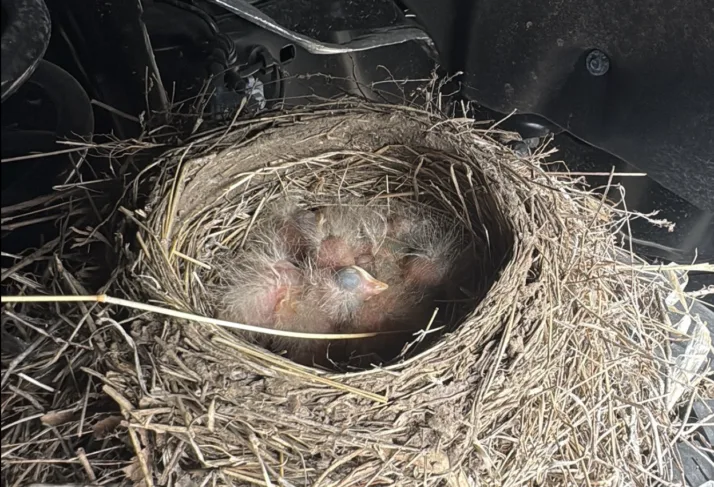
Before it could go to its new owner, a sold F-250 truck at Olathe Ford Lincoln first had to serve as the home of a family of robins.

What the dealership called an “unexpected adventure” on Facebook, started about a month ago when an employee noticed a robin building a nest on the truck’s right front tire. Days later, the bird laid four eggs.

It is forbidden to move robin’s nests under the federal Migratory Bird Treaty — so the employees had to wait until they left on their own. But the dealership embraced the young birds, naming them Lugnut, Turbo, Diesel and Axle and “interviewing” them on Facebook.

After 4 weeks of nesting, the dealership announced the birds flew the coop — er, tire — on Wednesday.

During the time the baby birds were nesting, Olathe Ford Lincoln turned to Operation Wildlife, the largest publicly funded clinic and wildlife rehabilitation service in Kansas, for guidance.

“All birds are protected by federal law,” Operation Wildlife Executive Director Diane Johnson told the Post in an email. That protection includes birds’ nests, eggs and “pieces, parts” of the animals.

On May 14, the company announced that the eggs had hatched. Employees checked on the new family daily.

Luckily for the dealership, the truck’s new owners were willing to share with the robins.

“We want to give a huge THANK YOU to our incredibly kind and understanding customers, who have been so patient and thoughtful while we wait for these little ones to grow up and leave the nest safely,” the dealership wrote on its Facebook page on Wednesday.

According to Johnson, robins learn to fly in about 30-35 days, but Lugnut, Turbo, Diesel and Axle were advanced — leaving in just under two weeks.

Even though the birds have flown away, the dealership posted on Facebook that it will wait a few days to make sure they don’t return before removing the nest and allowing the owner to drive their new truck away.


Read the whole story
angelchrys
5 days ago
reply
Overland Park, KS
Share this story
Delete

I can literally feel my heart expanding in such a good way that’s probably normal where ginger boys are concerned but also maybe I should call my doctor?

1 Share
Y’ALL. Okay, so I have been in a very deep depression lately so I had an emergency ketamine session and I’ve been following all of my normal tools and they’ve helped but I was still struggling a little and finally I admitted that this house is just too sad after the loss of my twoContinue reading "I can literally feel my heart expanding in such a good way that’s probably normal where ginger boys are concerned but also maybe I should call my doctor?"
Read the whole story
angelchrys
12 days ago
reply
Overland Park, KS
Share this story
Delete

Judge halts Kansas ban on gender-affirming care for minors, questions credibility of state witnesses

1 Share

Douglas County District Court Judge Carl Folsom gives little weight to the testimony from expert witnesses for the state of Kansas in a lawsuit that challenges a state law banning gender-affirming care for minors. Folsom appears on Jan. 21, 2021, at a confirmation hearing before a Senate panel. (Photo by Sherman Smith/Kansas Reflector)

TOPEKA — A Kansas judge blocked the state from enforcing portions of a ban on gender-affirming care for minors, allowing transgender kids in Kansas to undergo hormone therapy and use puberty blockers.

In a 117-page Friday ruling, Douglas County District Court Judge Carl Folsom said provisions of Senate Bill 63, dubbed the Help Not Harm Act,” likely violate the Kansas Constitution. He also disputed the credibility of most of the state’s expert witnesses, who testified before the court in November.

The decision, while temporary and part of ongoing litigation, is a blow to Kansas officials who passed the ban in 2025 in an attempt to levy civil, financial and regulatory sanctions against the provision of gender-affirming care to minors.

Attorney General Kris Kobach, who represents the state, said in a Saturday statement the decision “is a stark example of judicial activism.” He vowed to appeal the judge’s temporary injunction, which immediately halts enforcement statewide of the ban on hormone treatment and puberty blockers for kids under 18 in Kansas.

“The judge invented a new constitutional right out of whole cloth,” Kobach said. “Even though the Kansas Constitution says nothing about it, the judge created a new right of parents to obtain otherwise-illegal treatments for their children.”

According to Folsom, the families were trying to preserve their constitutional rights, including “the natural right to personal autonomy,” equal protection under the law and the right to make parenting decisions.

Folsom said the pseudonymous parents and their teens were likely to prevail in their argument that SB 63 infringes on their right to personal autonomy by prohibiting them from making medical decisions on behalf of their children, “in accordance with their children’s wishes and doctor’s recommendations, including the decision to treat gender dysphoria with puberty blocking medication or hormone therapy” and replacing those decisions with government preferences.

He added that the parents are “substantially likely” to show that the state has failed to demonstrate SB 63 satisfies strict scrutiny, the weighty and highly specific test states must overcome to defend a law against legal challenges. They must justify a compelling government interest in regulating an issue and prove its actions advance that compelling interest in a narrowly tailored way.

Kobach and state lawmakers have argued that SB 63 protects kids from experimental and harmful medical interventions and shields the integrity of the medical profession.

“Protecting children and regulating the medical profession are likely legitimate and important state interests,” Folsom wrote, “but such broad articulations are likely insufficiently specific to satisfy the strict-scrutiny standard.”

Folsom came to the decision to issue a temporary injunction after two days of testimony in November. The four witnesses for the teens and their mothers included pediatric endocrinologists, a pediatric and adult hospitalist and bioethicist, and a child and adult psychiatrist. Folsom deemed each of the witnesses credible, gave full weight to their testimony and relied heavily upon their facts in his decision.

The state’s eight witnesses included a plastic surgeon, a medical ethicist, an endocrinologist who treats adults and a neuroscientist. Folsom gave little weight to three of the eight, some weight to one and little-to-no weight to another. Folsom deemed Chloe Cole, who received puberty blockers and hormone therapy treatment as a minor in California, credible but gave her testimony less than full weight because her experiences didn’t occur in Kansas.

Harper Seldin, senior staff attorney for the American Civil Liberties Union’s LGBT & HIV Rights Project, said the decision was “an enormous relief.”

The ACLU and ACLU of Kansas represent the two teens and their parents, along with lawyers from the Philadelphia-based law firm Ballard Spahr.

“Our brave clients invested tremendous effort to represent not only their interests but also the interests of all transgender youth in Kansas,” said Kristen Broz, partner in the firm’s litigation department.

In addition to the Attorney General’s Office, the state is being represented by First and Fourteenth, a Colorado-based boutique law firm that is also assisting the attorney general in a lawsuit in Johnson County challenging the validity of a set of anti-abortion laws.

The Republican-led Legislature passed SB 63 in January 2025, and Democratic Gov. Laura Kelly vetoed it. Republicans overrode her veto, the bill became law in February 2025, and the ACLU and ACLU of Kansas challenged it that May.

Read the whole story
angelchrys
13 days ago
reply
Overland Park, KS
Share this story
Delete

Plex is tripling the price of a lifetime pass to $750 after doubling it last year

1 Comment

I am dying to know how much money Plex is about to make the next six weeks charging people to stream their own video from their own homes. Today, it's giving every prospective customer until July 1st to lock in a lifetime subscription at today's rates - before it triples the price to $750.

Plex already more than doubled the price of a lifetime Plex Pass subscription from $119.99 to $249.99 last March, and it'll triple again on July 1st to $749.99. At that price, you'd have to subscribe for 11 years (at the current annual rate) to make the lifetime sub worthwhile.

Plex isn't choosing the new number because it expects you to pay $750. In a …

Read the full story at The Verge.

Read the whole story
angelchrys
14 days ago
reply
Mental note: Look into Jellyfin
Overland Park, KS
Share this story
Delete
Next Page of Stories