 Log in


|
I am the Queen of Awesome. My words do not represent my employer, but I bet you already knew that.
|

Overland Park, KS



Muscle Plus is a free stock photo site that features Japanese bodybuilders in unusual places and situations. From Tokyo Weekender:
There are men declaring their love in the middle of a tea plantation, men frolicking among sunflowers and men who have been abandoned in cardboard boxes, sometimes in the woods, sometimes by the roadside. The last scenario has proved popular enough to warrant an entire category, sute macho, or “abandoned buff guy,” borrowing its premise from the stray kittens left in cardboard boxes by Japanese roadsides.




Some of the names are great too. These two are called “The person summoned from another world wasn’t a hero, but a muscular, disposable guy” and “A muscular man who can’t fall asleep in an unfamiliar bed”:


Tags: Japan · photography
Overland Park, KS


In the wee hours of a busy Saturday morning, on June 28, 1969, police raided The Stonewall Inn in Manhattan’s Greenwich Village, a renowned hangout for the LGBTQ+ community. During the 1950s and 1960s, few businesses openly welcomed gay people, and the legal system was against them—even two consenting adults in the privacy of their own home could face years in prison or a psychiatric institution if convicted of the crime of sodomy. Bar raids were common, but this one was particularly fraught due to the volume of people, and police quickly lost control. A riot erupted, which sparked even further protests over the coming weeks in what became known as the Stonewall uprising.
Among those on the front lines, from the raid onward, was Marsha P. Johnson—the “P” stands for Pay It No Mind—a Black transgender woman who advocated throughout the 1960s and 1970s for gay and transgender rights, LGBTQ+ youth, and those affected by HIV and AIDS. Known fondly as The Saint of Christopher Street, nodding to the well-known and welcoming area for the gay community (and home of The Stonewall Inn), she was widely known for her effervescent smile, creative clothing, and the flowers she would often wear in her hair.
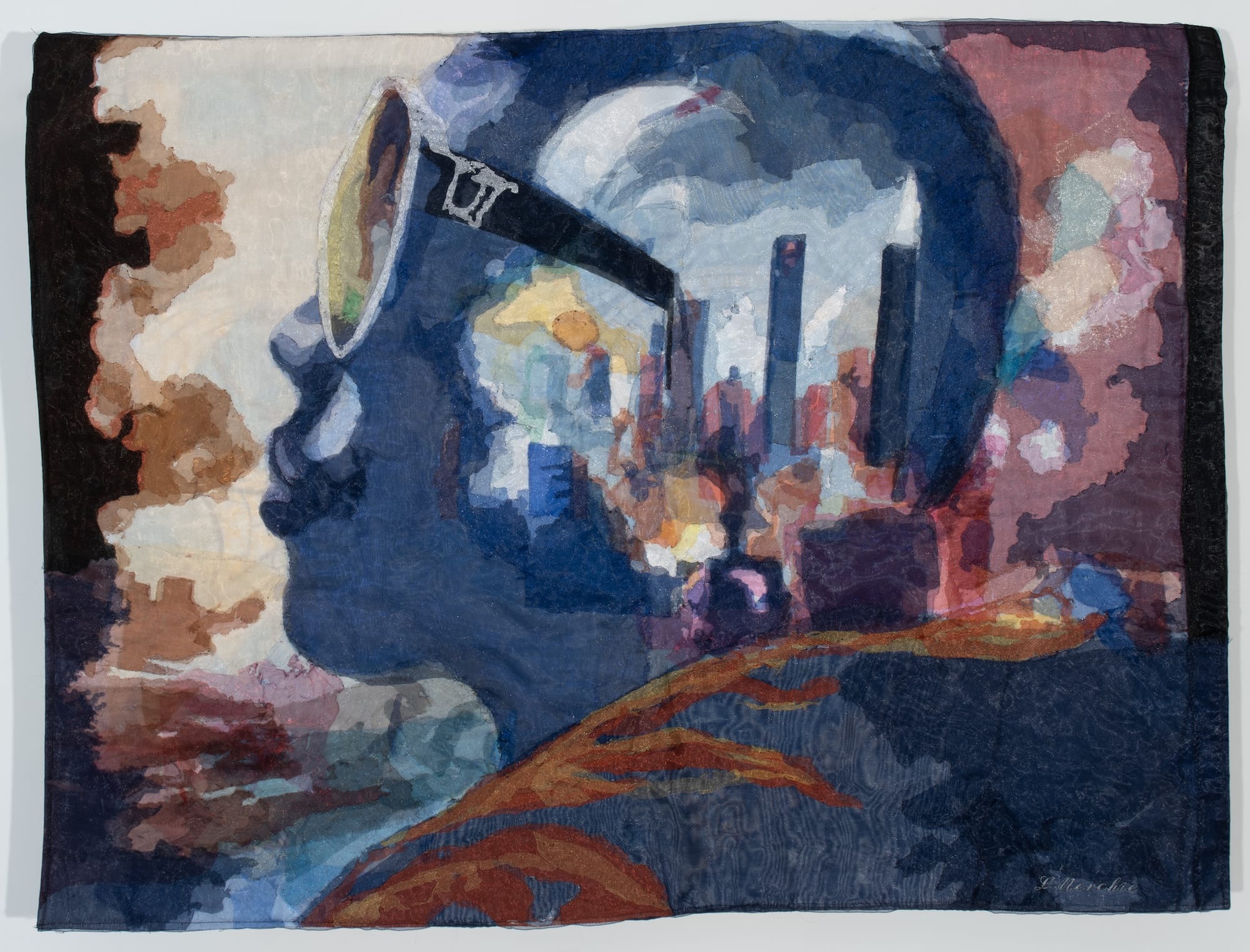
For quilter Rosy Petri, Johnson proved a beautiful and vibrant personality for a large-scale textile work in We’re Still Here: Quilted Works Curated by Carolyn Mazloomi at Claire Oliver Gallery.
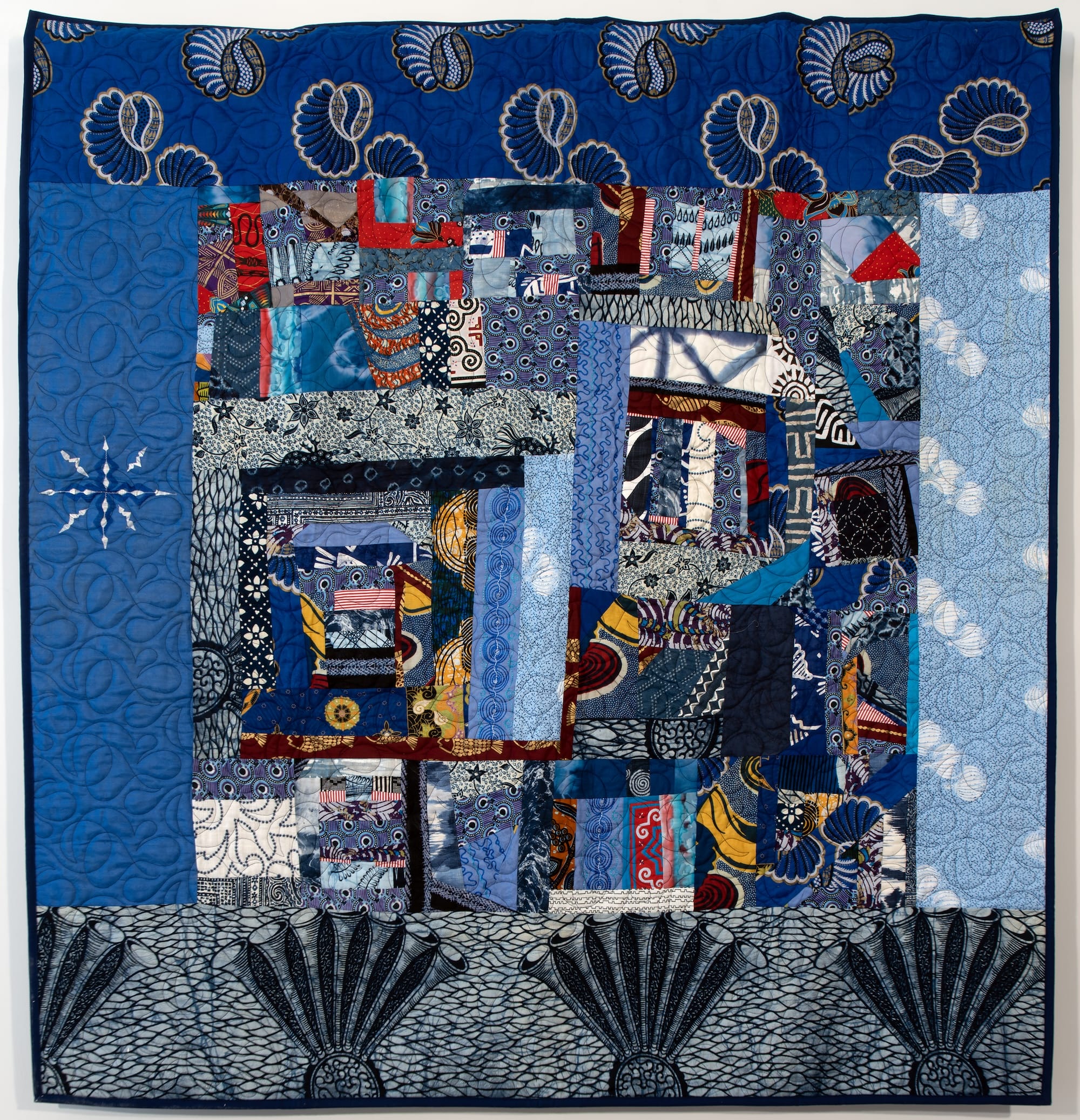
The works of 15 contemporary quilt artists take center stage in the expansive group exhibition. The show emphasizes work created by members of the Women of Color Quilters Network (WCQN), which historian, curator, and quilter Carolyn Mazloomi founded in 1985. Boldly pictorial and incorporating a wide range of materials, the pieces in We’re Still Here transcend the definition of quilts as stitched bed coverings; the compositions are rooted in the timeless craft of piecing and sewing, yet their portraits, stories, and collages surge into the realm of art.
L’Merchie Frazier’s “Climate Change in my Head: Afro Future Still Here,” for example, adopts a watercolor-like appearance with layers of nylon. Like many works in the show, a crucial topic is rendered front-and-center. Alita Aldridge’s “Underground Takes a Village” reflects the cooperation needed to make the Underground Railroad viable for enslaved people seeking freedom. And April Anue Shipp’s “The Oracle of Liberation” depicts abolitionist Frederick Douglass holding red and blue pills—a reference to the 1999 film The Matrix—in which we’re presented with a choice between seeing reality for what it is or remaining ignorant.
In addition to history, Black community, family, and other themes, bold portraiture recurs throughout the exhibition, such as in Viola Burley Leak’s “Maya Angelou II.” The renowned writer and civil rights activist peers over symbolic representations of her life’s work, including a bird fleeing an enclosure in a nod to her seminal memoir, I Know Why the Caged Bird Sings.

“All of the work I make, and the work of my fellow quilters, deals with Black history and material culture,” Mazloomi says in a statement. Through WCQN, along with curatorial projects and in advocacy of the art form, she strives to raise critical awareness of Black quilters’ practices. “This exhibition is our way of saying that our history cannot be erased by any politician or revisionist force; our work will always showcase our triumphs, suffering, creativity, courage, bravery, and genius of my people. Black history is American history.”
We’re Still Here continues through January 7 in Harlem. You might also enjoy Chronicle Books’ recent release, Stories in the Seams: A People’s History of Black Quilts and Their Makers.



41 x 38 inches





Do stories and artists like this matter to you? Become a Colossal Member today and support independent arts publishing for as little as $7 per month. The article ‘We’re Still Here’ Celebrates Remarkable Quilts by 15 Contemporary Black Artists appeared first on Colossal.
Overland Park, KS


In 2015 Microsoft acquired a to-do list app called Wunderlist, for a price rumored to be as high as $200 million. Wunderlist fans were worried that Microsoft would make their beloved app soulless and corporate, or worse, hide it behind some convoluted enterprise subscription. But against all odds, Microsoft was a good steward: The app became Microsoft To Do, but it remained a useful and powerful way for people to manage their tasks across all platforms.
Now Microsoft is pulling the rug. Buried deep in a blog post about "unified tasks and plans for Copilot and Microsoft 365" is the news that the To Do apps will "retire" on June 30th, 2027. T …
Overland Park, KS

Yes, everything is stupid right now, including that every few hours it feels like another system has broken. In just the last week we’ve had Microsoft web services go down, the FAA comms system collapse (supposedly due to a contractor’s router flooding the network during a routine upgrade?), bank websites go down, United Airlines systems go down, a bunch of tech companies (including Zoom and Salesforce) get exploited via Optimizely, Apple’s iCloud go down, and even the NSA’s super duper top secret network go down. Of all these, only the Optimizely mess appears to definitely be an exploitation, though many people are asking questions about the rest.
It should be no surprise that people are also connecting the dots and wondering if these things are all connected. I mean, how could you not? For what it’s worth, I tend to agree with the experts Prof. Kate Klonick has spoken to who suggest the most likely explanation is a benign one — old systems do break down, and it can be a bit of a coincidence that a bunch of big-name systems all broke down around the same time, but humans (as pattern-matching animals) are just paying closer attention to all of them breaking down at once.
WHY IS EVERYTHING BREAKING?
A thread on the internet suddenly going to hell
— Kate Klonick (@klonick.bsky.social) 2026-11-17T21:10:38.324Z
If there is a throughline here, my guess is that a lot of the tech companies have been quick to push layoffs lately, stupidly believing that they can replace people with AI (which, as we’ve been saying, is a dumb plan), and that means a lot of expertise — including the kind of tacit knowledge AI can’t easily capture — has walked out the door. When the people who actually know how to keep these old systems running are gone, those systems become a bit more likely to fail. That is, while lots of people jumped to “AI” being to blame, my guess (and it is a guess) is that it’s less the direct impact of AI systems, and much more the downstream indirect results of stupid CEOs cutting corners by laying off the kind of people who could keep these systems online.
Still, it does no one any favors to have the dumbest fucking people alive in charge of all of this, but we do. Back on Friday when the FAA ground stop situation happened, the first one to talk about it was DHS Secretary Markwayne Mullin (who, back when he was a senator, was long considered one of the dumbest people in the Senate). When asked if the FAA situations had anything to do with AI he responded by refusing to rule it out (“You just can’t rule out anything at this point”) and with the absolutely ridiculous retort: “We call it SI around here, remember?” He also said that it wasn’t “another 9/11” which is an awfully odd comparison to make, and only served to make many people wonder if we should be even more worried.
Later that evening he appeared next to Transportation Secretary Sean Duffy, where there were awkward exchanges where Duffy and Mullin didn’t appear to be on the same page about what happened or what was to blame. However, both the FAA and the contractor behind its newly expanded $875 million AI system insisted that system had nothing to do with it.
Then, on Monday evening Mullin went on Sean Hannity’s show and… reminded everyone just how clueless he still is. The video clips are remarkable, mainly this one that shows him first suggesting that all the outages don’t appear to be a cyberattack, based on his conversations with CISA, and then saying how he spoke to some successful tech bro who he says asked not to be named (though he says it’s not Elon) who fed him some nonsense that, once it makes it through the empty caverns of Mullin’s brain, came out even more garbled:
Mullin mentions that he had the folks at CISA (the Cybersecurity & Infrastructure Security Agency) look into all of these events, and they told him that it doesn’t appear to be an interrelated cyberattack.
“[W]hen we start looking at the cyber world, I start asking CISA, hey, what’s going on here? And they said, sir, we’re not seeing any traffic that would make us think that this is a cyberattack, they’re all individually unrelated.”
First up, mentioning CISA is fascinating, given that MAGA’s conspiracy theory-level false belief that CISA engaged in “censorship of conservatives” meant that many MAGA Republicans wanted to kill the entire agency. Even though that didn’t happen, there were massive cuts. Also, as we’ve previously reported, the second Trump Administration was so obsessed with their false belief regarding the work CISA did that froze a bunch of the infrastructure security work it did, and instead moved those infrastructure security experts into roles processing deportation paperwork.
Yes, that’s right, the federal government gutted its cybersecurity infrastructure staff and put many of those who remained on “deportation paperwork processing” instead. And that hollowed-out agency is the one we’re now relying on to tell us everything’s fine.
Anyway, the next bit of Mullin’s ramblings to Hannity is just absolutely bizarre:
“And so I started talking to the tech industry, and one guy that’s very smart with tech…it’s not Elon…I said, what could be causing all these separate outages, and he says, I believe that it’s the SI. He said because these programs aren’t designed to work as fast as SI is, and so, when they…put in a program that’s able to write codes, and it goes in, it self-fixes itself, as it starts self-fixing itself, it’s like doing a change order on a house. When you change one thing in a house, everything else starts changing, and it’s a ripple effect, and it causes these systems to be over[run] that weren’t designed to run as fast as the SI technology is today. That was the conversation I had today. That kind of makes sense to me.”
Sooooooo… you can kinda piece together what someone probably told Mullin if we backtrack it through the reverse-stupid filter. From Mullin’s description, it sounds like someone explained to him what recursive self-improvement (RSI) means (“self-fixing”) and he then tried to apply that to the outages? Except that RSI is on the training new models side of things, not the keeping basic infrastructure working side of things. The whole “work as fast as” and “self-fixing” thing really sounds very much like someone who was told a few things about how AI systems work and are trained and not understanding the technology even slightly, and regurgitating it to the press in the stupidest way possible.
Also, dude, you’re the Secretary of Homeland Security, speaking to “one guy that’s very smart with tech” is not exactly the way you should be going around trying to get a handle on what’s happening with our technology systems these days.
As mentioned, it’s very possible AI played an indirect role here, and some of these outages may even have more direct AI-related causes. But so far almost everyone involved has denied that AI tools had anything to do with it, so it’s not very reassuring when the Homeland Security Secretary who goes around saying “this is not another 9/11” also decides to call up random tech bros to get their take, which he will then explain badly in a manner that doesn’t make much sense. There may be more to all of this, but I have zero faith that Mullin would either understand or be able to explain to the public what AI’s role was.
At this point, I am way less worried about all these system outages (and I say that as someone who got stranded 3,000 miles from home for five days due to the FAA mess, and am writing about this on the first flight I could finally get back towards home many days later) than I am about the fact that we really have the dumbest, most credulous, conspiracy-theory believing dipshits in charge of any sort of coordinated response to all of these outages.
Overland Park, KS
In the video game industry, trademark disputes over similarly named games are not remotely uncommon. Usually when this happens, we’re talking about one same or similar word amongst games names: “scroll”, or “rage”, or “wasteland”. Those tend to annoy us, because they seem certain to fail the real test of trademark law in most cases, which is whether or not the buying public will be confused about an association or similar source between the products.
But what if there were two games named identically that were released in close proximity to each other? We saw that exact thing happen earlier this year, when two unrelated games that shared the title Piece by Piece were released on Steam.
Earlier this year, Piece by Piece launched on Steam. Then another game, also called Piece by Piece, launched on Steam.
“Back when we announced the Steam launch date for our Piece by Piece in March, a day later the Piece by Piece from Neon Polygons also announced their launch date, and it was two days after ours,” said Mike Rose, co-founder of No More Robots. He said he got a nervous email from Neon Polygons, concerned that No More Robots would go after them for having a game of the same name.
This sort of thing happens all the time, of course. Two companies or developers working separately on projects that have similar, or identical in this case, titles for their work by pure happenstance. There’s nothing malicious here. There’s no intent to confuse anyone, or to ride off of someone’s coattails.
But because this is business and the only way to really protect your investment is to participate in the IP-maxing of your product… right?
As it turns out, no, you can just be human and awesome instead.
“I got back to them and said ‘Well, that’s just hilarious. Do you wanna bundle up on Steam? I did it partially because it was a nice / fun thing to do, but I also kinda did it because I love chaos.”
It’s a beautiful story about how not being an asshole can lead to other joint business opportunities, so long as you don’t default to IP protectionism. The games are different, nobody is confused, but why not bundle them together.
It’s a great little tale if that’s as far as it went. But it gets funnier when they decided to keep teaming up for a release on Nintendo’s Switch.
Now they’re launching together on the Switch under the same publishing label, because sometimes video games and the people who make them are good.
“We had to explain over and over again, to each separate Nintendo organization (Europe, Japan, America), that ‘No, sorry but those are two separate games. Yes, they have the same name. Yes, they have the same release date. Yes, we are very sorry. We promise we won’t do this again,’” Rose said.
It apparently took repeated conversations to explain to Nintendo why the two companies were working together instead of slugging it out either in court or with the USPTO over trademark concerns. It’s quite fun for me to picture Nintendo execs and lawyers sitting around a conference room phone, being told by these two developers that they’re not going to war over the shared titles, as they sit their with confused looks because that just doesn’t compute to Nintendo.
More of this please. More people choosing humanity over IP maximalism. It’ll make the world a better, more fun place, I promise you.
Overland Park, KS
Next Page of Stories