Discovery Plus is raising prices across its ad-free and ad-supported plans. Starting Tuesday, the ad-supported plan will go from $5.99 to $6.99 / month, while the ad-free tier will jump from $9.99 to $11.99 / month.
U.S. Sen. Roger Marshall, a Kansas Republican , appears Sept. 12, 2026, at the Kansas State Fair debate. (Photo by Jill Hummels for Kansas Reflector)
Welcome, newcomer, to the bewildering phantasmagoria of Kansas politics!
Perhaps you hail from another state and have been told by election forecasters, political pundits or your great-aunt Sally that Kansas’ U.S. Senate race has become unexpectedly competitive. Perhaps you’re a Kansan who smartly ignores politics most of the time . Perhaps you’re — like me — a masochist for political gossip.
Whoever you are, and wherever you come from, just know that U.S. Sen. Roger Marshall of Kansas has a habit of stumbling into excruciatingly embarrassing news stories. National commentators repeatedly voice surprise at seeing Marshall in trouble.
Those of us following him in Kansas aren’t surprised.
Here’s a sampling of headlines from the past six years — from Marshall’s first campaign for Senate to the present — showing how deeply strange stories swarm around the former doctor. Yes, Democrat Adam Hamilton has his own issues (and Kansas Reflector has covered themat length). But he’s nothing compared to Marshall.
Unless otherwise specified, these stories come from Kansas Reflector. I’ve included links to each one so you can easily click through if you have questions. Enjoy this trip into the peculiar past and confounding psyche of Roger Marshall.
Ah, the urtext of Marshall deep dives. Do the same rules apply to Marshall as the rest of us? Apparently not, as a district court judge transformed the “suspended jail sentence for the future Kansas Congressman and Republican U.S. Senate candidate into a slap on the wrist.” Was the prosecutor in the case “also the son of Marshall’s business partner and neighbor”? Yup!
Just after arriving in the Senate, Marshall voted to reject Joe Biden’s certification as the next president. An attempted insurrection followed, but that didn’t change Marshall’s mind. When the Senate reconvened, he still voted against the results — supporting those who would foil the peaceful transfer of power. He made sure to issue a statement saying he disagreed, though.
U.S. Sen. Rand Paul, R-Ky., is shown on a monitor as Dr. Anthony Fauci (left) testifies before the Senate Homeland Security and Governmental Affairs Committee on July 29, 2026, in Washington, D.C. (Photo by Kevin Dietsch/Getty Images)
Overthrowing the government would be A-OK with the good doctor, but not talking about transgender people on TV shows. We have to draw the line somewhere.
Art Laffer promoted supply-side economics, the fringe theory that undergirded former Gov. Sam Brownback’s tax “experiment.” Wonder of wonders, he turned up on Marshall’s “Ag Talk” YouTube show a few years ago. Somehow, the two didn’t find time to explore the Kansas budget disaster.
Sigh. I would love to write at length about some of these stories, but the sheer, dogged dumbness depicted strains my imagination. Yes, Marshall wanted an impeachment investigation into former President Joe Biden. Because of course he would.
We’ve reached the second big kahuna of Marshall investigations, this corker from the Star about Marshall’s devotion to a “much larger and more expensive house that includes a boat dock on a bayou and is only a short walk away from Sarasota Bay” in Florida. Wonder why online wags taunt the senator as a “Florida man“? This is why.
Marshall pops up here calling for the firing of a KU lecturer who made an inappropriately violent comment in class. Because he’s tending to the vital business of Kansas!
“U.S. Sen. Roger Marshall of Kansas asserted President Joe Biden’s attempts to improve diversity among air traffic controllers by rejecting white male applicants factored in the catastrophic midair collision of a passenger jet from Wichita and a military helicopter.”
This town hall began the downward spiral around which Marshall’s re-election campaign still spins. He fled the event early and — to my knowledge — hasn’t held an open town hall since. That’s 19 months! The scene suggested that even rural Kansans didn’t support the vituperative chaos of President Donald Trump’s second term.
I wrote this column, and the headline says it best. I still haven’t taken the smallest nibble.
Republican U.S. Sen. Roger Marshall of Kansas describes, with signage, the number of vaccines he claims U.S. children typically receive by age 18 during a Sept. 4, 2025, hearing of the U.S. Senate Finance Committee. (Kansas Reflector screen capture from U.S. Senate Finance Committee video)
As a former OB-GYN, Marshall might be expected to advocate for the health of newborns. Not when the ruddy face of RFK Jr. casts its spell! “By the time they’re 18 months, they’ve had 18 jabs,” Marshall proclaimed while the health secretary appeared before a Senate panel. “By the time they get to be old enough to vote, they have 76 jabs.”
The headline says all you need to know. But this quote from Marshall perhaps explains why he’s struggling: “I’ve never seen such hatred coming out of people’s mouths at President Trump and his agenda. I don’t know why people are upset that the borders are safe and the price of gas and groceries are down and the economy’s looking better.”
“The top aide to Sen. Roger Marshall of Kansas (Brent Robertson) charged $44,000 to taxpayers over the past two years in commuting expenses between Washington and Lynchburg, Virginia, where he lives, according to public records.”
Here’s a crazy story nearly forgotten in the heat of campaign season. Marshall’s staff worked with Kansas legislative leaders on a law canceling the U.S. Senate election if he quit to work with the Trump administration. Legal experts suggested the move would be unconstitutional. But hey, Marshall tried overruling voters once already!
This important follow-up, also from the Star, reveals that “Marshall’s taxpayer-funded trips to the Sarasota area over three years were more extensive and more expensive than previously reported.” But he’s selling the Florida house now, so please don’t get mad at him.
The recent pileup of bad Marshall news began with this story from the Gray Lady herself. Sure, it looks bad. Sure, it is bad. Contrary to what the doctor’s defenders say on social media, the arrests over unpaid bills weren’t inevitable: “Mr. Marshall’s lawyers repeatedly requested arrest warrants.”
The Rev. Adam Hamilton, a Democrat, and Republican U.S. Sen. Roger Marshall appear on the debate stage on Sept. 12, 2026, at the Kansas State Fair in Hutchinson. (Photo by Anna Kaminski/Kansas Reflector
Turns out that Marshall didn’t just own a home in Florida. He and his wife really lived there, applying for various licenses and sending paperwork from the Sarasota address. I’m sure it’s absolutely fine, though.
More Brent Robertson! This time, he reported “roughly $16,000 over the limit of what Senate staffers can make in outside income between 2021 to 2024.” The chief of staff’s lawyer said he was complying with ethics rules.
This collaboration between the Reflector and MS NOW includes more startling revelations than you can shake a stick at, exposing the overlap between Marshall’s taxpayer-funded office and partisan political campaign. You hear a lot more about Robertson’s role in the senator’s office as well. Read it.
Cookiegate! Or so it was dubbed by Hamilton’s campaign. We don’t need to hear any more about this, despite the repellant irony of a man who sued patients over unpaid medical debts stiffing a small-town bakery.
This latest dive into Marshall’s business practices arrived Sunday. Guess what? “The 18% annual interest rate Marshall applied to unpaid bills was by far the highest of the roughly 150 medical practices whose public records were reviewed by The Star.”
The incumbent surely yearns for Election Day, if only to end the pain.
As I wrote last month, none of this means Marshall will lose come Nov. 3. Republicans have money to burn and deep connections in the Sunflower State. The polling we’ve seen could be shaped by any number of confounding factors, such as conservative-leaning folks refusing to respond or Kansans wanting to send a message to Marshall.
You don’t have to be competent or even appealing to win elections as a GOP candidate in Kansas. Just look at former Gov. Sam Brownback (who for some reason endorsed Marshall on Saturday). He had all the charisma of pickled herring and kept winning elections.
Soon enough, Kansas Republican leaders will put Trump in the rearview mirror and pretend the past decade didn’t happen.
Kansas Reflector editor Sherman Smith and senior reporter Morgan Chilson appear at a Nov. 7, 2025, town hall in Hiawatha. (Photo by Jessica Tufts for Kansas Reflector)
We’ll still be here
National reporters and pundits have descended on Kansas. You can barely browse news websites without stumbling across another article titled “Why scarlet-crimson-ruby-red Kansas might vote for a — gasp — Democrat for the first time in 5,000 years.”
Here’s a lesson I learned over the course of a career that deposited me in two swing states: Florida and New Hampshire. (Yes, I worked in Florida back when it was a swing state.) Those national reporters will leave. Those Sunday talk shows will stop analyzing us. Steve Kornacki will forget all he ever knew about Johnson County.
We’ll still be here. The steadfast staff of Kansas Reflector live and work here, in Kansas. We care about the people who live here. And we will keep writing them and the policy that affects their lives, regardless of a single high-profile election.
I’m happy to welcome newcomers. But please, stick around. We’ll do the same.
Clay Wirestone is Kansas Reflector opinion editor. His first book, “Opinionated: Kansas Journalists Who Proved Why Commentary Matters — Then and Now,” was published in September 2026 by the University Press of Kansas. Through its opinion section, Kansas Reflector works to amplify the voices of people who are affected by public policies or excluded from public debate. Find information, including how to submit your own commentary, here.
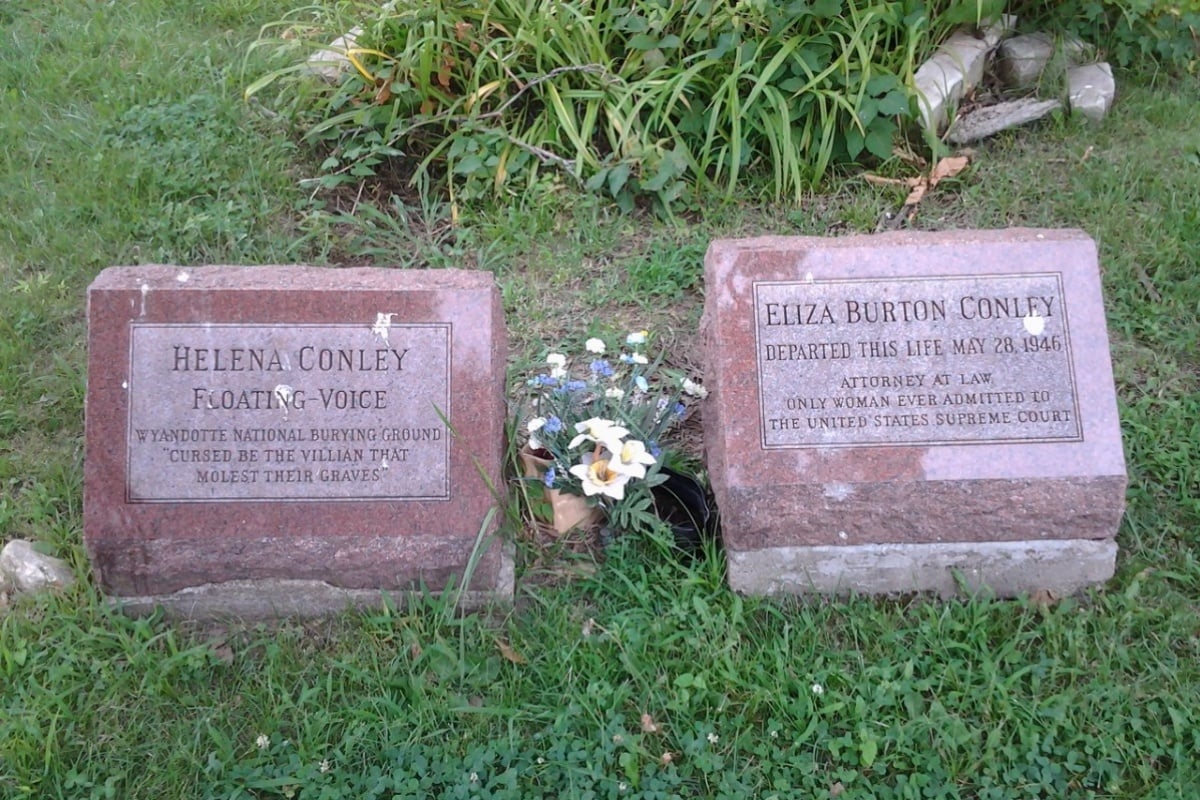
Three sisters once lived in a 6-by-8-foot shack behind a padlocked gate in downtown Kansas City, Kansas, guarding their family's burial ground with a shotgun that was never actually loaded. Congress had approved selling the cemetery where their relatives were buried, and Lyda, Helena and Ida Conley were not going to let that happen without a fight.
The Wyandot cemetery holds the remains of as many as 600 Wyandots, according to Axios. The tribe was forced from Ohio and Michigan to Kansas, arriving in 1843 after the Delaware tribe gave them land for a burial ground, Axios reports. Nearly 100 Wyandots died within the first year, as measles and other illnesses spread through the group, according to the same report. That grim founding is also documented by KCUR, which describes the hill near the confluence of the Missouri and Kansas rivers and recounts illness and flooding during the group's arrival.
Part of the Wyandot tribe later moved to what is now Oklahoma, and a land surveyor secured the cemetery's sale in federal law for that Oklahoma Wyandot group, per Axios. Lyda Conley, who grew up in Kansas City, Kansas with family buried in the cemetery, earned a law degree in 1902 and sued the government over the planned sale, arguing the government had promised the Wyandot the land forever. That argument traced back to an 1855 treaty that stipulated the enclosed public burying ground in Kansas City, Kansas shall be permanently reserved and appropriated as a cemetery, according to the Wyandot Nation of Kansas.
A Padlocked Gate and an Unloaded Shotgun
While the legal case moved slowly, the sisters took matters into their own hands. They padlocked the cemetery gates, hung a trespassers beware sign, and occupied their small shack on the grounds for years, guarding the graves with a shotgun, the Axios report states. Wyandot Nation of Kansas Chief Judith Manthe, who is related to the Conley sisters as a first cousin three times removed, said the gun was never loaded and the sisters bluffed people with it to keep the grounds safe.
Police jailed the sisters at one point, and Lyda Conley chose 10 days behind bars rather than pay a $10 fine, according to the same report. Manthe has described burial grounds as the most sacred thing because they preserve remembrance, a sentiment that frames why the sisters were willing to risk arrest to protect the site.
A Historic, Losing Supreme Court Case
Lyda Conley eventually argued her own case before the U.S. Supreme Court in 1910, becoming the first Native American woman to argue before the nation's highest court. The Supreme Court Historical Society recounts her argument before the justices. She appeared pro se, without a Supreme Court bar sponsor, after she was unable to find a lawyer to vouch for her admission to the Supreme Court bar.
She lost. In the unanimous January 31, 1910 ruling in Conley v. Ballinger, Justice Oliver Wendell Holmes Jr. held that Conley lacked standing, finding that the 1855 treaty did not legally oblige the federal government to protect the cemetery, per the Supreme Court Historical Society. Holmes noted in his opinion that the court had examined Conley's arguments with great care even as it ruled against her.
The courtroom defeat did not end the fight. Congress repealed the cemetery sale in 1913, and Kansas Senator Charles Curtis — a member of the Kaw Nation who later became vice president — sponsored 1916 federal legislation protecting the cemetery from commercial sale and setting aside $10,000 to maintain it, according to the National Women's History Museum.
The Threats Did Not Stop There
Even with federal protection on the books, the cemetery faced more pressure in the decades that followed. Congress authorized another attempt to sell the cemetery in 1956, but protests stopped that sale, Axios reports. Decades later, the Wyandotte Nation threatened to build a casino over the cemetery, prompting the Kansas and Oklahoma Wyandot groups to reach a 1998 agreement that the cemetery cannot be used for anything else, according to the Wyandot Nation of Kansas. That settlement ended earlier proposals for a gaming facility on the site, and the U.S. Department of the Interior later designated the cemetery, also known as the Eliza Burton Conley Burial Site, as a National Historic Landmark on December 23, 2016, according to the WikiTree record of the site.
Lyda Conley was killed during a robbery in 1946. Her sister Helena, who gave an interview in the 1950s that the Wyandotte County Museum later found, told the interviewer that nobody would remember the sisters, per Axios.
Keeping the Conley Sisters' Story Alive
That prediction has not held up. The University of Missouri-Kansas City's Starr Women's Hall of Fame inducted Lyda Conley into its Class of 2025 during an anniversary ceremony at the Kauffman Center for the Performing Arts on February 20, 2025, according to UMKC.
A traveling public art installation called Fort Conley, a portable replica of the sisters' shack, has visited sites around the Kansas City metro since debuting at the Wyandotte County Historical Museum in August 2025, according to Axios. The piece, co-created by Monumenta and the Wyandot Nation of Kansas, moved to Johnson County Community College's Nerman Museum, where Chief Manthe has visited Helena Conley's grave during a cemetery tour, per the same report.
Kansas City PBS will premiere a new documentary, Lyda: Wyandot Warrior, produced by Mid-America Emmy winner Emily Woodring in collaboration with Chief Manthe. The film incorporates historical photographs and documents curated alongside the Wyandotte County Historical Museum, according to Kansas City PBS.
U.S. Sen Roger Marshall pauses during the debate at the Kansas State Fair in Hutchinson on Sept. 12. (Photo by Jill Hummels for Kansas Reflector)
Visualize a clenched fist, fingers tight and knuckles braced, pulled back to strike.
Visualize that fist taking an unexpected turn, avoiding an opponent and instead circling back to slam into its owner’s face. I won’t describe the sights and sounds that follow, just know that the fighter for some unholy reason keeps clenching that fist and striking his own face, over and over and over.
Fresh attacks on his Democratic rival. the Rev. Adam Hamilton of Leawood, misfired after a New York Post story turned out to rehash Kansas Reflector reporting from months ago about abuse at a church camp. Don’t believe me? Look here and here for our coverage from May and July.
The Post even cited our reporting four times in that single article! Marshall’s staffers — and their out-of-state financiers — planned a juicy smear campaign against their opponent. I understand. But reanimating allegations that were extensively covered by local news media sure smells like desperation.
That wasn’t the end of the embarrassment. A Marshall ad about the allegations had to be revised after including footage from other Kansas camps. Visuals showing Linwood’s Tall Oaks Camp and Conference Center, along with Lacygne’s Valley Cabins, illustrated the attack.
Whoops! A little slip-up there.
Actually not so little, given that actual Tall Oaks campers appeared in the ad. I’m sure they won’t face any scrutiny or humiliation after being used as political props. You could describe Marshall’s campaign in many ways after this episode — just don’t use the words “careful,” “attentive to detail,” or “grounded in reality.”
Finally, Marshall himself felt the need to inflict damage on his efforts to secure another six years in Washington, D.C.
In an “exclusive” with the Washington Examiner — the favorite news source of at least two or three Kansans — Marshall proclaimed that Hamilton ““lives in a bubble. Johnson County is one of the wealthiest counties in the country.”
Wait, did I read that correctly?
Roger Marshall decided to badmouth the most populous county in Kansas? I would hope someone in the campaign explains to Marshall that you need more voters to cast their ballots for you than your opponent to win elections. It’s a fairly fundamental fact!
I understand that the incumbent wants to underscore his rural roots, but surely you could do that without insulting a huge swath of Kansans. Also, what’s wrong with being rich? Wasn’t Marshall building his wealth when he sued more than 700 patients? I’m reliably informed by the good doctor’s fans on social media that he deserved payment for his work.
Don’t Johnson County doctors and lawyers and dentists deserve the same opportunities?
We’ve watched Marshall’s team follow this dismal playbook before. Back in May 2025, his chief of staff Brent Robertson ridiculed residents who showed up for a feisty town hall: “Real Kansans overwhelmingly support President Trump’s DOGE initiative, shrinking the size of the federal government, and firing career bureaucrats. Local Oakley citizens had no clue who these people were and were embarrassed by the behavior.”
Note that term: “real Kansans.” Marshall has followed the example of his employee and divided the people of this great state into the deserving and undeserving, the virtuous and the sinful, the rural and the urban.
Division didn’t work out for him 19 months ago. I’m not sure why he thinks it will now.
Roger Marshall just cant stop walloping himself in the face.
Clay Wirestone is Kansas Reflector opinion editor. His first book, “Opinionated: Kansas Journalists Who Proved Why Commentary Matters — Then and Now,” was published in September 2026 by the University Press of Kansas. Through its opinion section, Kansas Reflector works to amplify the voices of people who are affected by public policies or excluded from public debate. Find information, including how to submit your own commentary, here.
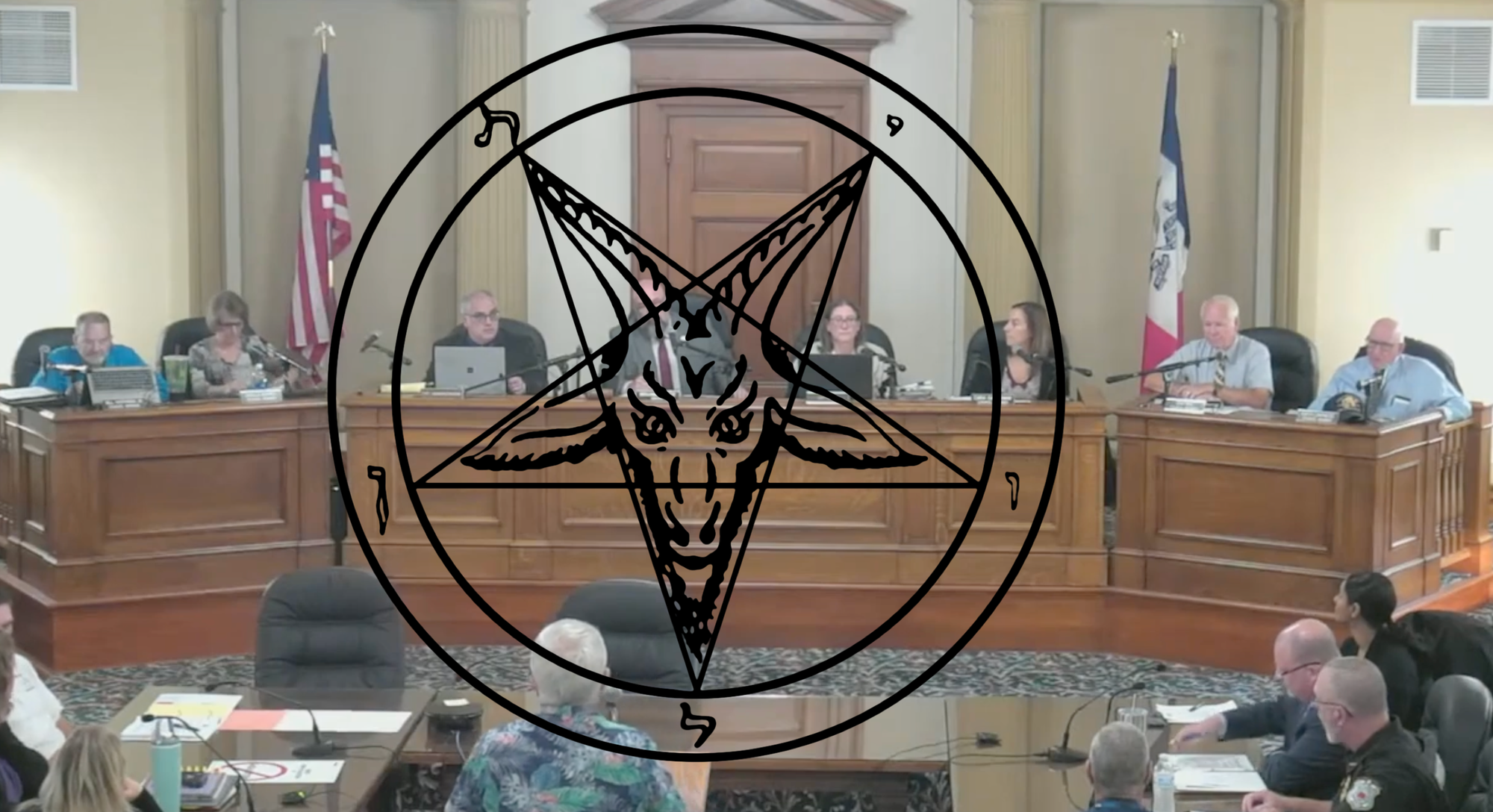
An Iowa man has kicked off controversy over religious freedom in the small town of Ottumwa, Iowa by opening a city council meeting with a prayer to Satan, which then kicked off a debate about the proper time in the meeting agenda to undo the “curse.”
On Tuesday night, Ottumwa resident, satanist, and former city council member Matt Dalbey took the podium to read an invocation to start a routine meeting of the council. “Thank you mayor, council. Let us pray,” Dalbey started. “Dear dark father, let us stand now unbowed and unfettered by arcane doctrines born of fearful minds and darkened times. Let us embrace the Luciferan impulse to eat off the tree of knowledge and dissipate our blissful and comforting delusions of old.”
The prayer is a common one used by the Satanic Temple of Iowa. “Let us demand that individuals be judged for their concrete actions, not for their fealty to arbitrary social norms and illusory categorizations,” he continued. “Let us reason our solutions with agnosticism in all things, holding fast only to that which is demonstrably true. Let us stand firm against any and all arbitrary authority that threatens the personal sovereignty of one or all. That which will not bend must break. And that which can be destroyed by truth should never be spared its demise.”“It is done. Hail Satan,” he finished.
Another citizen, a pastor named Rick Bick, rushed to the podium. “Let’s just reverse that curse that was just put on our city,” he said. “That ending with hail Satan and hail dark god. That’s not welcome here.”
“Mayor, that should be done at the end,” city councilor Cara Galloway said.
“It needs to be done now, OK.” Rick said. “I appreciate what Ms. Galloway is saying but that was a curse put on our city when he said ‘Hail Satan’ and the dark god and most of you know that. And we need to just stop and reverse it.”
“So what I’m gonna do now…I’m just gonna invite us into a 30 second time of prayer — time of silence.”
“No,” Galloway said. “We are at the consent agenda. I’m sorry, but it’s time to move forward. The invocation happened.”
“As mayor of this city…I’m going to ask right now that we do a moment of silence to reflect on whatever it is we need to reflect on at this time. And then we will move to the consent agenda,” mayor Benjamin Foote said.
Galloway spent the moment of silence with her head up and her arms crossed. An hour later, she spoke up. “Opening with an invocation means allowing viewpoints that may not reflect our own and responding to someone’s invocation is a slippery slope to putting a financial liability on the taxpayers and allowing others to object or respond. This is exactly why I had concerns about having an invocation when we first talked about it.”
Dalbey told 404 Media he was a sincere member of the Temple of Satan but stressed it’s “an organization of nontheists, people who don’t believe in any deities or supernatural beings.”
He served on the city council for eight years and has largely stayed out of local politics since leaving the council in 2021. But when the city council passed a new rule earlier this year that allowed city council meetings to start with religious invocations, he decided to do something. “I’m a constitutionalist,” he said. “And when I see this, the implication I got was that we were again starting to mix religion into the government.”
At the Tuesday night council meeting, the audience stood up to recite the Pledge of Allegiance the moment Dalbey finished.
Ottumwa has only been reading invocations at its meeting for a short time. The city council passed a resolution allowing the practice on January 20. Galloway was the only person on the council who voted against it. At the time, she said Satanists might show up and read a prayer and that everyone would have to be OK with that. Readers of 404 Media may remember Ottumwa, Iowa because it is the place we aired our Super Bowl commercial.
Anyone who wants to show up to read an invocation before a city council meeting needs to fill out an electronic form. The form asks applicants to list an organization they represent, but allows people to say “none.” Dalbey has signed up to read invocations three times this year. He’s listed as representing “none” each time on the schedule. He was supposed to read a prayer on September 1, but couldn’t make the meeting because of his work. He’s on the schedule to read an invocation on November 3rd. “I plan on being there in November, absolutely,” he said.
Dalbey said he’d be happy to see the invocation policy rescinded. “When I was on the council [...] we were approached several times about doing an invocation, and the very reason that we didn't was because our attorney had warned us that when you do, you open the door to any and all people who want to present. That's the law,” he said.
The invocation to Satan in a small town in Iowa is just the latest salvo in a 10-year-long battle over religious freedom of expression in the state. In 2016, a religious liberty group installed a Christian nativity scene at the state capitol in Des Moines. Later that year a group of atheists installed its own nativity scene honoring the Bill of Rights. In 2023, The Satanic Temple put up a pentagram built from red ribbon and topped with a mirror-mask ram’s head that invoked Baphomet in the capitol rotunda. The group also began holding winter celebrations in the Rotunda. A man vandalized the display, police arrested him and charged him with a hate crime.
In 2024 — the same year Governor Kim Reynolds signed a state law meant to protect religious freedom — officials blocked Satanists from holding their winter celebration. The ACLU filed a Freedom of Information Act request looking for records about the incident and, earlier this year, sued Iowa on behalf of the Satanic Temple for violating federal free speech laws.
“I think we're seeing you know a big shift in our politics. I think we've seen a rise of Christian nationalism in this country [...] and I think it's trying to grasp and get a hold of controlling our politics, our laws and our government, and I find that highly troubling,” Dalbey said. “And I think anytime we let any religion dominate our politics, we revert right back to where we were 250 years plus ago: a monarchy where the church ruled the country, and that was bad for everybody. That's one of the reasons our founding fathers decided to form a new nation. And I think if we are not careful, you know, we're going to slide right back into that scenario.”
Major media companies insist they simply have to merge to create all manner of amazing new “consolidative synergies.” The debt from the acquisitions then result in brand and company cannibalization as labor and consumers are forced to carry the load. The net result is mass layoffs, higher prices, and shittier products from corner cutting. Typical enshittification.
It used to be that after a major acquisition, executives would spend six months to a year at least pretending there were no labor downsides to consolidation. Now they don’t even bother.
“Integrating two companies will bring change, including difficult decisions that affect our workforce,” the execs wrote in the memo, a copy of which was obtained by Variety. “We are committed to handling this process thoughtfully and respectfully.”
The mass firings are, employees are told, part of “building a culture” where people feel “supported” and “empowered:”
“We must never lose sight of what matters most: our people. We will build a culture where people feel respected, empowered, supported and proud of the work they do.”
It’s important to recall that Skydance was first created years ago by Larry Ellison as an avenue that would allow his son David to pretend he was an actor. Like most extraction-class brunchlords, David has just failed upward ever since, to the point where he’s now in charge of most of Hollywood’s biggest studios.
Paramount execs say they’re aiming to create more than $6 billion in annualized cost savings over three years, most of which will come from layoffs (despite claims to the contrary by deal architect and RedBird Capital Partners boss Gerry Cardinale). Recall that when AT&T bungled its dual, doomed acquisitions of DirecTV and Time Warner, more than 50,000 employees ultimately lost their jobs.
This comes after numerous rounds of layoffs caused by the previous merger between Paramount and Skydance. Further layoffs will come next year as bumbling Paramount execs struggle to adapt to shifting demand across traditional film and television. We know this because this is literally what happens every single time major media companies (especially Warner Brothers) pursue “growth for growth’s sake” consolidation.
The risks here are so bad, even normally pro-consolidation and pseudo-growth obsessed Wall Street is getting cold feet about how this all ends:
“TD Cowen analyst Doug Creutz wrote in a note Wednesday that investors should hold their shares of Skydance as the firm remained “quite cautious on the ability of the company and its management to avoid integration and execution problems that have bedeviled other major media mergers.”
“The risks (leverage, integration) of the combination with WBD are high; we remain skeptical that SKYD management will be able to create value from this deal when so many other major media deals have failed,” the note read.”
And again, this could have been potentially prevented if California Democrats like Gavin Newsom, Karen Bass, and gubernatorial nominee Xavier Becerra hadn’t pressured state AGs to settle their antitrust lawsuit against the company. What’s worse is they couldn’t even be bothered to affix meaningful conditions to the deal; most were simply empty gestures Paramount suggested itself.
 Log in