Live Nation-Ticketmaster isan illegal monopolist, a Manhattan jury found, according to Bloomberg. The jury found the company liable on three counts: illegally monopolizing the market for live event ticketing, amphitheaters, and tying its concert promotions business with the use of its venues, Bloomberg reported.
The verdict, reached after several days of deliberation, leaves the live entertainment giant open to a potential breakup - which was the stated goal of the lawsuit back when it was filed by the Biden administration's Department of Justice. Such an outcome would go far beyond the settlement that the Trump administration's DOJ reache …
You know who else wanted to construct gaudy buildings in his own image? Here’s Timothy Ryback on Adolf Hitler’s obsession “with adding an expensive new wing to the Reich chancellery”.
The new annex, connected to the chancellery by a marble corridor hung with crystal chandeliers, was part of Hitler’s ambitious plans to align the Berlin cityscape with his vision for the future of the country. Hitler wanted a Triumphbogen, a triumphal arch, twice the size of the Arc de Triomphe in Paris. He wanted an “Avenue of Splendor” for military parades. “The Champs-Élysées is a hundred meters wide,” Hitler told Speer. “We will make our avenue twenty meters wider.” A planned Volkshalle was to accommodate 180,000. The Eiffel Tower could fit beneath its cupola. This “Hall of the People” was to be topped by the largest swastika on Earth. Berlin itself was to be rechristened as Weltstadt Germania, “Capital of the World.”
Ryback is the author of several books on Hitler and the Nazis, including his forthcoming 53 Days: How Hitler Dismantled a Democracy, which sounds like a must-read to me.
Spring always feels like a reset in the kitchen. It’s also the season when fresh vegetables really start calling my name again, especially asparagus, which is one of my favorite signs spring has officially arrived. When asparagus is in season, you get better flavor, better texture, and better prices, which is a win all around for budget minded cooking. That seasonal sweet spot is exactly where this Creamy Asparagus Chicken lives! It’s a one-pan meal that stretches two chicken breasts into four satisfying servings, with a silky pan sauce, garlic, lemon, and tender asparagus that tastes more special than the price tag suggests!
Creamy Chicken with Asparagus
This single skillet recipe is inspired by our reader-favorite creamy garlic chicken. I’ve scaled back the garlic a little (but only a little! I love a creamy garlicky sauce) and added in-season asparagus for a springy twist. The chicken gets a light flour coating and a quick pan-sear, which helps build flavor and gives the broth, cream, butter, dried herbs, and lemon something to cling to. I like to let the sauce reduce a bit for a luscious texture before adding the chicken back to the pan, then I cook the asparagus just until it’s bright green and crisp-tender.
This creamy asparagus chicken is deliciously lemony and herb-kissed, but most importantly, it disappears fast. My husband and daughter absolutely gobbled this asparagus chicken up and genuinely licked their plates, which is always the highest compliment in our house!
Recipe Success Tips
Prep before you start cooking. This creamy asparagus chicken recipe moves quickly once the chicken hits the skillet. I like to have the asparagus cut, garlic crushed, lemon ready, and sauce ingredients measured before I begin. It makes the whole recipe much easier to manage!
Don’t skip the flour. The light coating helps the chicken turn golden in the pan, and the little bit of flour left behind also helps the sauce slightly thicken later.
Use heavy cream for the smoothest sauce. Heavy cream has a higher fat content than milk, so it’s much less likely to curdle in a hot skillet sauce. Half-and-half can work, too, but the sauce will be a little thinner.
Bring the cream to room temperature first. Cold dairy hitting a hot pan is more likely to separate. I recommend letting the cream warm up a bit at room temperature before using it to keep the sauce silky.
Crushed garlic works better here than minced. Crushed garlic gently infuses the butter and sauce instead of hitting you with a sharper minced-garlic bite. It also won’t burn as quickly as minced garlic, so we can simmer it in the butter for longer. Peel the garlic cloves and then crush them with the bottom of a glass/cup or carefully with the side of your knife.
Keep the sauce at a gentle simmer. High heat can make creamy sauces split, so once the broth and cream go in, lower the heat and let it bubble gently instead of boiling.
1bunchasparaguscut into 1-2 inch pieces, (about 1lb.) $3.50***
1lemon$0.80
Instructions
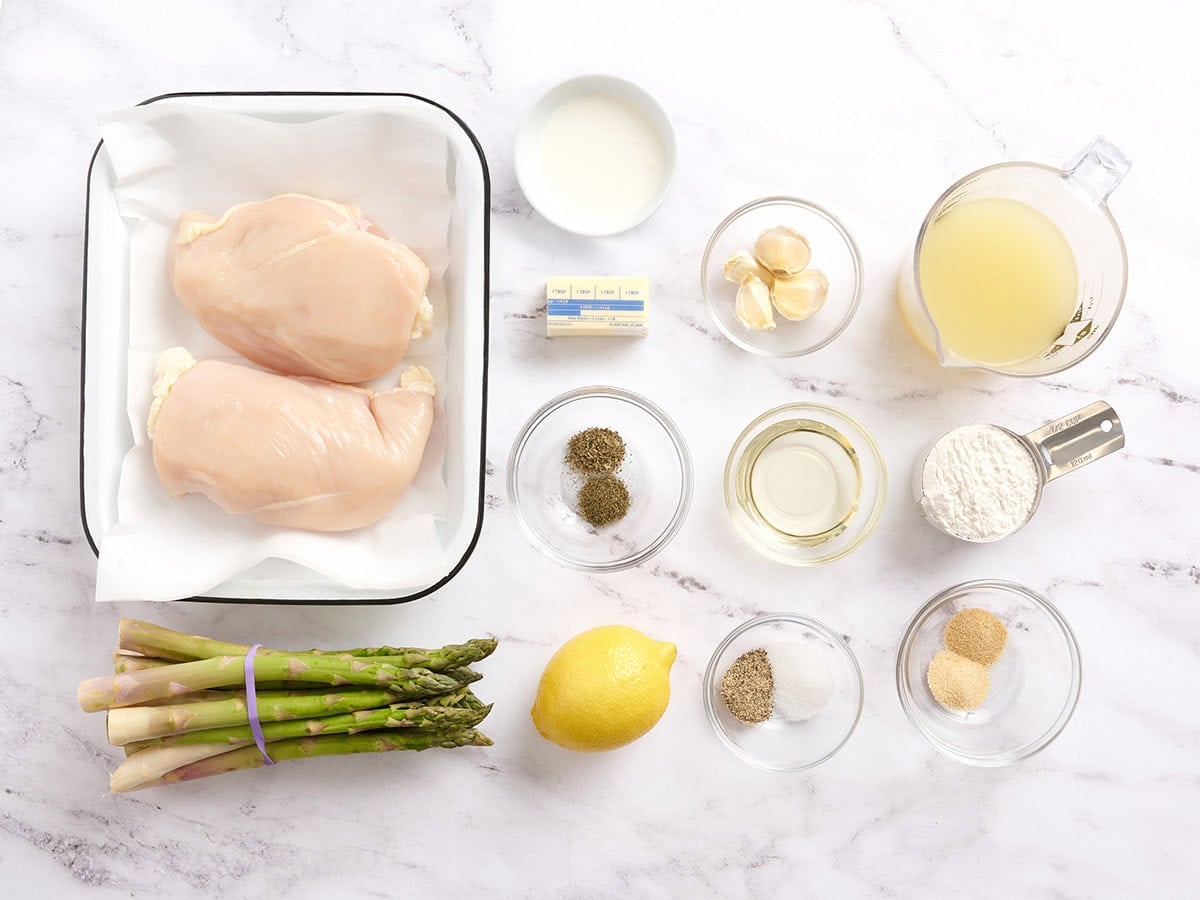
Gather your ingredients.
Prepare fresh ingredients: crush garlic cloves, seed and slice lemons, and cut asparagus. I like to cut them into 1-2” pieces so they still hold their own in the sauce and don’t cook too fast.
Filet 2 chicken breasts in half so you have 4 portions.
Salt and pepper the chicken breasts and then dip them in the flour until they are completely covered.
Place a large skillet or sauté pan over medium high heat. Add 2 Tbsp vegetable oil and 2 Tbsp salted butter.
Once hot, sear breasts for 4 minutes on each side until golden brown. Flip and sear the next side for another 4 minutes.
Once the internal temperature of the chicken reaches 165℉, remove the breasts from pan and turn the heat down to medium.
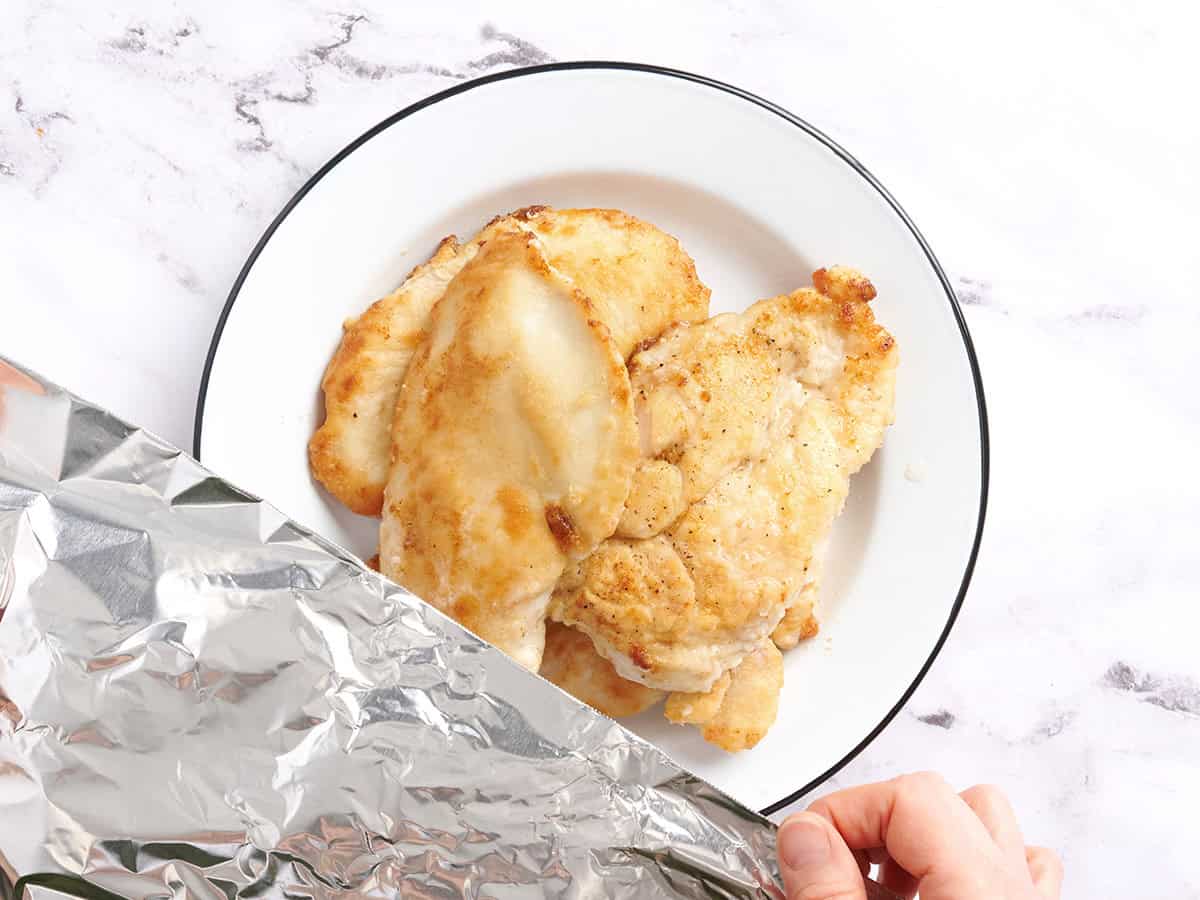
Cover with tinfoil and set aside.
Add 2 Tbsp butter to the pan with smashed garlic cloves. Cook until golden and fragrant, about 2-3 minutes.
Turn the heat down to medium-low. Mix room temperature heavy cream with chicken broth and pour into the sauté pan, whisking up any bits of chicken and garlic stuck on the bottom of the pan.
Bring the sauce to a simmer and add dill, garlic powder, onion powder, and dried basil. Whisk it again and let it reduce by ¼, giving it a stir every few minutes. I simmered my sauce for about 8 minutes.
Add the chicken back to the pan with the quartered asparagus. Let it simmer covered for 8 minutes. This will steam the asparagus and help the chicken heat back up.
Spoon the sauce over the chicken and veggies and finish with a squeeze of fresh lemon juice. Adjust salt and pepper to your liking.
*Slicing two chicken breasts in half helps stretch this recipe into four servings! Try to slice them evenly so they cook at the same rate. You can also swap in boneless chicken thighs (don’t slice these in half as they’re already pretty thin. You’ll need four boneless thighs for four servings). Make sure the internal temp of your chicken reaches 165℉.**I like to use Better than Bouillon to make my broths. It’s low-cost, easy to store, and one pot lasts forever in the fridge!***Choose asparagus that feels firm and looks bright green for the best flavor. In the U.S., asparagus season usually runs from late February-June, with April being one of the peak months. I like to trim off the woody ends and discard them so the spears cook through evenly.
how to make Creamy Asparagus Chicken step-by-step photos
Gather all of your ingredients.
Prep the fresh ingredients: Smash 4 garlic cloves using the bottom of a cup or the side of your knife (carefully!). Slice or wedge 1 lemon and remove any seeds. Now cut 1 bunch asparagus into 1-2-inch pieces. Be sure to remove the woody ends and discard them. I like keeping the asparagus pieces a little bigger so they stay tender-crisp and don’t disappear into the sauce.
Slice the chicken: Carefully filet 2 chicken breasts in half lengthwise so you have 4 thinner cutlets. Try to cut them as evenly as possible. This helps them cook faster and more evenly in the skillet.
Coat the chicken: Season both sides of the chicken with 1 tsp salt and 1 tsp black pepper, then pour ¼ cup all-purpose flour into a shallow dish and dredge each piece of chicken in the flour until fully coated. Shake off any excess so the flour layer stays light and doesn’t get gummy in the pan.
Pan fry the chicken: Set a large skillet or sauté pan over medium-high heat. Add 2 Tbsp vegetable oil and 2 Tbsp salted butter.
Once the butter is melted and the pan is hot, add the chicken.
Sear the chicken for about 4 minutes per side, or until each piece is golden brown with crisp edges. If the flour starts browning too quickly, lower the heat slightly so the outside doesn’t darken too much before the inside is cooked through.
Once cooked, the chicken should reach 165°F internally on an instant-read thermometer.
Transfer the chicken to a plate and loosely cover with foil to keep it warm while you make the sauce.
Make the creamy sauce: Reduce the heat to medium and add the remaining 2 Tbsp salted butter along with the smashed garlic cloves. Cook for 2-3 minutes, stirring often, until the garlic is fragrant and lightly golden.
In a small bowl or measuring cup, stir together ¼ cup room temperature heavy cream and 1 cup chicken broth. Lower the heat to medium-low, then pour the mixture into the skillet while whisking to loosen all the flavorful browned bits from the bottom of the pan.
Season the sauce: Add ¼ tsp dried dill, ½ tsp garlic powder, ½ tsp onion powder, and ¼ tsp dried basil. Whisk until the sauce looks smooth, then bring it to a gentle simmer. Let it cook for about 8 minutes, stirring every couple of minutes, until it reduces by a quarter and looks a little silkier.
Add the chicken and asparagus: Return the chicken to the pan and scatter in the chopped asparagus. Cover with a lid and let everything simmer for about 8 minutes more. The asparagus should turn bright green and become just tender, while the chicken warms back through.
Once the asparagus is tender and chicken warmed, spoon some sauce over the top.
Serve: Finish with a generous squeeze of fresh lemon juice from the prepared lemon. Taste the sauce and adjust with more salt and pepper if needed. Spoon the creamy asparagus sauce over the chicken before serving and enjoy!
Serving Suggestions
This creamy asparagus chicken is perfect with a starch on the side to make it feel even more satisfying. Instant Pot mashed potatoes are great when I want something easy, roast potatoes add a crisp bite, and pasta turns it into a super cozy dinner. Penne, angel hair, spaghetti, or orzo are my top picks. I also love making our homemade potato gnocchi, which would be perfect with this chicken for a date night on a budget. Our mushroom rice is another delicious option that fits right in with the creamy sauce.
Storage & Reheating
Store leftover chicken and asparagus in an airtight container in the fridge for up to 3-4 days. Reheat in the microwave or gently on the stovetop until warmed through, adding a splash of room temp cream or broth if you want to loosen the sauce a little. I don’t recommend freezing this one since creamy sauces can separate after thawing.
Try These Creamy Chicken Breast Recipes Next:
Our Creamy Mushroom Chicken turns simple chicken breasts into a cozy skillet dinner with a garlicky mushroom sauce and a crunchy onion finish.
My family loves this Creamy Garlic Chicken! The tender pan-seared chicken and rich garlic cream sauce are hard to resist.
This Creamy Dijon Chicken is tangy, savory, and loaded with flavor, with spinach stirred in for an easy pop of color and greens.
My take on the viral Marry Me Chicken combines golden chicken breasts with a creamy sun-dried tomato sauce!
San Francisco police have arrested a 20-year-old man suspected of throwing a Molotov cocktail at OpenAI CEO Sam Altman's Russian Hill house early Friday morning, The San Francisco Standard reports. The incident was caught on surveillance cameras shortly before 7AM ET. Later that morning, someone matching the suspect's description was seen making threats outside OpenAI's Mission Bay offices, where he was arrested around 9AM ET.
OpenAI spokesperson Jamie Radice confirmed the incident in a statement to The Verge, saying, "Thankfully, no one was hurt. We deeply appreciate how quickly SFPD responded and the support from the city in helping keep …
Farmers won their right-to-repair fight against John Deere. The settlement includes a 10-year “agreement by Deere to provide ‘the digital tools required for the maintenance, diagnosis, and repair’ of tractors, combines, and other machinery”.
When Lloyd Gaines, a Black man, won a Supreme Court case in 1938 for admission to the law school, Missouri did not admit him. It created a separate law school instead. When Lucile Bluford won a similar case for the journalism school, the university shut down its entire graduate journalism program rather than let a Black woman attend.
When Gus T. Ridgel finally became the first Black student admitted, in 1950, no white student would room with him and every social space on campus was whites-only. The university’s only preparation, according to a memo uncovered in its own archives, was to search for someone on campus who could serve as a support system when the inevitable discrimination came. Not to prevent the discrimination. To find someone Ridgel could cry to.
This is the University of Missouri. It has always been the University of Missouri.
In 2022, Meg Miller, president of Mizzou’s chapter of Turning Point USA, posted a smiling selfie on Snapchat after three Black University of Virginia football players, Lavel Davis Jr., D’Sean Perry, and Devin Chandler, were shot and killed by a fellow student. Her caption: “If they would have killed 4 more n*ggers we would have had the whole week off.”
The Kansas City Defender broke the story. Students demanded her expulsion. The university refused to discipline her, with President Mun Choi citing First Amendment protections for speech at a public university. Ta-Nehisi Coates later cited the reporting in Vanity Fair as evidence of the white supremacist culture cultivated on campuses nationwide.
So it should surprise no one that on Friday, April 3, 2026, the Division of Student Affairs moved to finish the job. With less than 24 hours’ notice, administrators summoned the leaders of five multicultural umbrella organizations and informed them that all designated funding would be eliminated effective July.
Three days later, more than a thousand students showed up.
But first: what happened in that room.
The affected groups: the Asian American Association, the Association of Latin American Students, the Queer Liberation Front, the Legion of Black Collegians, and FourFront, a coalition of marginalized student groups.
LBC is the first and only Black student government at any American university. It was established in 1968, the year Martin Luther King Jr. was assassinated, by Black students who were tired of hearing “Dixie” played at their football games and seeing Confederate flags on their campus. For 57 years, it has been the political voice, the cultural home, and the institutional lifeline for Black students at a university built with slave money on a slaveholder’s land.
Its budget this year was approximately $63,000. Next year, it will be effectively zero.
LBC President Maya Morgan, a junior who double-majors in documentary journalism and medical studies, stood at the front of the room and spoke through tears. She described arriving at Mizzou as a Black woman and feeling invisible. “I first came here, walked on campus, and seen so many white faces, and seen no one that looks like me. It hurt my heart,” Morgan told the auditorium. She described what LBC gave her. The friends. The mentors. The older students who modeled what was possible. “That’s why I’m president. That’s why I fight so hard. Because I love Black Mizzou.”
LBC President Amaya Morgan (Left), LBC Vice President Desmond Jones (Right)
Then she turned the grief into a question the university has never been willing to answer: “What are the kids who look like me going to do for the future? How are they going to find community here?”
Its status as a student government, the designation that guaranteed it a seat in conversations with administrators, curators, and university leadership for over half a century, will be eliminated. It will be reclassified as a Recognized Student Organization, the same designation held by the 600-plus clubs on campus, and eligible to apply for up to $3,000 a year from a shared pool. The cap per event: $1,500. The oldest Black student government in America will now hold the same institutional status as the Mizzou Pickleball Club.
The reason cited was a Department of Justice memo that labeled common campus DEI practices, including identity-based spaces open to all students, as potential civil rights violations. The memo was guidance. It was not law. It was not binding. It carried no enforcement mechanism. As ALAS stated: “It is important that we distinguish that a memo is not a federal law, thus this decision was at the hands of the University and the University alone.”
Asher McFerran of the Queer Liberation Front put it more bluntly in an interview with The Defender: “The university immediately complied with it when they did not have to, and has thus taken away our funding because they chose to submit to the fear of having the rest of their other funding taken away. And they do not care if we get hurt.”
The University of Missouri did not have to comply. It simply chose to.
When the university finally responded publicly, it was not by email to the affected organizations. It was by commenting on their Instagram posts, where it misspelled “Legion” as “Legian” and announced it could no longer “allocate funding or space based on protected demographic characteristics.”
The same university that found constitutional protection for a white student leader joking about the murder of Black people found no such protection for the funding of the oldest Black student government in American history.
The Killshot: Inside the Defunding of Mizzou’s Black & Multi-cultural Student Organizations
The five organizations being gutted are not social clubs. LBC alone oversees roughly a dozen sub-organizations. ALAS serves eight. Together, they support more than 40 student groups and serve as the first point of contact for every incoming student of color at a predominantly white institution that has never demonstrated a sustained interest in doing that work itself.
LBC Vice President Desmond Jones told The Defender what the meeting on April 3 looked like. The leaders were called in to meet with Vice Chancellor of Student Affairs Angela King Taylor and other administrators. Not all advisors had been informed. Not all representatives were present.
“There will be three groupings,” Jones told The Defender. “Recognized student organizations, sponsored student organizations, and university programs. And we would be required, if we want LBC to still exist, to register as an RSO.” The budgetary impact was total. “For it to go from something like $60,000 to zero is essentially killing the organization. Honestly, you can’t operate at all with that budget.”
Jones described what vanishes with governmental status. “Things like us having an office, having direct access to administrators, all that kind of goes away,” he said. “We no longer have a storage room to keep things for events that we typically use, or have a place to meet with our members. That all just dissipates with the new changes.”
The organizations were given almost no time to process the decision, let alone respond. McFerran described the abruptness: “The initial email requested that the meeting happen next week, and then the follow-up was actually, cancel that, we have to have it tomorrow.” Trinity, the executive director of FourFront, was not even in the meeting and learned about the reclassification through a phone call from a friend the morning of the town hall. The university’s initial deadline for new paperwork was April 10, seven days later. When students protested, it was extended to April 27.
McFerran captured the dynamic precisely. “It feels like a challenge that they expect us to lose,” McFerran told The Defender. “That they wish that we would just kind of quietly accept it and not make a fuss about being erased.”
A Thousand Strong: Students Pack the Room
The students did not quietly accept their fate.
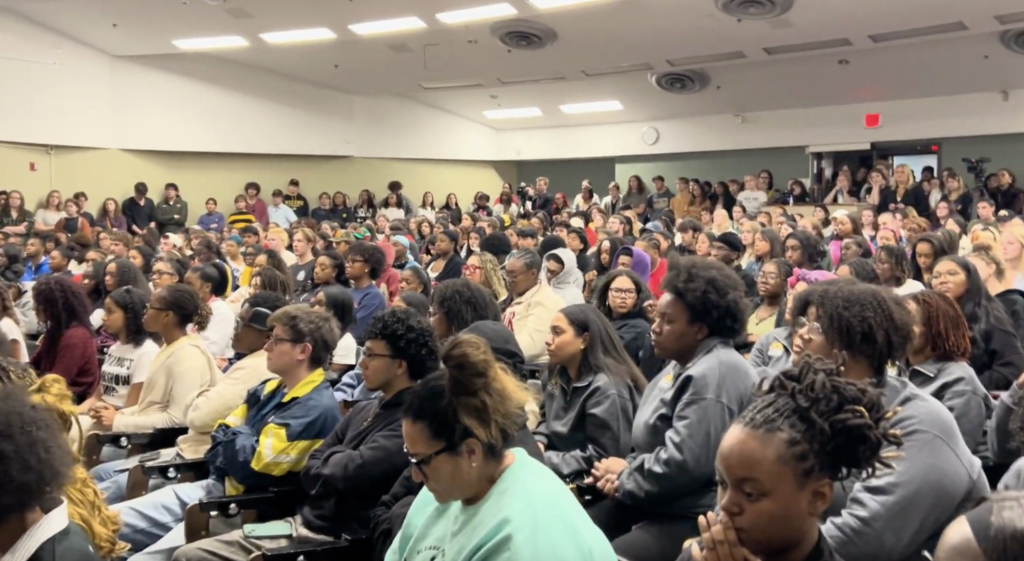
On Monday night, three days after the announcement, the auditorium in Schlundt Hall was overflowing. Students lined the walls, sat in the aisles, crowded into the doorframe. Overflow classrooms filled across campus. More than a thousand people watched a livestream. As McFerran told The Defender: “We reached the legal capacity for the auditorium we were in. Classrooms were filled with students watching a live stream. I believe one of them had at least 1,000 people watching.”
The students played a recording from the April 3 meeting with the administration. In it, Vice Chancellor Angela King Taylor could not give a straight answer about whether funding was going to zero. Morgan had to ask explicitly. The administrator deflected. “If Maya didn’t explicitly ask, ‘We will have no money, correct,’ she was not going to give us that straight answer,” one student leader told the crowd. “She was very much avoiding the question.”
A student from the Bronx described the culture shock of arriving at a campus where nobody in her dorm looked like her or understood her. She described filling out her transfer papers. She described never submitting them because of the community she found through these organizations. “My transfer papers were filled out. I just never pressed submit because of my community.”
A student who started a nursing organization for Black students under LBC’s umbrella, because nobody in the nursing school looked like her, described learning about the defunding through a phone call while sitting in class. She had not been included in any email from the administration. “The fact that I woke up this morning and had a phone call from somebody else, that’s not on the board, is bull crap,” she said.
When someone suggested the organizations charge membership fees to replace the lost funding, a student leader shut it down. “We’re already lucky enough to be here and most definitely lucky enough to be here on scholarships. I’m not going to sit here and ask minority students to give us money to be in spaces that they deserve to be in.”
When the students pointed out that the university found time over the weekend to post defensive Instagram comments, misspelling their name in the process, but could not send them a single follow-up email with actual information, the room erupted.
“You came to us with no solutions,” one student leader said directly into the microphone. “You basically told us we’re cutting your funding, you’re no longer a student government, figure that out. But you have no solutions.”
McFerran told The Defender about the appetite for resistance. “There is a healthy amount of fear. I personally hold some, if not for myself, if just for the people I love on this campus,” McFerran said. “But I feel like last night at the meeting, we got to see a lot of how much the student body also agrees with our anger and our unwillingness to back down. A lot of people really agree with our message and want to resist and find ways to fight the university and to support our efforts to not disappear.”
The University of Missouri’s Long War on Its Own Students
Place Friday’s announcement alongside the last decade at the University of Missouri and the defunding reveals itself as the latest strike in a campaign of institutional erasure that predates the current administration and will outlast it if left unchallenged.
In 2010, two white students scattered cotton balls across the lawn of the Gaines/Oldham Black Culture Center, a hate act designed to evoke enslaved Black people picking cotton. The center is named in part for the very man the university refused to admit after he won a Supreme Court case. The students were convicted of littering. No further accountability.
In 2015, the student body president posted on Facebook about white men in a pickup truck screaming the n-word at him on campus. Weeks later, a white student crashed an LBC Homecoming rehearsal, was asked to leave, and reportedly called the members n****rs on his way out. A swastika drawn in human feces appeared on a dorm bathroom wall. The administration issued statements. The statements did nothing.
But the students did something. A group of Black students formed Concerned Student 1950, named for the year Mizzou finally admitted its first Black student, more than a century after its founding. The backs of their shirts read: “1839 was built on my b(l)ack.” Graduate student Jonathan Butler launched a hunger strike. Black players on the football team announced a boycott of all team activities, threatening the university with a $1 million forfeiture. On November 9, 2015, UM System President Tim Wolfe resigned in tears. Chancellor R. Bowen Loftin stepped down the same day.
What followed was not reform. It was retaliation. Between 2013 and 2023, Black student enrollment at Mizzou declined by nearly 34%. In the same period, comparable public universities across the region saw their Black student populations grow. Ohio State saw a 42% increase. Even the University of Arkansas, Mizzou’s SEC peer, saw gains. Black freshman enrollment at Mizzou collapsed by 42% in a single year. The university shuttered seven dormitories and eliminated more than 400 positions.
In 2025, University President Mun Choi, asked about free speech, cited the threat of losing federal funding as his rationale. He did not cite a commitment to his students.
And now, in 2026, the complete defunding of every multicultural organization on campus and the elimination of the only Black student government in American history.
Each of these events was framed, at the time, as isolated. Taken together, they tell the story of an institution returning to what it has always been: a university built by slaveholders, for whom Black presence has never been anything more than a problem to be managed and, when possible, removed.
And at every turn, students fought back. In the 1960s, they organized sit-ins and integrated Columbia’s restaurants. In 2015, they shut down a football program and toppled a president. On Monday night, they packed an auditorium past capacity on three days’ notice.
The Slaveholder’s University
The University of Missouri was built by 384 slave owners on a slaveholder’s land, and for 187 years it has treated every concession to its Black students as a temporary inconvenience to be reversed at the earliest opportunity. It admitted its first Black student 111 years after its founding, and only because the Supreme Court made it impossible not to. It recognized its Black student government in 1969, and in 2026 it stripped that recognition. It created a diversity office after a hunger strike and a football boycott forced its hand, and it dissolved that office the moment the political winds shifted. It played “Dixie” until students made it stop. It kept a Confederate Rock on campus for decades. It tried to force the renaming of a Black barbecue. And when students resisted, it canceled the barbecue.
Every reform at Mizzou has been extracted under duress. And every reform has been quietly undone when the pressure lifted.
But the students have never waited for permission. Not in 1968, when they founded LBC in the shadow of King’s assassination. Not in 2015, when they brought a university president to his knees. Not on Monday night, when they filled a room past its legal capacity and told the administration, in terms it could not deflect: we see what you are doing, and we are not going anywhere.
“We will not let this university speak us into the darkness,” a student leader told the crowd. “We are going to stay here for generations to come.”
The last time students at Mizzou organized at this speed and at this scale, a president lost his job.
The university should remember that. Because the students certainly do.
The Kansas City Defender is a radical Black media organization based in Kansas City, Missouri. To support our independent journalism, visit kansascitydefender.com
 Log in