I am the Queen of Awesome. My words do not represent my employer, but I bet you already knew that.
18984 stories
·
35 followers

Matt Mullenweg Orders Accessibility Revert, Tells Core Committer to “Contribute Your Talents to Another Project” - The Repository

1 Comment and 2 Shares

Andrea Fercia has spent more than a decade making WordPress more accessible. But on Tuesday, WordPress co-founder Matt Mullenweg told the long-time core committer to take his talents elsewhere.

“Please revert all of this,” Mullenweg wrote on Trac ticket #50486, in his first comment on the six-year-old ticket aimed at making admin notices accessible. “@afercia you no longer hold any <a href="http://WordPress.org" rel="nofollow">WordPress.org</a> positions or titles or authority, and are invited to contribute your talents to another project.”

He didn’t say why. But the next day, apologizing in WordPress Slack after Fercia’s account was locked, Mullenweg made it clear the removal wasn’t a mistake. He was, he wrote, “just no longer interested in his contributions.”

Within a day of Mullenweg’s comment, independent core committer Joe Dolson reverted the changes in the ticket, punting the work to a future release.

Fercia, an accessibility specialist based in Rome, was granted commit access in 2015 and became a permanent core committer the following year. He has contributed to 33 WordPress releases, according to his WordPress.org profile.

Mullenweg didn’t immediately respond to questions from The Repository. Fercia declined to comment. It’s not clear if his commit access has been revoked.

The admin notices ticket

Fercia opened the ticket in 2020 to fix how WordPress handles admin notices. Because the notices lack markup to identify them to assistive technology, screen reader users aren’t alerted when one appears, and keyboard users have no way to jump directly to it.

The ticket was bumped through seven releases before Dolson milestoned it for WordPress 7.1, then 7.2. After testers flagged problems with a first attempt, he came back with a simpler version that only covered notices created via WordPress’s standard notice function, which Fercia reviewed and supported, and Dolson committed it last weekend. The change wrapped notices in a navigable landmark and added a notice count to the page title.

A day later, Fueled-sponsored core committer Peter Wilson reopened the ticket after noticing the new title counter was reporting notices that didn’t exist, showing “(2 notices)” on every load of the Dashboard. Dolson opened a follow-up pull request to fix the count, and contributors were still debating the details when Mullenweg weighed in.

Dolson reverted the work about 19 hours after Mullenweg’s comment, while his own fix for the counting bug was still open. In the revert commit, he noted that WordPress handled too many unusual kinds of notices for the change to work reliably yet.

“Following merge, it became evident that the complexity of notices as handled in the WordPress admin make this change premature,” Dolson wrote, adding that his follow-up fix “would have significantly limited the false positives, but not sufficiently for production.”

Fercia’s account locked, then restored

Soon after Mullenweg’s comment, Fercia’s <a href="http://WordPress.org" rel="nofollow">WordPress.org</a> account was disabled. Banned accounts don’t display any contribution history. Several people in Post Status Slack pointed out that would cut Fercia off from showcasing his work while he looks for a new role. He left Yoast in May after 10 years and now lists himself as self-employed.

Former plugin reviewer Mika Epstein wrote in Post Status Slack that bans were originally meant for “actual bad actors. Spammers. Harassers. People you legit DO NOT want to help.”

“I feel like that’s being abused now,” she wrote.

Mullenweg returned to the ticket to say the ban “wasn’t what I asked for and isn’t needed,” then posted in the #core channel on WordPress Slack on Wednesday.

“I apologize that @afercia’s account got locked, that was not supposed to happen,” he wrote, adding that he was “tracking down who did that and reversing it.”

Automattic-sponsored core committer Konstantin Obenland, who had disabled the account, quickly replied that he had reversed it. It’s understood the temporary ban was a mistake due to a genuine misunderstanding.

A history of friction over accessibility

It’s the second time in three months Mullenweg has intervened in the Accessibility Team’s work.

In August, he declared the team had “overstepped its authority, usefulness, and charter” after Dolson extended a deadline for themes to meet updated accessibility-ready guidelines. “Going forward, any other team or committer can override suggestions or requests from current accessibility team members,” Mullenweg wrote at the time. The team has since found a workaround that means no themes will be delisted.

The friction goes back years. In 2018, then Accessibility Team lead Rian Rietveld stepped down, citing political complications around the Gutenberg editor. A WPCampus-commissioned audit the following year found Gutenberg failed all 30 of the WCAG 2.1 success criteria tested.

In May 2025, Mullenweg floated the idea of developing accessibility improvements as a canonical plugin, which accessibility contributors pushed back on. At the time, he told The Repository he had “always been deeply committed to accessibility as a core component of WordPress products.”

Two long-time contributors who spoke to The Repository, both on the condition of anonymity, said they hadn’t seen any pushback against the Accessibility Team’s work from other core committers.

“There have been debates, certainly, but I’d consider them constructive rather than problematic,” one contributor said.

The other, a core committer, had their own theory about where the tension comes from.

“I think Matt is annoyed by accessibility because it makes things move slower. I think he feels they are just naysayers,” they said. “It’s true that making things accessible can slow things down and impede progress, but if it’s not progress for all, it’s not really progress.”

Community reaction

Mullenweg’s comment set off a wave of support for Fercia on LinkedIn and in Post Status Slack, where his former boss, Yoast founder Joost de Valk, wrote that he was shocked.

“I think this is hitting ‘down’ by Matt in a way that I can’t justify,” wrote de Valk, who was banned from the project in early 2025 and then reinstated. “It’s just wrong.”

Taco Verdonschot, who worked with Fercia at Yoast, went further on LinkedIn, writing that WordPress has a Code of Conduct and an Incident Response Team, “But in reality, everyone in WordPress knows that when that co-founder is the bully, no action is taken.”

Contributor Courtney Robertson wanted to know what process, if any, had been followed. “If there were other reasons, what were they? What policies applied? What process was followed?” she wrote on LinkedIn.

Others were more guarded, including Dolson, who carried out the revert.

“I’m very much in the pool of people who can’t really afford to comment, but this whole thing is heartbreaking to me,” he wrote in Post Status Slack.

Equalize Digital CEO Amber Hinds, a long-time Accessibility Team contributor, wrote that she was “in a place where it’s extremely difficult to say what I want to say.”

Sé Reed, CEO of The WP Open Community Collective, wrote in the same thread that she understood why people were staying quiet. “The threat of being blackballed is real, with a long line of examples to prove it,” she wrote. But she argued the responsibility didn’t sit with employees. “It is the LEADERS of companies, who are also here in Post Status, who have the ability to change things.”

The admin notices work, meanwhile, has been moved to a future release, where it has sat for much of the past six years. Dolson has suggested it would be better handled as part of the proposed Feature Notifications project, which had been dormant since April 2023 until last Saturday, when Automattic developer advocate Jonathan Bossenger revived it.

Bossenger is aiming to ship version 0.3.0 as a plugin on December 1, but wrote that the system “isn’t wired up end to end yet,” and there’s no timeline for it landing in core.

Disclosure: Automattic-owned Pressable is a sponsor of The Repository.

Feature image: WordCamp Europe 2024.

Read the whole story
acdha
7 hours ago
reply
What a jerk
Washington, DC
angelchrys
2 hours ago
He's awful
angelchrys
3 hours ago
reply
Overland Park, KS
Share this story
Delete

Kansas City Woman, 57, Beats Stage 4 Breast Cancer With Experimental Drug Combo

1 Share

Lori Anderson, 57, was told she might have only two to five years left to live after her triple-negative breast cancer spread through her body. Her latest scan now shows no evidence of metastatic disease, the result of an experimental drug combination she received years before it became a formally approved treatment.

Anderson first discovered a lump in August 2021 and was diagnosed that month with stage 2b triple-negative breast cancer, according to KSHB 41 Kansas City. She began treatment at Saint Luke's Cancer Institute, undergoing chemotherapy, surgery, radiation and immunotherapy. Her cancer initially responded well, but it returned and spread. By the end of January 2023, Anderson said her triple-negative breast cancer had metastasized to her skin, and by June 2023 her treatment was no longer controlling the disease, the station reports.

Triple-negative breast cancer lacks the estrogen, progesterone and HER2 receptors that many other treatments target, making it notoriously difficult to fight. The subtype accounts for 10% to 15% of all breast cancer diagnoses in the United States, and patients diagnosed with distant metastatic disease face a five-year relative survival rate of roughly 12% to 13%, according to data cited by the Dana-Farber Cancer Institute. Anderson said she feared not having time left with family and friends.

A Team Decision Years Ahead of FDA Approval

As the disease progressed, Anderson’s team at Saint Luke's Hospital Koontz Center for Advanced Breast Cancer, led by medical director Dr. Timothy Pluard, chose to combine pembrolizumab (Keytruda) with sacituzumab govitecan-hziy (Trodelvy). KSHB reported that published evidence establishing the combination’s safety and effectiveness in triple-negative breast cancer was lacking at the time, and that Anderson was among the early patients to receive it.

Pluard described Keytruda as an immunotherapy and Trodelvy as an antibody-drug conjugate, a treatment designed to deliver cancer-killing medication to cells expressing a particular target. He told KSHB that the team saw signs of a response within weeks. Anderson’s tumor markers had fallen significantly within four months and eventually became undetectable, the station reported.

The FDA approved the Trodelvy-Keytruda combination in June 2026 as a first-line treatment for adults with unresectable locally advanced or metastatic triple-negative breast cancer whose tumors have a PD-L1 combined positive score (CPS) of at least 10 on an FDA-authorized test. In the 443-patient Phase 3 ASCENT-04/KEYNOTE-D19 trial, median progression-free survival was 11.2 months with the combination and 7.8 months with chemotherapy plus Keytruda; overall-survival data were immature, according to the U.S. Food and Drug Administration. The results showed a 35% reduction in the risk of disease progression or death, as also reported by CURE. A separate exploratory post-hoc analysis of 443 patients, presented at the 2026 ASCO Annual Meeting, found a 33% reduction in the risk of a second disease progression or death compared with chemotherapy plus Keytruda, according to The ASCO Post. These trial findings describe group outcomes, not a prediction for an individual patient.

What Approval and Survival Statistics Can—and Cannot—Show

The FDA approval covers a specific first-line setting and patients whose tumors meet the PD-L1 CPS threshold. The National Cancer Institute says the FDA typically requires evidence from a large clinical trial before an anticancer drug can be used broadly in patient care. That general process does not establish whether Anderson received her earlier regimen through a clinical trial or another route, nor does it make her preapproval treatment standard care. For population context, National Cancer Institute SEER data report a five-year relative survival rate of 14.9% for distant HR-/HER2- female breast cancer. This is a group-level estimate, not an individual prognosis.

Blood Test Finds No Molecular Trace of Disease

To track Anderson's response at the molecular level, her care team used Signatera, a personalized tumor-informed circulating tumor DNA test that looks for cancer-associated DNA fragments in the bloodstream, which can help clinicians monitor treatment response or signs of recurrence in appropriate patients. The test is built to create a tumor-specific fingerprint capable of detecting residual cancer fragments down to one part per million, identifying recurrence an average of 10.5 months earlier than standard imaging, according to Natera. Medicare covers Signatera testing for patients across Stage II through Stage IV breast cancer, in both treatment and recurrence monitoring settings, the company notes.

Anderson's Signatera testing showed no detectable molecular evidence of disease. She had a PET scan this past September — her first since just before surgery — and said the report showed no evidence of metastatic disease. Even so, patients who have experienced metastatic breast cancer need continued monitoring, as the station's report makes clear.

A Decade-Old Kansas City Facility Built for Stage 4 Care

The Koontz Center, which opened in 2016, was established to focus on comprehensive care for patients with Stage 4 or metastatic breast cancer and marks its 10th anniversary this month. It remains the first facility in the United States dedicated exclusively to comprehensive care for metastatic breast cancer patients, according to Saint Luke's Health System. The center is named in connection with the Paul Koontz Endowed Chair of Breast Disease, honoring Dr. Paul G. Koontz Jr., a longtime Kansas City surgical oncologist, an endowed chair affiliated with the University of Missouri - Kansas City School of Medicine.

Saint Luke's Cancer Institute also operates a Center for Precision Oncology alongside the Koontz Center, offering whole genome sequencing and computational biology analysis for advanced cancer patients across a 450-mile radius around Kansas City, giving physicians the ability to identify specific tumor genomic alterations down to the DNA level. Nationally, an estimated 168,000 to 170,000 women were living with Stage 4 metastatic breast cancer in the United States between 2025 and 2026, according to Susan G. Komen — the population of patients who stand to benefit as treatments like Anderson's move from off-label experimentation to approved standard of care.

Anderson’s outcome is an individual response; clinical-trial and population statistics describe groups of patients and cannot predict what will happen to any one person.


Read the whole story
angelchrys
1 day ago
reply
Overland Park, KS
Share this story
Delete

Discovery Plus is getting more expensive

1 Comment
Vector collage of the Discovery Plus logo.

Discovery Plus is raising prices across its ad-free and ad-supported plans. Starting Tuesday, the ad-supported plan will go from $5.99 to $6.99 / month, while the ad-free tier will jump from $9.99 to $11.99 / month.

The price hike comes just one week after Paramount closed its acquisition of Warner Bros. Discovery, which owned Discovery Plus and HBO Max. The combined companies, known as Skydance, plan to merge Paramount Plus and HBO Max into "a single service over time," though it's not clear whether Discovery Plus will remain a standalone streamer.

Discovery Plus streams shows from networks like TLC, The Discovery Channel, HGTV, Food Netw …

Read the full story at The Verge.

Read the whole story
angelchrys
6 days ago
reply
Surprise me more 🙄
Overland Park, KS
Share this story
Delete

A beginner’s guide to the strange stories swirling around U.S. Sen. Roger Marshall of Kansas

1 Share
U.S. Sen. Roger Marshall, a Kansas Republican , appears Sept. 12, 2026, at the Kansas State Fair debate.

U.S. Sen. Roger Marshall, a Kansas Republican , appears Sept. 12, 2026, at the Kansas State Fair debate. (Photo by Jill Hummels for Kansas Reflector)

Welcome, newcomer, to the bewildering phantasmagoria of Kansas politics!

Perhaps you hail from another state and have been told by election forecasters, political pundits or your great-aunt Sally that Kansas’ U.S. Senate race has become unexpectedly competitive. Perhaps you’re a Kansan who smartly ignores politics most of the time . Perhaps you’re — like me — a masochist for political gossip.

Whoever you are, and wherever you come from, just know that U.S. Sen. Roger Marshall of Kansas has a habit of stumbling into excruciatingly embarrassing news stories. National commentators repeatedly voice surprise at seeing Marshall in trouble.

Those of us following him in Kansas aren’t surprised.

Here’s a sampling of headlines from the past six years — from Marshall’s first campaign for Senate to the present — showing how deeply strange stories swarm around the former doctor. Yes, Democrat Adam Hamilton has his own issues (and Kansas Reflector has covered them at length). But he’s nothing compared to Marshall.

Unless otherwise specified, these stories come from Kansas Reflector. I’ve included links to each one so you can easily click through if you have questions. Enjoy this trip into the peculiar past and confounding psyche of Roger Marshall.

Roger Marshall was convicted of reckless driving in 2008. Here’s how it was erased (Jonathan Shorman and Bryan Lowry, Kansas City Star, June 21, 2020)

Ah, the urtext of Marshall deep dives. Do the same rules apply to Marshall as the rest of us? Apparently not, as a district court judge transformed the “suspended jail sentence for the future Kansas Congressman and Republican U.S. Senate candidate into a slap on the wrist.” Was the prosecutor in the case “also the son of Marshall’s business partner and neighbor”? Yup!

Senator Roger Marshall acknowledges Biden victory after objecting to electoral votes (Travis Meier, Fox 4 Kansas City, Jan. 7, 2021)

Just after arriving in the Senate, Marshall voted to reject Joe Biden’s certification as the next president. An attempted insurrection followed, but that didn’t change Marshall’s mind. When the Senate reconvened, he still voted against the results — supporting those who would foil the peaceful transfer of power. He made sure to issue a statement saying he disagreed, though.

U.S. Sen. Rand Paul, R-Ky., is shown on a monitor as Dr. Anthony Fauci, left, testifies before the Senate Homeland Security and Governmental Affairs Committee on July 29, 2026 in Washington, D.C. (Photo by Kevin Dietsch/Getty Images)
U.S. Sen. Rand Paul, R-Ky., is shown on a monitor as Dr. Anthony Fauci (left) testifies before the Senate Homeland Security and Governmental Affairs Committee on July 29, 2026, in Washington, D.C. (Photo by Kevin Dietsch/Getty Images)

‘What a moron. Jesus Christ,’ Fauci mutters after terse exchange with Sen. Roger Marshall (Ariana Figueroa, Jan. 11, 2022)

That would be White House chief medical adviser Anthony Fauci. His words echo down through the years.

Marshall demands special parental warnings on television shows exploring gender issues (Tim Carpenter, May 7, 2022)

Overthrowing the government would be A-OK with the good doctor, but not talking about transgender people on TV shows. We have to draw the line somewhere.

This architect of Kansas’ tax policy failure mocks our state. Leaders can’t ignore recent history. (Clay Wirestone, Nov. 21, 2022)

Art Laffer promoted supply-side economics, the fringe theory that undergirded former Gov. Sam Brownback’s tax “experiment.” Wonder of wonders, he turned up on Marshall’s “Ag Talk” YouTube show a few years ago. Somehow, the two didn’t find time to explore the Kansas budget disaster.

Marshall, Estes offer enthusiastic support for U.S. House impeachment inquiry of Biden (Tim Carpenter, Sept. 13, 2023)

Sigh. I would love to write at length about some of these stories, but the sheer, dogged dumbness depicted strains my imagination. Yes, Marshall wanted an impeachment investigation into former President Joe Biden. Because of course he would.

Roger Marshall calls Kansas cabin home. Official trips took him near $1.2M Florida house (Daniel Desrochers and Jonathan Shorman, Kansas City Star, Sept. 25, 2024)

We’ve reached the second big kahuna of Marshall investigations, this corker from the Star about Marshall’s devotion to a “much larger and more expensive house that includes a boat dock on a bayou and is only a short walk away from Sarasota Bay” in Florida. Wonder why online wags taunt the senator as a “Florida man“? This is why.

Kansas lecturer on leave after ‘inappropriate reference to violence’ during class (Anna Kaminski, Oct. 9, 2024)

Marshall pops up here calling for the firing of a KU lecturer who made an inappropriately violent comment in class. Because he’s tending to the vital business of Kansas!

U.S. Sen. Roger Marshall points to DEI hiring policies as factor in crash of flight from Wichita (Tim Carpenter, Feb. 4, 2025)

“U.S. Sen. Roger Marshall of Kansas asserted President Joe Biden’s attempts to improve diversity among air traffic controllers by rejecting white male applicants factored in the catastrophic midair collision of a passenger jet from Wichita and a military helicopter.”

Kansas senator’s rural town hall meeting swamped by people mad at Trump administration (Calen Moore, High Plains Public Radio, March 1, 2025)

This town hall began the downward spiral around which Marshall’s re-election campaign still spins. He fled the event early and — to my knowledge — hasn’t held an open town hall since. That’s 19 months! The scene suggested that even rural Kansans didn’t support the vituperative chaos of President Donald Trump’s second term.

Marshall says paid agitators swamped Kansas forum. If he proves it, I’ll eat a copy of Project 2025. (Clay Wirestone, March 5, 2025)

I wrote this column, and the headline says it best. I still haven’t taken the smallest nibble.

Republican U.S. Sen. Roger Marshall of Kansas describes, with signage, the number of vaccines U.S. children typically receive by the age of 18 during a Sept. 4, 2025, hearing of the U.S. Senate Finance Committee.
Republican U.S. Sen. Roger Marshall of Kansas describes, with signage, the number of vaccines he claims U.S. children typically receive by age 18 during a Sept. 4, 2025, hearing of the U.S. Senate Finance Committee. (Kansas Reflector screen capture from U.S. Senate Finance Committee video)

RFK Jr., U.S. senator from Kansas find common ground on vaccines at contentious hearing (Anna Kaminski, Sept. 4, 2025)

As a former OB-GYN, Marshall might be expected to advocate for the health of newborns. Not when the ruddy face of RFK Jr. casts its spell! “By the time they’re 18 months, they’ve had 18 jabs,” Marshall proclaimed while the health secretary appeared before a Senate panel. “By the time they get to be old enough to vote, they have 76 jabs.”

U.S. Sen. Marshall of Kansas fears in-person town halls will lead to violence (Anna Kaminski, Sept. 29, 2025)

The headline says all you need to know. But this quote from Marshall perhaps explains why he’s struggling: “I’ve never seen such hatred coming out of people’s mouths at President Trump and his agenda. I don’t know why people are upset that the borders are safe and the price of gas and groceries are down and the economy’s looking better.”

Meet the Senate aide with a $44,000 taxpayer-funded commute (Daniel Lippman, Politico, Oct. 29, 2025)

“The top aide to Sen. Roger Marshall of Kansas (Brent Robertson) charged $44,000 to taxpayers over the past two years in commuting expenses between Washington and Lynchburg, Virginia, where he lives, according to public records.”

‘Coordinated effort’: Kansas Republican leaders have a plan to cancel the 2026 U.S. Senate election (Clay Wirestone, June 19, 2026)

Here’s a crazy story nearly forgotten in the heat of campaign season. Marshall’s staff worked with Kansas legislative leaders on a law canceling the U.S. Senate election if he quit to work with the Trump administration. Legal experts suggested the move would be unconstitutional. But hey, Marshall tried overruling voters once already!

U.S. Sen. Roger Marshall of Kansas promises to refuse Trump administration appointment (Tim Carpenter, June 29, 2026)

Then “Meet the Press” asked Marshall about the law and he backtracked.

Marshall spent more time, taxpayer money near Florida property. It’s up for sale (Matthew Kelly, Kansas City Star, Aug. 24, 2026)

This important follow-up, also from the Star, reveals that “Marshall’s taxpayer-funded trips to the Sarasota area over three years were more extensive and more expensive than previously reported.” But he’s selling the Florida house now, so please don’t get mad at him.

A Doctor Sued 700 Patients for Debts; 81 Were Arrested. Now He’s a Senator. (Sarah Kliff, The New York Times, Sept. 9, 2026)

The recent pileup of bad Marshall news began with this story from the Gray Lady herself. Sure, it looks bad. Sure, it is bad. Contrary to what the doctor’s defenders say on social media, the arrests over unpaid bills weren’t inevitable: “Mr. Marshall’s lawyers repeatedly requested arrest warrants.”

The Rev. Adam Hamilton, a Democrat, and Republican U.S. Sen. Roger Marshall appear on the debate stage on Sept. 12, 2026, at the Kansas State Fair in Hutchinson.
The Rev. Adam Hamilton, a Democrat, and Republican U.S. Sen. Roger Marshall appear on the debate stage on Sept. 12, 2026, at the Kansas State Fair in Hutchinson. (Photo by Anna Kaminski/Kansas Reflector

Clamorous crowd dominates first Kansas U.S. Senate debate between Marshall, Hamilton (Anna Kaminski, Sept. 12, 2025)

“The scales of attendance at times tilted in Hamilton’s favor, as people booed, jeered and heckled Marshall’s answers.”

US Sen. Roger Marshall leaves paper trail in Florida while calling Kansas home (Anna Kaminski, Sept. 18, 2026)

Turns out that Marshall didn’t just own a home in Florida. He and his wife really lived there, applying for various licenses and sending paperwork from the Sarasota address. I’m sure it’s absolutely fine, though.

Senate aide’s side hustle raises questions (Daniel Lippman and Jacob Wendler, Politico, Oct. 7, 2026)

More Brent Robertson! This time, he reported “roughly $16,000 over the limit of what Senate staffers can make in outside income between 2021 to 2024.” The chief of staff’s lawyer said he was complying with ethics rules.

Roger Marshall’s complicated history of blurring the line between taxpayer dollars and campaign cash (Sherman Smith and Matt Fuller, Oct. 9, 2026)

This collaboration between the Reflector and MS NOW includes more startling revelations than you can shake a stick at, exposing the overlap between Marshall’s taxpayer-funded office and partisan political campaign. You hear a lot more about Robertson’s role in the senator’s office as well. Read it.

A Senator Facing Re-Election Settles a Bakery Bill, 6 Years Later (Tim Balk, The New York Times, Oct. 10, 2026)

Cookiegate! Or so it was dubbed by Hamilton’s campaign. We don’t need to hear any more about this, despite the repellant irony of a man who sued patients over unpaid medical debts stiffing a small-town bakery.

Marshall charged 18% on medical bills — more than other Kansas doctors who sued (Matthew Kelly, Kansas City Star, Oct. 11, 2026)

This latest dive into Marshall’s business practices arrived Sunday. Guess what? “The 18% annual interest rate Marshall applied to unpaid bills was by far the highest of the roughly 150 medical practices whose public records were reviewed by The Star.”

The incumbent surely yearns for Election Day, if only to end the pain.

As I wrote last month, none of this means Marshall will lose come Nov. 3. Republicans have money to burn and deep connections in the Sunflower State. The polling we’ve seen could be shaped by any number of confounding factors, such as conservative-leaning folks refusing to respond or Kansans wanting to send a message to Marshall.

You don’t have to be competent or even appealing to win elections as a GOP candidate in Kansas. Just look at former Gov. Sam Brownback (who for some reason endorsed Marshall on Saturday). He had all the charisma of pickled herring and kept winning elections.

Soon enough, Kansas Republican leaders will put Trump in the rearview mirror and pretend the past decade didn’t happen.


Kansas Reflector editor Sherman Smith and senior reporter Morgan Chilson appear at a Nov. 7, 2025, town hall in Hiawatha. (Photo by Jessica Tufts for Kansas Reflector)

We’ll still be here

National reporters and pundits have descended on Kansas. You can barely browse news websites without stumbling across another article titled “Why scarlet-crimson-ruby-red Kansas might vote for a — gasp — Democrat for the first time in 5,000 years.”

Here’s a lesson I learned over the course of a career that deposited me in two swing states: Florida and New Hampshire. (Yes, I worked in Florida back when it was a swing state.) Those national reporters will leave. Those Sunday talk shows will stop analyzing us. Steve Kornacki will forget all he ever knew about Johnson County.

We’ll still be here. The steadfast staff of Kansas Reflector live and work here, in Kansas. We care about the people who live here. And we will keep writing them and the policy that affects their lives, regardless of a single high-profile election.

I’m happy to welcome newcomers. But please, stick around. We’ll do the same.

Clay Wirestone is Kansas Reflector opinion editor. His first book, “Opinionated: Kansas Journalists Who Proved Why Commentary Matters — Then and Now,” was published in September 2026 by the University Press of Kansas. Through its opinion section, Kansas Reflector works to amplify the voices of people who are affected by public policies or excluded from public debate. Find information, including how to submit your own commentary, here.

Read the whole story
angelchrys
7 days ago
reply
Overland Park, KS
Share this story
Delete

Three Sisters, a Shack and a Shotgun Saved a Sacred KCK Cemetery

1 Share

Three sisters once lived in a 6-by-8-foot shack behind a padlocked gate in downtown Kansas City, Kansas, guarding their family's burial ground with a shotgun that was never actually loaded. Congress had approved selling the cemetery where their relatives were buried, and Lyda, Helena and Ida Conley were not going to let that happen without a fight.

The Wyandot cemetery holds the remains of as many as 600 Wyandots, according to Axios. The tribe was forced from Ohio and Michigan to Kansas, arriving in 1843 after the Delaware tribe gave them land for a burial ground, Axios reports. Nearly 100 Wyandots died within the first year, as measles and other illnesses spread through the group, according to the same report. That grim founding is also documented by KCUR, which describes the hill near the confluence of the Missouri and Kansas rivers and recounts illness and flooding during the group's arrival.

Part of the Wyandot tribe later moved to what is now Oklahoma, and a land surveyor secured the cemetery's sale in federal law for that Oklahoma Wyandot group, per Axios. Lyda Conley, who grew up in Kansas City, Kansas with family buried in the cemetery, earned a law degree in 1902 and sued the government over the planned sale, arguing the government had promised the Wyandot the land forever. That argument traced back to an 1855 treaty that stipulated the enclosed public burying ground in Kansas City, Kansas shall be permanently reserved and appropriated as a cemetery, according to the Wyandot Nation of Kansas.

A Padlocked Gate and an Unloaded Shotgun

While the legal case moved slowly, the sisters took matters into their own hands. They padlocked the cemetery gates, hung a trespassers beware sign, and occupied their small shack on the grounds for years, guarding the graves with a shotgun, the Axios report states. Wyandot Nation of Kansas Chief Judith Manthe, who is related to the Conley sisters as a first cousin three times removed, said the gun was never loaded and the sisters bluffed people with it to keep the grounds safe.

Police jailed the sisters at one point, and Lyda Conley chose 10 days behind bars rather than pay a $10 fine, according to the same report. Manthe has described burial grounds as the most sacred thing because they preserve remembrance, a sentiment that frames why the sisters were willing to risk arrest to protect the site.

A Historic, Losing Supreme Court Case

Lyda Conley eventually argued her own case before the U.S. Supreme Court in 1910, becoming the first Native American woman to argue before the nation's highest court. The Supreme Court Historical Society recounts her argument before the justices. She appeared pro se, without a Supreme Court bar sponsor, after she was unable to find a lawyer to vouch for her admission to the Supreme Court bar.

She lost. In the unanimous January 31, 1910 ruling in Conley v. Ballinger, Justice Oliver Wendell Holmes Jr. held that Conley lacked standing, finding that the 1855 treaty did not legally oblige the federal government to protect the cemetery, per the Supreme Court Historical Society. Holmes noted in his opinion that the court had examined Conley's arguments with great care even as it ruled against her.

The courtroom defeat did not end the fight. Congress repealed the cemetery sale in 1913, and Kansas Senator Charles Curtis — a member of the Kaw Nation who later became vice president — sponsored 1916 federal legislation protecting the cemetery from commercial sale and setting aside $10,000 to maintain it, according to the National Women's History Museum.

The Threats Did Not Stop There

Even with federal protection on the books, the cemetery faced more pressure in the decades that followed. Congress authorized another attempt to sell the cemetery in 1956, but protests stopped that sale, Axios reports. Decades later, the Wyandotte Nation threatened to build a casino over the cemetery, prompting the Kansas and Oklahoma Wyandot groups to reach a 1998 agreement that the cemetery cannot be used for anything else, according to the Wyandot Nation of Kansas. That settlement ended earlier proposals for a gaming facility on the site, and the U.S. Department of the Interior later designated the cemetery, also known as the Eliza Burton Conley Burial Site, as a National Historic Landmark on December 23, 2016, according to the WikiTree record of the site.

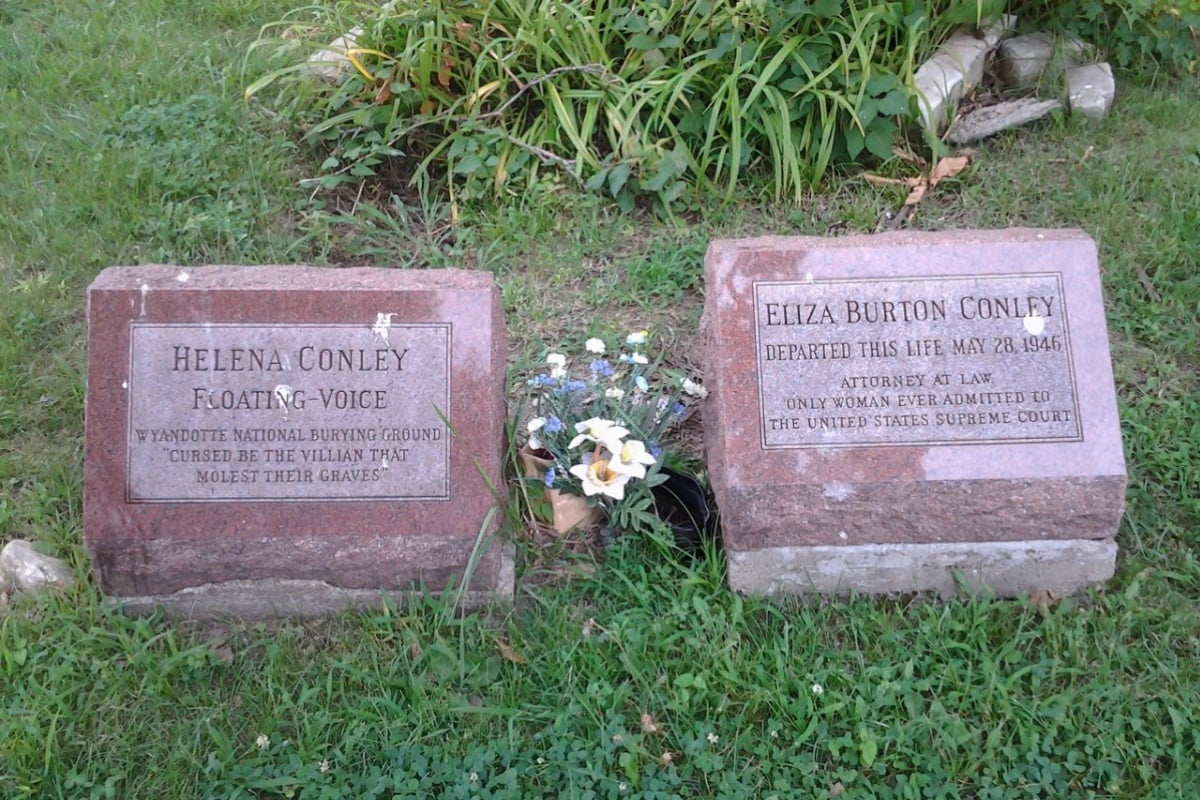
Lyda Conley was killed during a robbery in 1946. Her sister Helena, who gave an interview in the 1950s that the Wyandotte County Museum later found, told the interviewer that nobody would remember the sisters, per Axios.

Keeping the Conley Sisters' Story Alive

That prediction has not held up. The University of Missouri-Kansas City's Starr Women's Hall of Fame inducted Lyda Conley into its Class of 2025 during an anniversary ceremony at the Kauffman Center for the Performing Arts on February 20, 2025, according to UMKC.

A traveling public art installation called Fort Conley, a portable replica of the sisters' shack, has visited sites around the Kansas City metro since debuting at the Wyandotte County Historical Museum in August 2025, according to Axios. The piece, co-created by Monumenta and the Wyandot Nation of Kansas, moved to Johnson County Community College's Nerman Museum, where Chief Manthe has visited Helena Conley's grave during a cemetery tour, per the same report.

Kansas City PBS will premiere a new documentary, Lyda: Wyandot Warrior, produced by Mid-America Emmy winner Emily Woodring in collaboration with Chief Manthe. The film incorporates historical photographs and documents curated alongside the Wyandotte County Historical Museum, according to Kansas City PBS.


Read the whole story
angelchrys
10 days ago
reply
Overland Park, KS
Share this story
Delete

Roger Marshall keeps punching himself in the face. Kansans raise a bemused eyebrow.

1 Share
U.S. Sen Roger Marshall pauses during the debate at the Kansas State Fair in Hutchinson on Sept. 12.

U.S. Sen Roger Marshall pauses during the debate at the Kansas State Fair in Hutchinson on Sept. 12. (Photo by Jill Hummels for Kansas Reflector)

Visualize a clenched fist, fingers tight and knuckles braced, pulled back to strike.

Visualize that fist taking an unexpected turn, avoiding an opponent and instead circling back to slam into its owner’s face. I won’t describe the sights and sounds that follow, just know that the fighter for some unholy reason keeps clenching that fist and striking his own face, over and over and over.

Visualize U.S. Sen. Roger Marshall’s recent moves in his re-election campaign.

Fresh attacks on his Democratic rival. the Rev. Adam Hamilton of Leawood, misfired after a New York Post story turned out to rehash Kansas Reflector reporting from months ago about abuse at a church camp. Don’t believe me? Look here and here for our coverage from May and July.

The Post even cited our reporting four times in that single article! Marshall’s staffers — and their out-of-state financiers — planned a juicy smear campaign against their opponent. I understand. But reanimating allegations that were extensively covered by local news media sure smells like desperation.

That wasn’t the end of the embarrassment. A Marshall ad about the allegations had to be revised after including footage from other Kansas camps. Visuals showing Linwood’s Tall Oaks Camp and Conference Center, along with Lacygne’s Valley Cabins, illustrated the attack.

Whoops! A little slip-up there.

Actually not so little, given that actual Tall Oaks campers appeared in the ad. I’m sure they won’t face any scrutiny or humiliation after being used as political props. You could describe Marshall’s campaign in many ways after this episode — just don’t use the words “careful,” “attentive to detail,” or “grounded in reality.”

Finally, Marshall himself felt the need to inflict damage on his efforts to secure another six years in Washington, D.C.

In an “exclusive” with the Washington Examiner — the favorite news source of at least two or three Kansans — Marshall proclaimed that Hamilton ““lives in a bubble. Johnson County is one of the wealthiest counties in the country.”

Wait, did I read that correctly?

Roger Marshall decided to badmouth the most populous county in Kansas? I would hope someone in the campaign explains to Marshall that you need more voters to cast their ballots for you than your opponent to win elections. It’s a fairly fundamental fact!

I understand that the incumbent wants to underscore his rural roots, but surely you could do that without insulting a huge swath of Kansans. Also, what’s wrong with being rich? Wasn’t Marshall building his wealth when he sued more than 700 patients? I’m reliably informed by the good doctor’s fans on social media that he deserved payment for his work.

Don’t Johnson County doctors and lawyers and dentists deserve the same opportunities?

We’ve watched Marshall’s team follow this dismal playbook before. Back in May 2025, his chief of staff Brent Robertson ridiculed residents who showed up for a feisty town hall: “Real Kansans overwhelmingly support President Trump’s DOGE initiative, shrinking the size of the federal government, and firing career bureaucrats. Local Oakley citizens had no clue who these people were and were embarrassed by the behavior.”

Note that term: “real Kansans.” Marshall has followed the example of his employee and divided the people of this great state into the deserving and undeserving, the virtuous and the sinful, the rural and the urban.

Division didn’t work out for him 19 months ago. I’m not sure why he thinks it will now.

Roger Marshall just cant stop walloping himself in the face.

Clay Wirestone is Kansas Reflector opinion editor. His first book, “Opinionated: Kansas Journalists Who Proved Why Commentary Matters — Then and Now,” was published in September 2026 by the University Press of Kansas. Through its opinion section, Kansas Reflector works to amplify the voices of people who are affected by public policies or excluded from public debate. Find information, including how to submit your own commentary, here.

Read the whole story
angelchrys
10 days ago
reply
Overland Park, KS
Share this story
Delete
Next Page of Stories