 Log in

“They just want to be taller because they hate being / looked down upon.” — Matthew Siegel

|
I am the Queen of Awesome. My words do not represent my employer, but I bet you already knew that.
|

Overland Park, KS


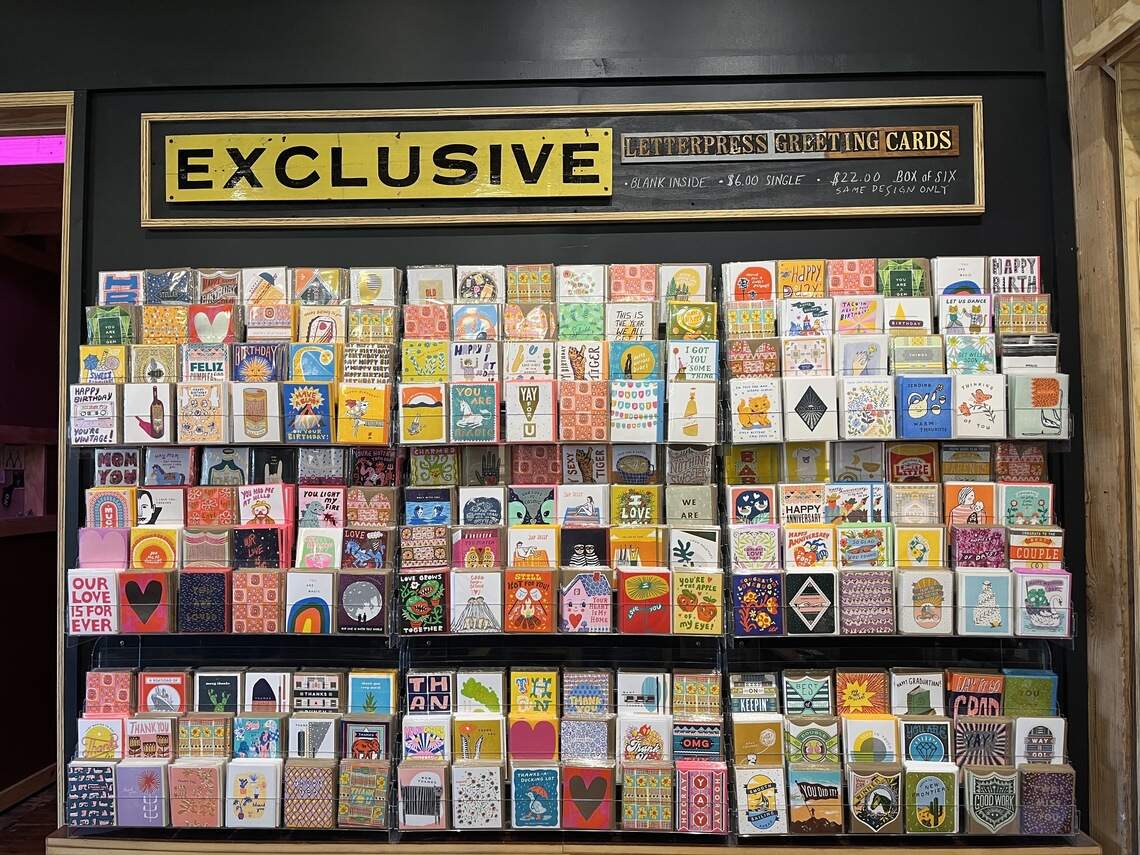
Greeting cards made by Hammerpress on display at its workshop and retail storefront in Kansas City’s West Bottoms.
Overland Park, KS


Overland Park, KS

I’ve taken a lot of shots at Nintendo over the years, often times under various versions of headlines that start with “Nintendo Hates You“. And those shots were well earned, given the company’s apparent policy of being as anti-fan as it possibly can be on all matters related to intellectual property. Nintendo never misses an opportunity to choose IP protectionism over embracing fan culture and the creativity of its own customers and evangelists.
But once we get away from matters of IP, Nintendo can actually be quite attentive to its fan-base. Everything about the UX for its platforms, consoles, and first-party titles show genuine care for what Nintendo fans want and like. It’s how this company has managed to remain so successful after all of these years. And that apparently extends to the latest console-war battleground, which is physical media. And on physical media, Nintendo appears to put a ton of weight on what a portion of its fans want as it plans to continue the use of physical media into the future.
Vice President and General Manager for Nintendo in Latin America Bill van Zyll spoke on the topic during a recent interview with YouTuber Coelho conducted during the Brazil Game Show. The Nintendo-focused YouTube channel asked about a number of topics related to Nintendo’s activities in the region, including localized Nintendo Directs. That’s when the question of physical games inevitably came up. Van Zyll was keen to emphasize the benefits of the format while assuring the company’s continued plans to produce physical games.
“Historically, we haven’t had a preference for a specific format,” he explains. “We take consumer preferences very much into consideration. We also have a platform that was just launched. We’ve been around for a little over a year with the Nintendo Switch 2, and it offers both digital and physical games. Therefore, we have no plans to abandon physical media. We know how much fans enjoy it.”
As Kotaku notes, consumer demographics are certainly playing a roll here. Nintendo gamers prioritize physical media games more than other console users. But in an industry that is quickly building a reputation for casting aside customer sentiment in favor of doing whatever the Copilot-created spreadsheet tells them they should do, seeing a gaming company actually take its own customers into account in this way is a good thing.
Nintendo’s heavier reliance on physical sales makes any argument for a shift towards digital sales exclusively far weaker, making the choice to continue supporting physical sales an expected response from the company. Still, as Sony continues conversations with a number of companies over their decision, it is at least reassuring for Nintendo fans that the company has no plans to follow Sony’s lead. At least for now.
There is a big enough percentage of the gaming public that likes to buy something physical, for all kinds of reasons. Ownership rights are far more robust that way (for now). Preservationists need physical media to truly do their preservation work. Treating these games and the media packaged with it as collectables is absolutely a thing.
So, those of you who want physical media games? Nintendo loves you is the only appropriate headline. I just wish that posture could infect all the other areas in which Nintendo has long treated its fans poorly.
Overland Park, KS


Back in 1975, Jack H. Hetherington, a physics professor at Michigan State University, wrote a research paper on low–temperature physics for the respected scientific journal Physical Review Letters. Before sending it off, Hetherington asked a colleague to review the paper, just to make sure it covered the right bases. What happened next Hetherington explained in the 1982 book, More Random Walks in Science:
Before I submitted [the article], I asked a colleague to read it over and he said, ‘It’s a fine paper, but they’ll send it right back.’ He explained that that is because of the Editor’s rule that the word “we” should not be used in a paper with only a single author. Changing the paper to the impersonal seemed too difficult now, and it was all written and typed; therefore, after an evening’s thought, I simply asked the secretary to change the title page to include the name of the family cat, a Siamese called Chester, sired one summer by Willard (one of the few unfixed male Siamese cats in Aspen, Colorado). I added the initials F D in front of the name to stand for Felix Domesticus and thus created F D C Willard.
The editors eventually accepted the paper, “Two‑, Three‑, and Four-Atom Exchange Effects in bcc 3 He.” And the ruse lasted until, remembers Hetherington, “a visitor [came to the university and] asked to talk to me, and since I was unavailable asked to talk with Willard. Everyone laughed and soon the cat was out of the bag.” (Pun surely intended.) Apparently only the journal editors didn’t find humor in the joke.
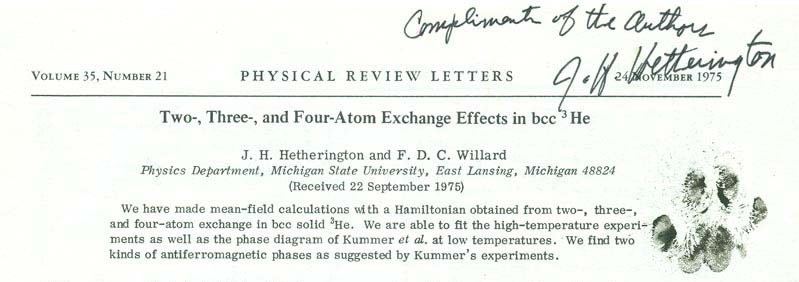
Above, you can see F.D.C. Willard’s signature (a paw print) on the front page of the article. The website, TodayIFoundOut, has much more on this enchanting little story.
If you would like to support the mission of Open Culture, consider making a donation to our site. It’s hard to rely 100% on ads, and your contributions will help us continue providing the best free cultural and educational materials to learners everywhere. You can contribute through PayPal, Patreon, and Venmo (@openculture). Thanks!
Note: An earlier version of this post appeared on our site in 2017.
Related Content:
The Shortest-Known Paper Published in a Serious Math Journal: Two Succinct Sentences
The Famous Schrodinger’s Cat Thought Experiment Gets Brought to Life in an Off-Kilter Animation
Insanely Cute Cat Commercials from Studio Ghibli, Hayao Miyazaki’s Legendary Animation Shop
Overland Park, KS



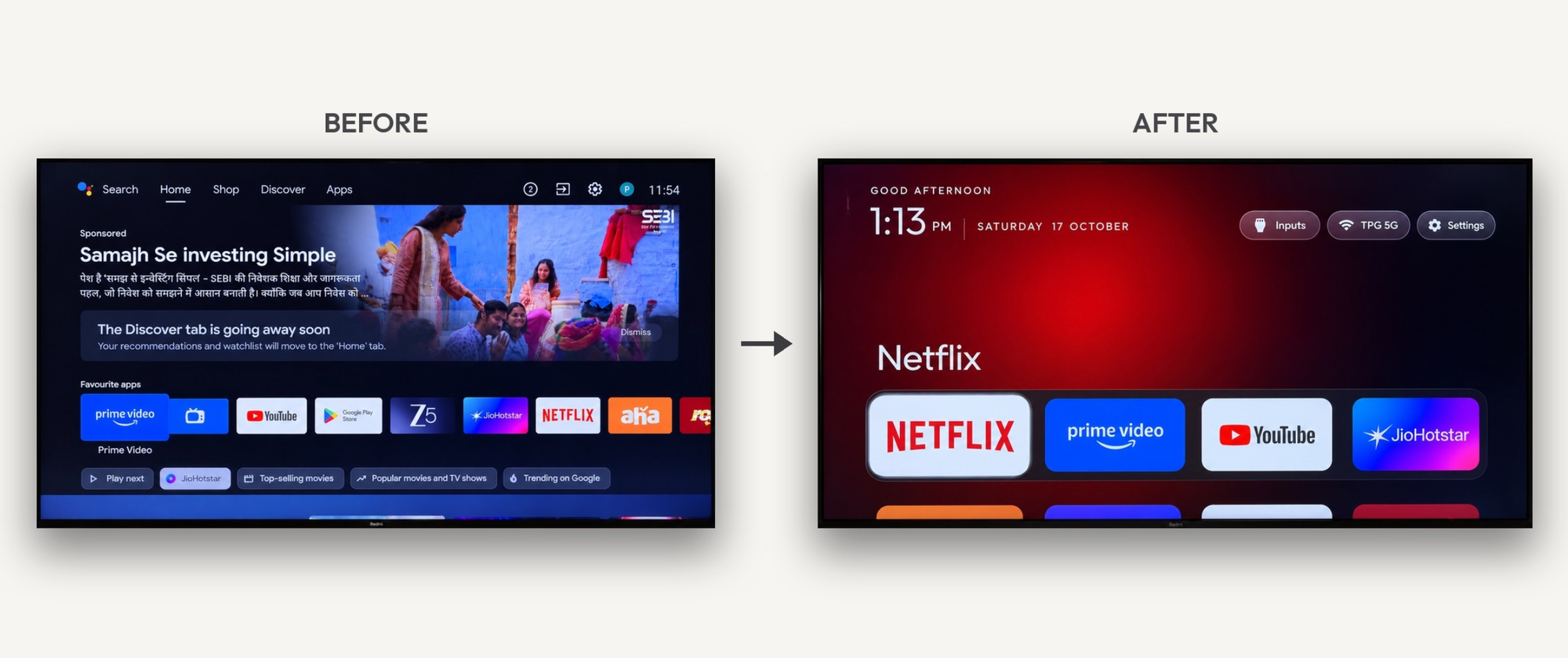
Over the weekend, it became fashionable to use AI to replace the operating systems on smart TVs with vibe coded or AI reverse-engineered ones to make them less bloated. People have taken proprietary internet-of-things devices that were bricked and abandoned by their creators and used AI to hack them and install new software on them, giving functionality the original developers took away.
In the last few days I have seen people hack smart picture frames to become AI-powered smart calendars, baby monitors to remove all ads, and bricked Lululemon mirrors to bring them back to life with new software. And dozens and dozens of TVs to install AI-written software that removes bloatware, ads, and simplifies the user interface.
What we’re seeing is vibe coding, but instead of making something from scratch, people are using AI to take an existing piece of software and replicate its features, its functionality, or cloning it wholesale. In some cases, people are using AI to take a proprietary piece of hardware and install some version of open source software on it. All of this is some mix of “decompiling,” “reverse-engineering,” “hacking,” vibe coding, AI slop, and stealing. It is the plagiarism machine being used for plagiarism, but also it is random people using AI to take control back over devices whose proprietary software was used to arbitrarily lock away basic functionality, to add advertisements, surveillance, and bloat to devices that probably shouldn’t have them, or whose functionality was bricked altogether.
“All I am hearing from software engineers is that software-as-a-service is dying as a business model,” Mike Nolan, who studies the politics of open source software, told 404 Media about the recent spate of AI-driven clones. “It’s becoming so easy to recreate the functionality that you want [with AI.]”
“The barrier for recreating this stuff is lower, so a lot of people are doing it for fun,” he added. “But there’s a lot of work associated with maintaining software so there may be a lot of instances where the software may not be reliable enough to use—I don’t know how many companies are going to be adopting these clones.”
In one example, a user named Gathin wrote in a post on X: “Vibe coded my parents’ TV this afternoon! It was showing a sponsored ad before you could even get to Netflix. Gave Claude Code the model number, it found the TV on wifi, removed 25 Xiaomi packages and wrote a new launcher.” That post has allegedly been viewed more than 6 million times. “Looks like an Apple TV now lol.”
It has been possible to do a lot of this for a long time using open source, human-coded repositories. There are many communities of people who have spent hundreds of hours bringing bricked internet-of-things hardware from the dead or finding vulnerabilities that allow one to modify or repair devices that have proprietary software on them.
But over the weekend, a project called “Reverse Engineer Anything” became one of the most viral GitHub repositories in recent memory, with more than 342,000 stars as of the time I’m writing this. The project uses AI to deconstruct features in other pieces of software, and allows the user to replicate them: “See a feature in an app that you want in your own product? Ask your agent to investigate it with REA. It can inspect the app without its source code, explain how the feature works, show the evidence, and build a version for your project.”
What this promises is a way to easily clone and modify other people’s products; it is the same general principle that has in recent weeks allowed for the viral, AI-driven clones of Adobe’s Creative Cloud software, Microsoft Office and the “decompilation” of hundreds of different video games. This tactic is being used not just on software you run on your computer, but also to reverse-engineer and modify the embedded software on physical devices.
A person who claims to make guitar pedals, for example, claimed on Hacker News that he used AI to clone the effects algorithms of three of his competitors using AI: “In the past 72 hours I have ONE-SHOT decompiled 3 of my main competitors products. Like, I could in theory just stick them in a box and resell them […] Basically, anyone with a Claude subscription can now rip off [sic] any best-in-class algorithm from any competitor.”
It is not necessarily the case that everyone will be writing and running their own software or that Adobe or Microsoft are screwed. But I’ve seen enough to say that the “decompiling” or “reverse-engineer anything” craze is going to have an actual real-world impact on software companies, coding communities, and open-source projects.
One of the criticisms I heard last week after writing about video game “decompiling” communities being overrun with AI-powered decompilations, ports, and clones is that a lot of the AI decompilations are not actually “decompiling” anything — that the resulting source code usually isn’t the same as the original, and that the resulting software has weird bugs, is of low quality, or doesn’t fully work.
But that’s one of the main problems here: AI-powered, cloned software often has bugs that the person using the AI doesn’t understand or know how to fix, and people are doing it anyway, using the software anyway, and unleashing it on the world and on these communities at a speed with which it cannot be vetted or moderated. Part of the reason that this will have an impact is specifically because, at least in the short term, a lot of this software will suck: The ability to cheaply and quickly clone software and modify features is going to have some sort of sloppifying impact on society whether you vibecode software or not. Unlike some of Silicon Valley’s wildest sickos, I do not expect most people to vibe code their own software or to hack their baby monitors, but like AI slop on social media or on menus, flyers, and billboards, you do not need to actually use AI or think that it’s good in order to be affected by this.
Inevitably, poorly coded, barely-functional, insecure software is going to be installed on critical hardware, which will lead to devices and networks being hacked; reverse-engineering communities and open source projects are going to be overrun with people Kool-Aid manning in with “their” AI projects and code.
All of this has been enabled by the agentification of AI, improving models, and the removal of guardrails. It is now possible to tell an AI to go do something, and to generally have it do that thing. This is leading to more people making more things and more AI agents acting in annoying and perhaps antisocial ways on the internet—we are likely to see an onslaught of semi-functional software and hardware slop, which will have knock-on effects for us all.
We are going to see hastily-created hardware startups using poorly cloned software that barely works, we are going to go to restaurants and be asked to order through a touch screen using cloned software with bizarre bugs. We are going to see people installing and using random code that they know nothing about on internet-connected physical hardware; and we are likely to see hackers try to infiltrate this process to include malware on some of that code. We are going to see smaller software and hardware companies killed by competitors who used AI to steal their products and undercut them. But what people use this for is likely to be a bit of a mixed bag; we are also likely going to see decompiled software used to remove manufacturer guardrails on products that never should have existed in the first place.
Overland Park, KS
Next Page of Stories