I am the Queen of Awesome. My words do not represent my employer, but I bet you already knew that.
18874 stories
·
35 followers

Getting an IUD can be very painful. There’s a solution.

1 Comment and 2 Shares

Skip to the content

Medical Examiner
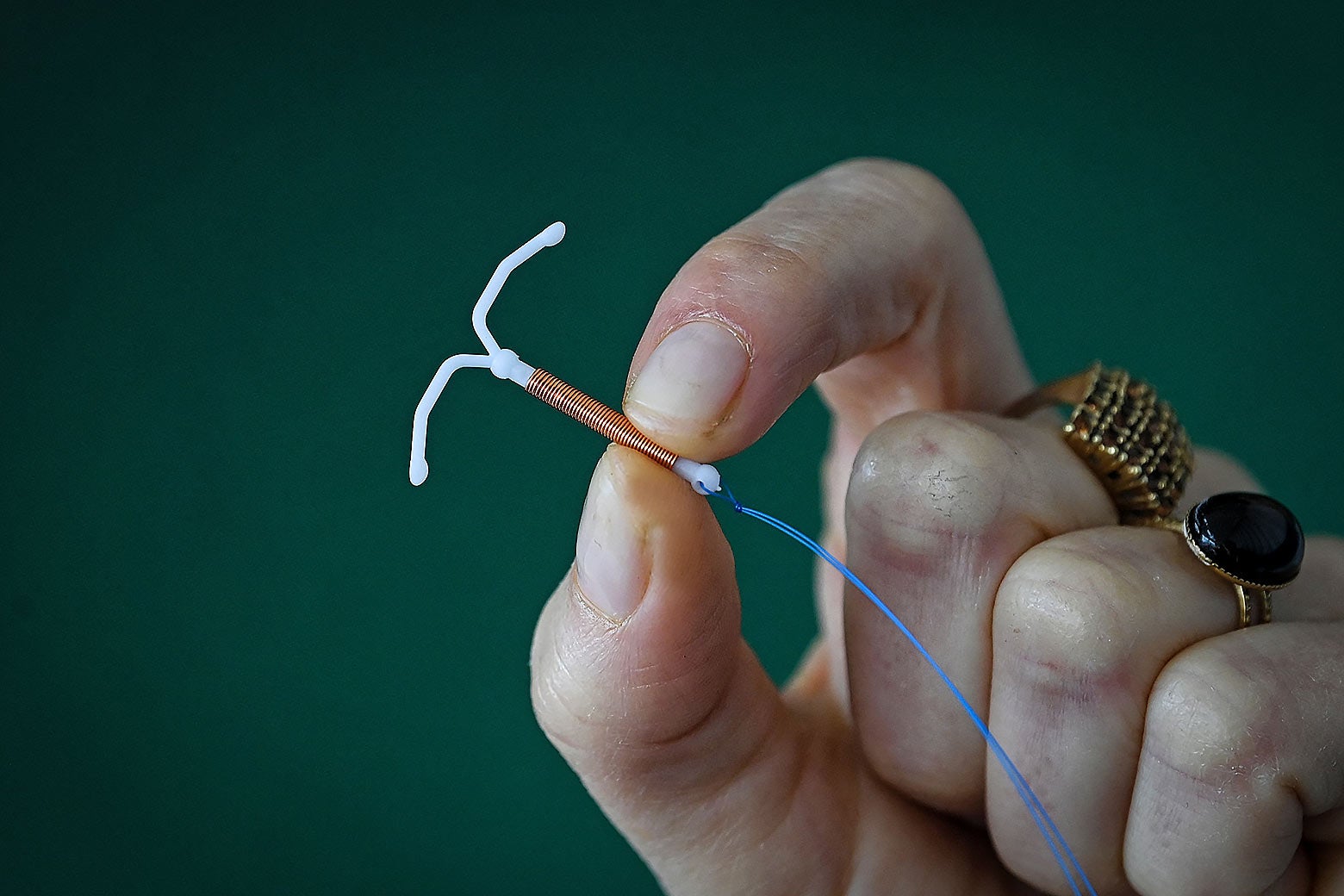
A hand holding an IUD.

When Tove Danovich recalls the first time she got an IUD, one thing stands out: the sheer pain of the procedure. After the IUD was placed, she remembers horrific, debilitating cramps.

Around a decade later, when Danovich went to a clinic for another IUD—a small, T-shaped birth control device that’s inserted past the cervix into the uterus—she asked the doctor for pain medication. The doctor gave her Ativan, an anti-anxiety drug, which Danovich found insulting. But she didn’t want to argue.

Unfortunately, Danovich’s experience is all too common; patients receiving IUDs are frequently told to take ibuprofen, grin, and bear it. But it doesn’t have to be this way.

Many clinicians point to the paracervical block—a simple, targeted injection of a local anesthetic around the cervix—as a way to greatly reduce pain during IUD insertions. Yet, in practice, paracervical blocks are rarely used for IUD procedures, a discrepancy rooted in the historical dismissal of women’s pain, limited research into IUD pain management, and patient anxiety about receiving an injection near their cervix.

One physician, however, is working to change this. Over the past two years, Roshni Kakaiya, a San Diego–based family medicine doctor, has created a training model that lets clinicians easily practice paracervical blocks—education she believes should be foundational for anyone in women’s health. The now-patented product has drawn national attention: Since last November, Kakaiya has sold 80 kits and compiled a long list of interested buyers. A kit costs $150 and comes with both a “beginner”-level silicone cervix to get the basics down, and a more realistic “advanced”-level cervix.

The hope is that these more highly trained providers will be able to offer patients a full range of pain-relief options and that paracervical blocks will become the standard of care for IUD procedures. “If we can make this experience slightly better for people, or if they feel like they have more agency, I feel like it would make a big difference,” Kakaiya said. “We can’t give patients their full range of choices if us as providers aren’t even trained.”

To insert an IUD, a clinician opens the vagina using a speculum and grips the cervix with a type of forceps, which can cause a sudden, sharp pain. A tube containing the IUD is then passed through the tiny cervical opening into the uterus, a process that is excruciating for many patients. Some experience cramping and discomfort for days after the procedure.

Research on IUD pain management is limited, and historically, there hasn’t been much data on cervical blocks. Consequently, the blocks just weren’t “valued as a procedure that was worth teaching,” said Kakaiya. “You had a whole generation of people who weren’t trained to do it, and then they can’t train others. And then that just keeps propagating.”
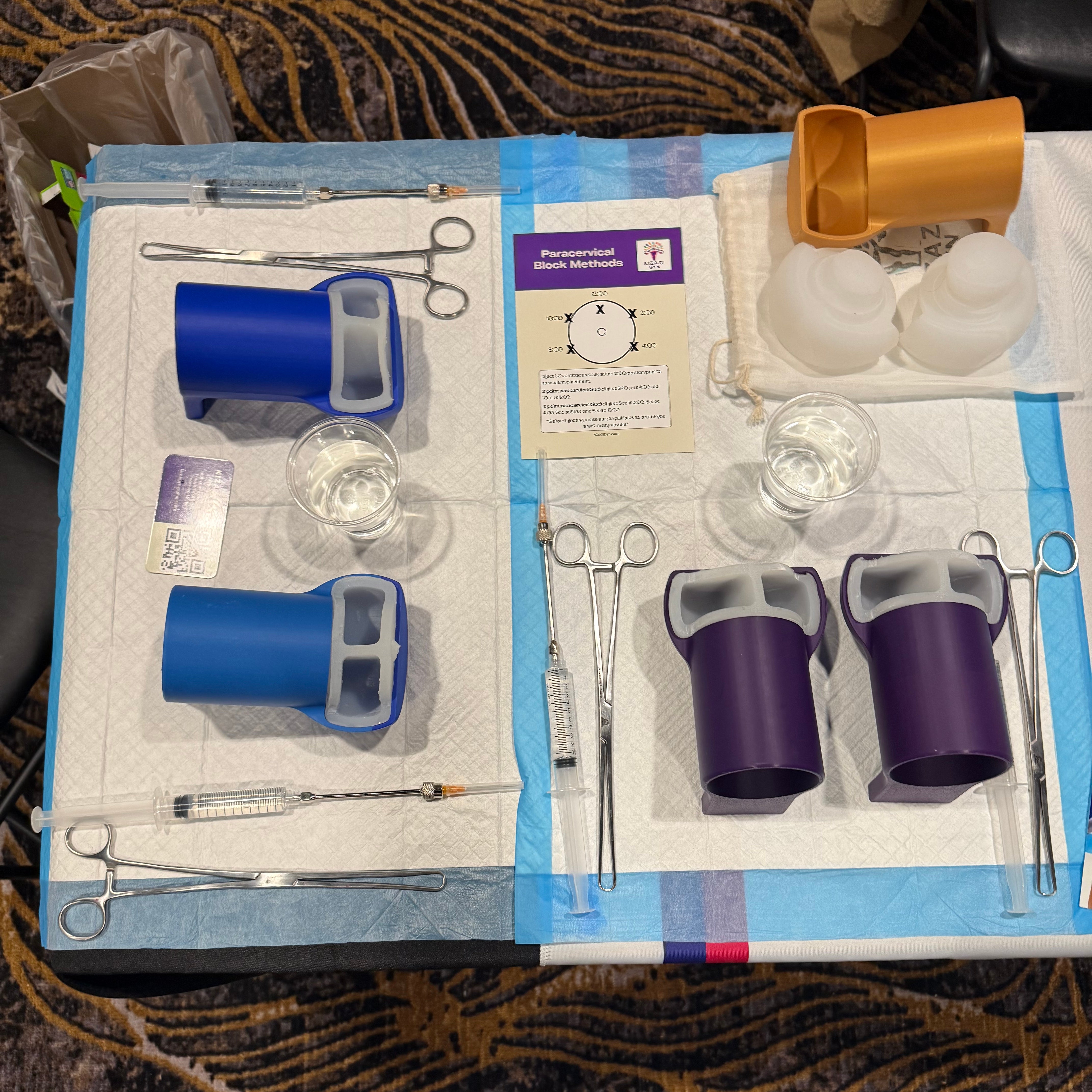
Roshni Kakaiya’s paracervical block training kit.
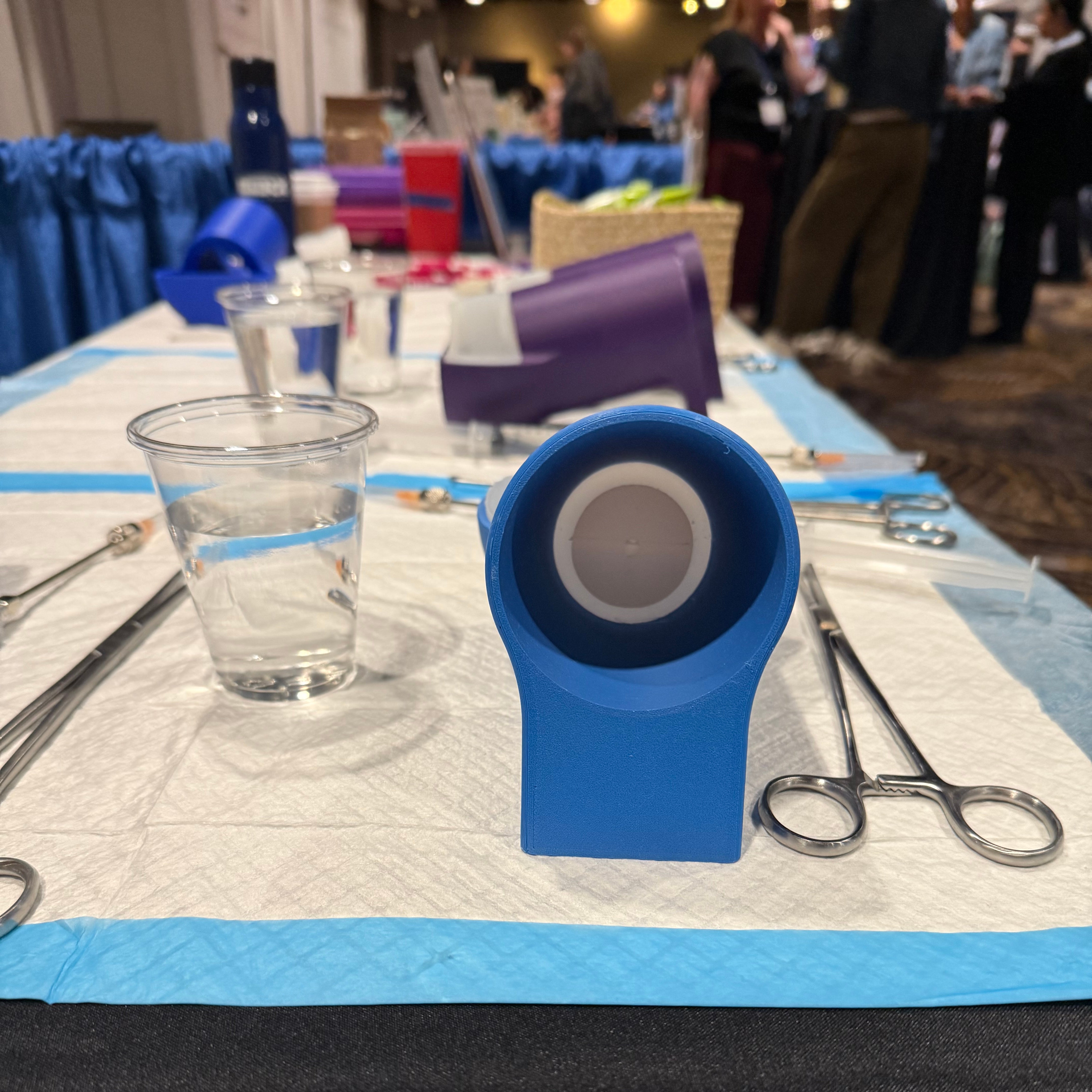
Side view of Kakaiya’s pelvic model, a blue plastic base holding a white silicone cervix, with forceps lying alongside.

Today paracervical blocks during IUD insertion in the United States remain rare. One nationwide study of Veterans Affairs clinics found near-zero use. Another, based out of the University of California, San Francisco health system, found that less than half of patients receive blocks. Instead, the standard recommendation for pain relief during IUD insertion is to take 800 milligrams of ibuprofen an hour beforehand—a method that falls woefully short of addressing the intense discomfort experienced by many patients.

Yet, numerous studies over the past decade have determined that paracervical blocks are highly effective at reducing pain during the procedure. “I don’t think [clinicians] are as aware of these studies and interventions that can decrease pain during IUD placements,” said Sheila Mody, an OB-GYN and professor at the University of California, San Diego Health, whose 2018 study found that paracervical blocks significantly decrease discomfort during IUD insertion.

Although OB-GYNs like Mody are trained in paracervical blocks (they’re used in surgical abortions and miscarriages), many IUDs are placed by advanced practice clinicians—such as physician assistants and nurse practitioners—who often lack training in this technique. To address this issue, Mody trains APCs in paracervical blocks and is currently conducting three studies to further evaluate the procedure’s effectiveness.

Paracervical blocks are so effective that both the American College of Obstetricians and Gynecologists and the Centers for Disease Control and Prevention support using them during IUD insertion. “There is an urgent need for health care professionals to have a better understanding of pain-management options and to not underestimate the pain experienced by patients and for patients to have more autonomy over pain-control options,” notes a review of the literature from the American College of Obstetricians and Gynecologists, published last year.

That emphasis on patient choice is what motivated Kakaiya to develop a better way to train clinicians to perform paracervical blocks.

The training process, however, proved more complicated than Kakaiya initially expected. She quickly discovered that available pelvic models have hard plastic shells around the cervix where providers practice injecting; this prevents trainees from getting the necessary tactile feedback to learn where to inject. In response, clinicians have created their own unique prototypes to mimic the cervix, including a tomato attached to a plastic cup, a lemon attached to a PVC pipe, or, in Kakaiya’s case, a dragon fruit attached to a thick silicone tube. But these templates don’t come anywhere close to the real thing, so Kakaiya decided to make an anatomically precise, patented 3D-printed model.

The product offers clinicians an easy way to learn without having to practice on patients already undergoing nerve-racking procedures. Since last fall, when Kakaiya began selling the model, clinician interest has mushroomed. “It has been an overwhelmingly positive response,” she said. The next step is to expand the product’s reach to even more clinicians who perform IUD placements.

Mody, who recently received her own kit, believes that the device can help build confidence—especially for clinicians who are APCs or work in family medicine but haven’t received paracervical block training. “I think if you’re being trained to put IUDs in, you should be trained how to do paracervical blocks as well,” Mody said.

When Danovich decided to have her IUD removed, she was told there were a few complications and that the process would be more involved than is typical. To avoid any additional pain, she sought out a clinic that offered paracervical blocks—a process she found to be surprisingly difficult. “I remember the first things that came up were concierge clinics … but it’s cash pay, ‘we don’t take insurance,’ ” Danovich said. “It took a while to find this normal doctor’s office.”

In the end, the IUD removal was easy and relatively painless, with only brief discomfort from the injection. “I’m glad there are doctors that are really taking the fact that these procedures can be incredibly painful into consideration,” said Danovich. “That feels like the bare minimum.”

Read the whole story
angelchrys
1 hour ago
reply
Great news that someone's working on this! First insertion felt like I was being punched in the cervix (do not recommend). Second insertion I managed to convince them to spray some lidocaine on the cervix first and it was less terrible. Ibuprofen doesn't cut it for IUD insertion and I'll throw it at migraines.
Overland Park, KS
acdha
13 minutes ago
I will just note that when I got a vasectomy they were going to send me home with a gigantic bottle of OxyContin even I though I only needed a couple of ibuprofen the first day. There’s no *medical* explanation for the double standard.
angelchrys
9 minutes ago
I'm not even slightly surprised.
acdha
6 hours ago
reply
Washington, DC
Share this story
Delete

FCC Wants to Kill Burner Phones By Forcing Telecoms to Get All Customers’ IDs

1 Share
FCC Wants to Kill Burner Phones By Forcing Telecoms to Get All Customers’ IDs

The Federal Communications Commission (FCC) wants to make it effectively impossible for people to buy what many call burner phones—a phone not explicitly linked to your identity at the point of purchase—which would impact privacy-conscious people, to domestic abuse survivors, to journalists, and many more. The FCC plans to do this by legally forcing the country’s telecoms to store a wealth of personal information about essentially all phone customers, including a government issued identification number and their physical address, alarming privacy advocates and civil rights activists who compare the measures to those from authoritarian countries where it can be difficult to buy a mobile phone plan without giving up your identity.

The proposed change would drastically shake up how people obtain phone plans in the U.S., and have all sorts of privacy and cybersecurity knock-on effects. The FCC is proposing the data collection partly as a way to combat scammers, with telecoms being required to collect other information on business and foreign customers like the intended use case of their bulk phone plan purchase and their IP address. But the changes would mean telecoms collect data on all new and renewing customers, and the FCC provides a long list of other things that the collected data could help authorities with.

💡
Do you know anything else about this proposed change? I would love to hear from you. Using a non-work device, you can message me securely on Signal at joseph.404 or send me an email at joseph@404media.co.

“For decades, civil libertarians have looked overseas at authoritarian countries where the government requires people to register to get a mobile phone to ensure they can be tracked. We never thought that would happen here,” Jay Stanley, senior policy analyst at the American Civil Liberties Union’s (ACLU) Speech, Privacy, and Technology Project told 404 Media in an email. “But make no mistake: with this rulemaking, the government is contemplating taking away people’s ability to get a burner phone, which will hurt low-income people, domestic violence victims, and anyone else who cares about their privacy.”

In a synopsis of the proposed changes, the FCC writes, “Specifically, we seek comment on requiring originating providers to, at a minimum, obtain and retain the name, physical address, government issued identification number, and an alternate telephone number of any new and renewing customer before granting access to its services.” The goal of collecting this data, the FCC writes, is to deter some scammers from getting onto a telecom network in the first place, and so “enforcers will be better able to identify the scammers when they do.” The FCC compares the changes to the sort of data collected by banks to prevent money laundering.

One section stresses that the newly collected data would help “law enforcement to more easily identify callers that use the network to perpetuate crimes by ensuring that voice providers have accurate and complete customer information.” It goes on to ask if the data would help identify people buying and selling illicit goods; the investigation of “fraud, espionage, or influence operations that undermine national security”, and “address abuse in text messaging networks.”

“Criminals continue to leverage the anonymity provided by phone calls and texts to defraud Americans and exploit communications networks to further other crimes,” one section reads.

At the moment, the FCC is seeking comments about its proposed changes, with interested or concerned parties—think telecom companies, law enforcement, or privacy advocates—able to weigh in. But the intention of the FCC is clear: the agency wants telecoms to be legally obligated to collect much more personally identifying information on new and returning customers, linking them directly to their phone number and phone usage data. The FCC also asks whether the amount of data collected should change depending on whether a customer is seeking a prepaid or a postpaid service plan.

Multiple privacy and technology experts strongly pushed back against the proposed changes. “This proposal by the FCC will do little to combat scams and robocalls, since most people doing that will have no trouble creating fake documentation or identities,” Cooper Quintin, security researcher and senior public interest technologist with the Electronic Frontier Foundation (EFF), told 404 Media. “Given this administration’s crackdown on free expression, protest, immigrants, and women’s health we have trouble seeing this as a bold attack on freedom of communication. They want to take away our ability to make an anonymous phone call.”

Eric Null, the director of the Privacy & Data Project at the Center for Democracy & Technology, told 404 Media in an emailed statement “To address the scourge of illegal robocalls, the FCC has unfortunately proposed to force every wireless subscriber in the nation to sacrifice their privacy and give up significant personal details before receiving or renewing a wireless line. While some carriers already collect such details, there are specific circumstances where a person may need privacy and anonymity when seeking a cell phone, including if that person is a victim of domestic violence, or is a journalist or whistleblower. This proposal represents a loss of privacy across the board, and from an agency whose remit includes protecting privacy. The FCC might let a few bad apples spoil the whole bunch.”

Cape is a privacy-focused telecom company that limits the amount of data it collects on its customers. John Doyle, the company’s CEO, told 404 Media in an emailed statement “We hate robocalls and support eliminating them, but entrusting telecom carriers to effectively create a nationwide ID registry for every American with a phone is not the solution. Mobile carriers have been breached time and again because the incentives to secure trillions of dollars of legacy architecture aren’t there. Further enriching compromised telecom datasets with government ID, physical addresses, and alternate phone numbers harms our security rather than improving it.” 

Given this proposal is in the comments stage, the FCC has many questions it is hoping to receive information on, such as whether “renewing” customers should be only those new to the provider, or those switching plans with their current telecom; or whether they should not allow the use of P.O. boxes or shared office locations as the required “physical address.”

The FCC did not respond to 404 Media’s request for comment. The proposal is open to comments until June 25.

Read the whole story
angelchrys
1 hour ago
reply
Overland Park, KS
Share this story
Delete

Judge Learns Lawyers on Both Sides of Case Used AI, Cancels Trial, Kicks Everyone Off the Case

1 Share
Judge Learns Lawyers on Both Sides of Case Used AI, Cancels Trial, Kicks Everyone Off the Case

The lawyers on both sides of a federal court case in Mississippi were caught using artificial intelligence, a situation where, effectively, generative AI tools were used to argue against each other. The judge wrote in a blistering sanctions order, that the lawyers wasted the court’s time, and that “in an era of rampant unverified AI usage within the legal field, this case presents a prime example of the risk associated with serving as a rubber-stamp.”

“This case presents the Court with an unusual scenario—attorneys for both litigants engaged in similar sanctionable conduct,” Sharion Aycock, senior United States District Judge for the Northern District of Mississippi wrote in a sanctions order. “This court is yet again ‘burdened with addressing AI hallucinations court filings.’”

The case in question involved a contractual dispute between lawyer Tom Withers and the city of Aberdeen, Mississippi, over apparently unpaid legal fees (Withers was not representing himself and was not sanctioned by the court). The case was first noticed by Rob Freund, a lawyer who frequently posts about cases involving AI hallucinations. Freund called it a “comedy of AI errors,” and suggested “there were two clients who basically were paying for ChatGPT (or whatever LLM) to argue against itself.”

404 Media has repeatedly covered the phenomenon of lawyers using AI to prepare their filings, and the specifics in this court case follow a similar pattern to what we’ve seen before: Lawyers for both sides cited nonexistent, hallucinated cases while making their arguments. The difference is that every lawyer involved in the case is implicated, leading Aycock to pause the proceedings, cancel the trial, and disqualify all four lawyers involved. Two of the lawyers were barred from appearing before the court for two years; all lawyers received a fine of between $1,000 and $3,500, depending on Aycock’s assessment of their culpability for not verifying the outputs of the AI they used. 

Judges around the country have been increasingly frustrated with lawyers who use AI; last week, we wrote about a judge who ripped into various lawyers for citing hallucinated cases in New York.

All four lawyers involved either admitted to directly using AI or admitted to rubber stamping legal briefs that had been prepared with AI without reviewing them. Aycock wrote that at a hearing in January, “each of the attorneys expressed embarrassment and apologized to the court.” One of the lawyers said they used an AI tool to do legal research; another, Kathleen Wilson, admitted to using an AI tool called First Drafts to write the entire briefing. The two other attorneys said they did not review the briefs in question and submitted them to the court. 

Notably, Aycock said that Wilson had since been caught continuing to use AI after the court had detected she was using it. “Wilson explained that she was shocked when the Court issued the show cause order pointing out the hallucinated cases appearing in her filing. In essence, Wilson took the position that she was unaware that AI could produce hallucinated cases and explained that she did not even know what a hallucinated case was,” Aycock said. “The Court finds that explanation to be insufficient and incredulous.”

“The Court is compelled to note that it has serious concerns that Wilson has continued this practice of AI misuse in other cases after she was put on notice of her violations in this case,” she added, noting that other judges in other cases had found hallucinated cases in Wilson’s filings as recently as April, four months after she was initially asked to explain her AI use in this case. “Her continued AI misuse demonstrates an extreme dereliction of professional responsibility on her part. Though this Court cannot consider subsequent conduct that did not occur before it in determination of the appropriate sanction(s) in this case, it finds that at minimum Wilson’s apologies to this Court on January 20, 2026 were not sincere.”

Another lawyer, Kathryn Williams, admitted to using an AI tool that she did not name to do research. Notably, that tool was described as being built for “in-house legal research,” and that the tool in question is not supposed to hallucinate cases. 

“Williams explained that the software was built to produce results from jurisdictions in which her law firm typically practiced, which did not include Mississippi,” Aycock wrote. “She explained that this case is the only Mississippi case she has ever been involved in, yet she resorted to using the software apparently knowing that it was not designed to encompass Mississippi law.”

Read the whole story
angelchrys
1 hour ago
reply
Overland Park, KS
Share this story
Delete

How a Starbucks marketing stunt spiralled into mass boycotts in South Korea | South Korea | The Guardian

2 Shares

It was a PR nightmare: customers smashing Starbucks branded tumblers and mugs as fans deleted loyalty apps and cashed out prepaid balances. Amid the uproar, government ministries cut ties with the coffee chain and apology notices were pasted on Starbucks stores across South Korea.

The initial shock may have passed, but the anger remains.

Hours after launching a marketing campaign called “Tank Day” for its new “Tank” coffee tumbler range on 18 May, Starbucks Korea found itself at the centre of a cultural storm that would force a billionaire chairman to apologise on national television, and see a chief executive sacked. The controversy reverberated all the way to the South Korean president’s office.

Starbucks’ Tank Series tumblers and discount campaign was designed to promote “spacious volume” for bigger coffees. But the specific date of the promotion’s launch, and its imagery and wording, reopened the painful wounds of a 46-year-old massacre in South Korea and dictatorship-era torture scandal.

Starbucks cancelled the promotion hours after it launched, and its CEO, Son Jeong-hyun, was fired that same day. But it was too late. The anger had already spread, with videos of people smashing the Starbucks mugs and tumblers circulated on social media.

Protests were held outside stores and people were incensed Starbucks had launched a tumbler called “tank” on 18 May, and that the coffee chain was declaring it “Tank Day”.

Known locally as 5/18, the 18th of May is the anniversary of a 1980 massacre in Gwangju. Over 10 violent days, paratroopers crushed pro-democracy protests against military strongman Chun Doo-hwan. Victims’ groups say hundreds were killed.

There was also a problem with a slogan the Starbuck campaign used: “thwack on the desk”. It echoed a notorious cover story used by police after the 1987 torture death of student activist Park Jong-chul. Authorities at the time initially claimed Park died because an officer had used his fist to “hit the desk with a thwack”.

Activists rally outside a Starbucks store in Seoul on 27 May, calling for a boycott of the Starbucks coffee chain. Photograph: Pedro Pardo/AFP/Getty Images

Marketers chose the slogan after consulting an AI tool, looking for suggestions, Shinsegae Group said. It turned out some managers who approved the campaign never opened the email attachments showing the marketing material.

In a statement issued before his dismissal, Son apologised and pledged company-wide education on historical awareness and ethics.

On 19 May, Chung Yong-jin, the billionaire chair of Shinsegae Group, swiftly issued a written apology. Chung’s Shinsegae Group is the parent company behind Starbucks Korea, operating the chain under licence from the Starbucks Corporation.

But that failed to quell the outrage. Starbucks is especially popular in South Korea, its third-largest market globally, with more than 2,100 stores nationwide.

Following the controversy, card payment volumes at Starbucks stores plunged 26% in a week, according to market data, with May card payments down 10% on the previous month. And customers began demanding refunds from an estimated 400bn won ($260m) held in Starbucks prepaid cards.

An apology notice about the controversial marketing campaign is posted at a Starbucks store in Seoul on 26 May. Photograph: Pedro Pardo/AFP/Getty Images

The musical actor Jung Min-chan stepped down from his production after posting a photograph of himself inside a Starbucks drew public backlash.

In attempt to stem the rising anger, Chung issued another apology, on 26 May, this time bowing three times at a televised press conference. “I take it very seriously the fact that many people felt deep pain and anger because of Starbucks Korea’s inappropriate marketing campaign,” he said.

Bereaved families and 5/18 organisations rejected Chung’s apology. Park Jong-chul’s elder brother wrote to police, demanding Chung and the former CEO, Son, be charged for insulting the memory of victims. Chung and Son have since been booked as criminal suspects by police.

Some people in South Korea reacted by smashing or cutting Starbucks cups and tumblers. Photograph: supplied/Yoon Kyung-jin

Cho Youngho, a political scientist at Sogang University, says attitudes towards the Gwangju Uprising mirrored the deepest divisions in South Korean society. “For people who supported democratisation in the 1980s and 1990s, now in their forties and fifties, the idea of commercialising, mocking or trivialising 5/18 is simply unacceptable.”

The controversy has also turned political. Government agencies stopped ordering Starbucks gift cards and the defence ministry suspended a partnership with the chain. The Democratic party’s leader, Jung Chung-rae, wanted Chung to kneel before the nation in atonement.

It did not take long before reverberations reached South Korea’s president Lee Jae Myung, who condemned those responsible as “low-class peddlers”. He raised the prospect of shutting down Ilbe, a far-right online community, similar to 4chan, where mocking of Gwangju victims is common.

Far-right groups have kept alive a decades-old, discredited state narrative that the Gwangju protesters were North Korean sympathisers, a claim the supreme court in February ruled was defamatory.

Those debates have acquired renewed urgency since Yoon Suk Yeol’s failed declaration of martial law in 2024, which revived public discussion of authoritarianism and state violence.

Shinsegae’s investigation found no evidence the Starbucks campaign was deliberate, and Starbucks Korea asked customers to refrain from directing their anger at frontline shop staff.

Starbucks Corporation, headquartered in Seattle, which licenses the brand but holds no equity in the Korean operation, said it was “deeply sorry for an unacceptable marketing incident.”

Shinsegae Group chairman Chung Yong-jin bows during a press conference on 26 May, as he apologises for the ‘Tank Day’ campaign. Photograph: YONHAP/EPA

“While unintentional, this should never have happened. We recognize the deep pain and offense this has caused, particularly to those who honor the victims, their families, and all who contributed to Korea’s democratization,” it said in a statement.

The company said it was reviewing internal review standards and training to ensure the incident was not repeated.

“We sincerely apologize to the people of Gwangju, to those impacted by this tragedy, and to our customers and communities.”

Prof Cho, who has studied the national struggle over 5/18, said the public reaction reflected more than a marketing failure.

“Companies today are expected to respect human dignity and social norms,” he said, adding that the controversy was unlikely to fade soon.

Read the whole story
angelchrys
22 hours ago
reply
Overland Park, KS
acdha
3 days ago
reply
Washington, DC
Share this story
Delete

The New Mister Rogers YouTube Channel

1 Share

The folks at Fred Rogers Productions have launched a YouTube channel dedicated to Mister Rogers’ Neighborhood. They plan to post compilations, clips, and full episodes, some of which haven’t been seen on PBS in years & years. One of the first complete episodes they’ve posted is the one about how crayons are made!

Other full episodes include A Visit with Officer Clemmons, The Very First Episode (from 1968), and Koko the Gorilla Meets Mister Rogers.

And there’s also this 30-minute compilation of fan-favorite factory visits.

Again, here’s the channel if you want to subscribe or explore more.

Tags: Fred Rogers · Mister Rogers' Neighborhood · TV · video · YouTube

Read the whole story
angelchrys
22 hours ago
reply
Overland Park, KS
Share this story
Delete

As Pride Month dawns, Kansas governor helps celebrate rainbow flag creator Gilbert Baker

1 Share
Kansas residents and activists gathered with Gov. Laura Kelly last week for her signing of a proclamation honoring rainbow flag creator Gilbert Baker.

Kansas residents and activists gathered with Gov. Laura Kelly last week for her signing of a proclamation honoring rainbow flag creator Gilbert Baker. (Photo from Kansas governor's office)

Happy Gilbert Baker Day!

Thanks to a proclamation from Kansas Gov. Laura Kelly signed Friday, we can celebrate the life and work of Parsons native Baker this June 2. He created a piece of American iconography that has spread across the globe and into the hearts of those who care for their gay neighbors: the rainbow pride flag.

Kelly Wall, a board member of PFLAG Lawrence, requested the day after reading about Baker in an authoritative piece by founding Kansas Reflector opinion editor C.J. Janovy. (You can also read Janovy’s work in the new anthology “Kansas Matters: Twenty-First-Century Writers on the Sunflower State.”)

Lauren Shepard of Parsons was on hand at the Statehouse to watch Kelly sign. She had just graduated from Pittsburg State University with a master’s degree. According to her, efforts to honor Baker locally ran into static.

“Ultimately, the town, the city commission ended up tabling the idea, so we pivoted and got together and started a Gilbert Baker Memorial Scholarship through the Parsons High School, where he graduated,” she told me. “So now every year we select a student that’s active in their OAQ, which is like a gay-straight alliance, it’s a student organization there at the high school.”

Wall was out of the state Friday, but a group assembled by her showed up to honor Baker. It included Shepard, several Lawrence activists and state Sen. Marci Francisco. I tagged along and noted that multiple groups had gathered on the second floor of the Statehouse for their own proclamation time with Kelly. One was promoting an “Asteroid Day.”

Inside the governor’s ceremonial office, group members realized that no one had actually brought a rainbow flag — the symbol for Pride Month and LGBTQ+ rights more generally.

No worries, Kelly told them.

She retreated into her actual office and returned bearing a rainbow flag coaster and a copy of Janovy’s book, “No Place Like Home: Lessons in Activism from LGBT Kansas,” which features rainbow stripes on the cover.

Crisis averted, the group took pictures with Kelly, the proclamation and the props. That was that.

Janis Guyot, the president of PFLAG Lawrence, holds a proclamation designating June 2 as "Gilbert Baker Day" in Kansas.
Janis Guyot, the president of PFLAG Lawrence, holds a proclamation designating June 2 as Gilbert Baker Day in Kansas. (Photo by Clay Wirestone/Kansas Reflector)

No one on hand missed the broader implications. Baker had turned his back on his Kansas background, living in San Francisco and New York City. He had finally agreed to return to Parsons, Janovy writes, for a key to the city and film festival in 2017. A month before the events, Baker died at the too-young age of 65.

“It allows us to recognize one of our own who created an emblem that allows us to recognize all of LGBTQ across the country and across the world,” said Rachel Reed of Lawrence. “And it’s very, very important.”

Janis Guyot serves as president of Lawrence PFLAG and stood in for Wall at the signing. Afterward, she held the proclamation certificate as others in the group swirled around to take a look.

“I’m really happy that there’s something to celebrate for the LGBTQ world right now,” Guyot told me. “It’s tough time for all of them.”

Since Baker’s untimely death, we’ve seen a public push and pull over gay rights. Transgender folks — members of the movement from the beginning, whether they were identified as such or not — have been systematically excluded and discriminated against. The Kansas Legislature has repeatedly passed hateful laws.

Who knows what Baker might say about this recent turmoil. Given that he went by the drag name “Busty Ross,” I imagine he would bring an irreverent sense of humor along with his passion for making the world a better place.

Hopefully, he would say progress hasn’t stopped, and it won’t stop, regardless of small minds and even smaller hearts.

In an oral history from 2008, Baker suggested as much: “I do know that time is on our side and that the young people generation, and more importantly my generation, we have fought hard, and we have — we’ve worked on our parents, we have our own children, and we’re moving society forward. So I think we’re going to be all right. I mean, it may take a little more fight and a little more work than people want, but we’ll get there.”

Clay Wirestone is Kansas Reflector opinion editor. Through its opinion section, Kansas Reflector works to amplify the voices of people who are affected by public policies or excluded from public debate. Find information, including how to submit your own commentary, here.

Read the whole story
angelchrys
5 days ago
reply
Overland Park, KS
Share this story
Delete
Next Page of Stories